Love letters…

John Keats


From: The Writer’s Almanac, February 8, 2010:

Valentine’s Day is coming up on Sunday, and we’re celebrating all week with love letters from the literary world.

Poet John Keats (books by this author) lived to be just 25 years old, but in that time he wrote some of the most exquisite love letters in the English language. The letters were to Fanny Brawne to whom he became engaged.

He was 23 years old, recently back from a walking tour of Scotland, England, and Ireland (during which time he’d probably caught the tuberculosis that would soon kill him), and had moved back to a grassy area of London, where he met and fell in love with Fanny Brawne. During this time, he composed a number of his great poems, including Ode to a Nightingale. And one Wednesday in the autumn, he wrote this letter, considered by many the most beautiful in the English language:

My dearest Girl,
This moment I have set myself to copy some verses out fair. I cannot proceed with any degree of content. I must write you a line or two and see if that will assist in dismissing you from my Mind for ever so short a time. Upon my soul I can think of nothing else. The time is passed when I had power to advise and warn you against the unpromising morning of my Life. My love has made me selfish. I cannot exist without you. I am forgetful of every thing but seeing you again — my Life seems to stop there — I see no further. You have absorb’d me. I have a sensation at the present moment as though I was dissolving — I should exquisitely miserable without the hope of soon seeing you. I should be afraid to separate myself far from you. My sweet Fanny, will your heart never change? My love, will it? I have no limit now to my love … I have been astonished that Men could die Martyrs for religion — I have shudder’d at it. I shudder no more. I could be martyr’d for my religion — love is my religion — I could die for that. I could die for you. My Creed is Love and you are its only tenet. You have ravish’d me away by a Power I cannot resist; and yet I could resist till I saw you; and even since I have seen you I have endeavored often “to reason against the reasons of my Love.” I can do that no more — the pain would be too great. My love is selfish. I cannot breathe without you.

Yours for ever
John Keats

The following spring, Keats wrote: “My dear Girl, I love you ever and ever and without reserve. The more I have known you the more I have lov’d. … You are always new. The last of your kisses was ever the sweetest; the last smile the brightest; the last movement the gracefullest. When you pass’d my window home yesterday, I was filled with as much admiration as if I had then seen you for the first time.”

Keats and Brawne became engaged. He wanted to earn some money for them before they got married. But then he began coughing up blood. When he saw it, he said: “I know the color of that blood; it is arterial blood. I cannot be deceived in that color. That drop of blood is my death warrant. I must die.” He wrote to tell her that she was free to break off their engagement since he would likely not survive. But she would not, and he was hugely relieved. But he died before they married.


No excuses book blogs…

Illustration from The Seattle Times

Please don’t ever say to me you can’t find SOMETHING to read. After we’ve exhausted the possibilities in my classroom library, and in the school’s library, you may want to check out these blogs. In reality, you should be checking them out anyway to keep up with new titles, authors you love, new authors, new genres, etc.:

Featured book blog: http://missprint.wordpress.com/

Glancing over a few of the reviews on this blog, I had the feeling that here is someone who really reads the books, and enjoys YA (young adult) literature (that would be you, kids).

One of my other favorite book blogs is: Dog Ear, which goes under the URL: http://nicolepoliti.wordpress.com/

Wannabes, posers, and the real deal.

This is something that’s been nagging at me a little bit–have you ever noticed that a hit book will come out, and then there comes a slew of wannabes? For example, when the Harry Potter series was published, and J.K. Rowling made more money than the Queen, publishers would have sold their own mothers to publish titles that were very similar genres and plots. Twilight has bitten millions of readers, and now anyone with a keyboard is dreaming up other traditional monsters to transform into anti-heroes with ripped abs and swooning heroines.

Well, maybe that’s not such a bad thing. Like plots, readers are, more or less, individuals. And even in a vat of vanilla ice cream, there are nuances to be found. (There’s French vanilla, homemade, Mexican vanilla, and birthday cake vanilla.) So, just because one kind of vanilla isn’t to your liking, perhaps another will be. And maybe you can have your cake and eat it, too–meaning, you can find novels that entertain, and add a little more to your life than before you read.

No matter what anyone tries to convince me otherwise, I still go back to Harry. I will defend the Potter series–no amount of sparkling vampires can compare. Sorry, Ms. Meyer–I know you’re secure enough in your belief in your talents and your bank account to take a little criticism. But it’s a flick of the wrist and a know-it-all bookworm witch, and jester/joker twins who enchant me.

the ring

However, if you really want to go back to some authors who influenced the fantasy genre the most, you’ll have to go to the kings: Tolkien and Lewis. My grandmother was a fan of CS Lewis, but I never really delved into his works as much as I should; but Tolkien…oh yeah. The Hobbit, and the Lord of  the Rings trilogy was my first taste of being transported to another time and place, completely and wholly, in my mind.

From the Writer’s Almanac, January 3, 2010:


It’s the birthday of J.R.R. Tolkien, (books by this author) born John Ronald Reuel Tolkien in Bloemfontein, South Africa (1892). His father, a banker, had moved to South Africa for work, but he died when Tolkien was four years old, and his mother moved the family back to England. They lived in a rural village outside the city of Birmingham. Train tracks went right beyond their house and young Tolkien was drawn to the Welsh names on the sides of coal cars, names like Nantyglo and Senghenydd. And his mom tutored him in Latin, and as a young child he was fascinated by the way that language worked. When he was eight years old, his mom converted to Catholicism, and her family was so upset that they disowned her. Now the family, which hadn’t had much money anyway, had even less.

And then, when Tolkien was 12 years old, his mother died from complications of diabetes, and he and his younger brother were put in the care of a Catholic priest. He went to a good school, started inventing his own languages, and formed a literary group called the T.C.B.S., friends who exchanged ideas and critiqued each other’s work. He graduated, got into Oxford. But before he started, he took a summer trip with friends hiking in the Swiss Alps, and much later when he wrote about Bilbo Baggins hiking the Misty Mountains, he used his memory of that summer in the Alps.

But as a teenager starting at Oxford, he had no desire to write fantasy novels. Instead, he was interested in language. He studied Classics, Old English, Finnish, Welsh, and the Germanic languages. He went to fight in WWI, spent four months on the Western Front and then got trench fever and was sent home to recover. All but one of his friends from the T.C.B.S. literary group were killed in the war, and to honor them and also to help work through his own awful war experiences, he decided to write down some stories. They were stories about elves and gnomes, but they were not cheery fairy tales — they were filled with war and violence and trenches dug under battlefields.

Hey, you, get off of my cloud.

Impulsivity + Meanness=Regret.

I am still trying to find forgiveness for something I did when I was about seven or eight years old. When I was on the playground, one cold, crisp Texan school yard afternoon, the bell rang, and we went to line up. One of my classmates, a sweet, shy boy, while running to line up, was tripped by me. I impulsively stuck out my leg, and down he went. The look on his face when he was getting up was so sad – the meanness was so unexpected, so abrupt, that I knew, I knewI had done something near unforgivable. I will never forget the look on his face. (I know I helped him up, said sorry, but the damage was done.) I am the one who provided that kid with the experience of people are jerks, and sometimes do cruel things for no reason. Yea, me.

Since I can’t find the little boy (who’s obviously not little anymore) that I tripped in first grade, since the vast detective work of Google, Bing, or others will not find this one soul out of billions, and, I don’t remember names, exact dates or locations, I may never be able to find him and say, “I am sorry. I acted rashly, impulsively, but it may have hurt your feelings, and you still may remember it, and it hurt you for a long time.” 

Sharing this anecdote with students, one girl commented (several times), “that’s mean, Mrs. L,” until I finally had to say, “Yes, I know…it was mean, and I regret it, feel guilty and remorseful every time I think of it. Now let’s move on.” I would like to think that one act of impulsive, yet intentional bullying was out of character for me. That perhaps I was just ‘trying it on,’ and answering an inner curiosity about what is it like to do something wrong…totally, and absolutely outright wrong. But that sounds like a lot of mental justification.

 Trolling for interesting podcasts the other day, I came upon a This American Life episode called “Mind Games” that made me think about how people treat each other, and how if it’s based on lies, it usually doesn’t work out. At all.

This led me to listen to another episode from May, 2002, titled ‘Devil on My Shoulder.’  The premise or theme is that we humans are in constant struggle to choose right versus wrong, moral versus immoral behaviors, and we have so many outside influences pushing us, tempting us, this way and that, that sometimes we are compelled to blame it on a ‘devil on our shoulder,’ feeding us tiny lies and whispering small, but powerfully motivating ways to act unkindly. While my personal philosophy doesn’t include a personification of immoral judgements sitting on my left shoulder, I do believe in a dash of free will along with decision making, cognitive abilities thrown in with a cup of destiny, frosted with fate. Meaning, whether or not you believe in devils and angels, deities and do-gooders, we humans are still faced with the burning question, “what does it mean to do the right thing, and why do we sometimes NOT?”

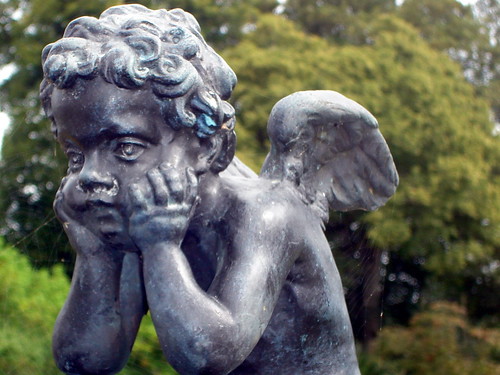
 When I think about what I did, my heart hurts. That’s guilt. I might be a bit mired (stuck) in this one event, true. I am not sure why I’ve had difficulty finding atonement. If one of my children did something like this, I would tell them to learn from it, not to behave in a mean way again, and move on. So, I guess in that way, perhaps if I took my own advice, I can say I did learn from it. I never tripped anyone else again, and certainly never intentionally hurt anyone again. I just hope that somewhere out there, that boy knows I am sorry.bored angel

“Safety and happiness can only come from individuals, classes, and nations being honest and fair and kind to each other.”-CS Lewis

Monster spray.

“Courage is resistance to fear, mastery of fear – not absence of fear”–Mark Twain

On Wednesday, while we were reviewing the final Journey of the Hero project, I shared a personal story with some of you about when I was a little girl. My parents were renting a house, and I had a room somewhat separated from the rest of the family. My room had its own bathroom, which on the surface seems very luxurious. The closet in the bathroom, holding cleaners, towels, etc., had a crawl space, that hosted constant shadows, no matter how the light shone in, or how bright the sunlight glowed. There were monsters in that crawl space. No doubt, no question, no mystery. Monsters. Small, yes, but ferocious. Spiky, oozing, biting monsters. Luckily, I had a hero–my dad. When I brought him my worry and concerns about the crawl-space-bathroom-dwelling-monsters, he didn’t dismiss my fears; he solved them. Taking a can of Lysol, he thoroughly sprayed the inside of the monsters’ lair, and all around the bathroom. In my four-year-old’s memory, I can still see those monsters disintegrating like so much foul fog and smoke. He placed the can by my bed, in case I should ever need to kill monsters in the middle of the night. I haven’t had a monster problem since.

That’s kind of a silly story, I know. Just a small moment in time when someone who loved me made me feel braver. I guess I could think of the Monster Spray as being my own supernatural aid.

But we know that heroes face much worse–and that the definition of a hero/heroine is someone who does something for other people without thinking of themselves. But that’s the ideal hero. Humans are far more complicated than that. It’s the complications I want you to think about. We can’t relate to heroes who make it look easy all the time-it becomes unattainable. Maybe that’s why in Greek/Roman mythology, the gods/goddesses are flawed. Maybe that’s why in the Bible story of David and Goliath, David is this runt kid. Maybe that’s why in the legend of Joan of Arc, she’s this crazy teenage girl. There’s the Jewish story of a young girl named Esther, who saved her people through her bravery. Scheherazade used her brains and beauty to tell imaginative stories that not only saved her own neck, but showed her loyalty and faithfulness.

But what is the nature of bravery, and courage?

From Mr. Spencer’s Blog:  I saw a woman lose it at the grocery store the other day. She picked up a pink box  and slammed it to the shelf. I can’t remember the words exactly, but she said, “they’re using cancer to sell cereal. I’m sick of it. Why can’t they just have a celebrity?” And she started into a loud rant that quickly cleared the aisle and left her husband red-faced.

She stopped herself after knocking down a few of the boxes. I stared at Brenna and heard, “I’m sick of wearing pink and I’m tired of pretending. Cancer sucks.”

As I drove my cart off, she took off her hat and cried right there in the grocery store. Loud tears. Heaving sobs. Her husband held her.

Listen to these three stories, chosen because the storyteller met an obstacle, or had to overcome a fear:

http://www.storycorps.org/listen/stories/griselda-lemus-and-her-mother-papsy

http://www.storycorps.org/listen/stories/john-hope-franklin-with-his-son-john-w-franklin

http://www.storycorps.org/listen/stories/ezra-awumey-and-sam-harmon

Tumble. Polish. Shine. Repeat. Any questions?

ThumblerTumbler-1Many patterns in teaching and learning emerge over time. The pattern of knowing what you don’t know is one of those long-term, polishing-a-rock patterns.  Every time you, my students, take a test, write a paper, talk about a book you’ve read, or create reasons why you didn’t, you give me answers. You answer questions such as, “does she understand how to generalize?” “Does he know what this word means?” “How can I help them understand an abstract concept such as making an inference?” And the time-honored, “?” written on a test or quiz. Even knowing when you don’t know something is helpful to me, so I can help you.

I just finished reviewing your latest reading assessment. Here’s what I know now: Most of you know more than you think you do, but you’re still struggling on how to express it. Also, many of you  need help working on big ideas, such as “what does it mean to generalize information?” or “is this a reasonable conclusion?” I guess many adults are not asked to perform such higher level thinking as we demand of eighth grade kids.  You are little diamonds in the rough, my gems, and let’s bring out your best! It’ll take some time, but teaching is truly a patient, faithful process…I need to believe that if you don’t get it now, someday you will. Otherwise both of us will be ground down for not much but some fool’s gold. Your knowledge and education is your mental gold, and you want the most ka-ching!! as possible. It’s worth it to put forth your best effort, and have faith in yourself, too, and patience.

These are your gems of wisodom for today.

Stir it up.

Oh, kids. I’m starting to sense it. It’s that time of year when you’re looking at your assignments, feeling overwhelmed, like a deer in the headlights, unable to move forward. Now to mix some metaphors: The bad habits are setting in, like early morning frost, slowly creeping in, freezing our minds, getting us stuck in fixed thinking. You’re a frozen deer in frosty headlights.  I can sense my own bad teacher habits bubbling to the surface, like so many globs of oil, getting everything filmy and gross.

I don’t want to be that kind of teacher–getting angry and frustrated. Letting the sarcastic comments slip in. I want to keep believing. Believing that you will take in what I’m saying, and what you’re saying–we talked about what makes students successful today, and come up with a pretty cool list. Two of the biggies: Read Directions and Ask Questions.

But how do you define success?

To me, success is problem solving in a creative way. Knowing when something is not working, and finding another way. Breaking a bad habit.

I believe what we’re studying right now is really interesting – I could spend a lifetime thinking about it. But I’m not Joseph Campbell. I’m not a professor in mythology and comparative religions. I can still think it’s pretty fascinating, though. But if it’s not coming through as something that’s interesting to you, we need to find another way. Creative, thinking people find a way to make what they’re learning interesting. Boring, stuck people don’t.

Look at this blog, and see if anything sparks you, or if it takes you on a reading journey across the Internet: http://www.kerismith.com/blog/ 

Make a wish...
Make a wish...


Let me know what happens.

Holy da Vinci, Batman!


 From The Writer’s Almanac:

It’s the birthday of the comic-book author Bob Kane, (books by this author) born in the Bronx (1916), who was working at DC Comics in 1939 when his editors began asking for more superhero characters to follow up on the success of Superman. Kane thought about it over the weekend, and on Monday morning he turned in some sketches of a character he called Batman. The character made his debut in DC Comics number 27, “The Case of the Chemical Syndicate,” in May of 1939. He is alter ego of multimillionaire Bruce Wayne and one of the few superheroes in the history of comic books who doesn’t have any special powers. He’s just rich enough to build himself special crime-fighting gadgets. Kane said he based the character partly on Zorro, because he liked the idea of a fashionable rich guy dressing up as a vigilante at night to fight crime. He got the idea for Batman’s costume from a drawing by Leonardo da Vinci of a bat-winged flying machine.

So, burning question:

Your faced with a creative challenge. What do you do? What resources will you draw from, (literally, if you’re an artist, or figuratively, if you’re tangling another sort of task)? Did you ever imagine that Bob Kane would use the genius of a 420-year dead guy to inspire him? Happens all the time.

Giving wolves a bad name.

I really hate lies. Lies make the world so…diminished. I’m not talking about the “little white lies” that we use to not hurt someone’s feelings, although those can be pretty dreadful, too. I’m talking about the big whoppers that put people’s lives, time, and trust at risk. Lies are as old as time. I’m also not talking about stories that everyone knows is a story and is enjoying. I’m talking about intentional, deceitful, “I am knowingly trying to pull one over on other people” lies. I have students who are so in the habit of lying, they don’t even know it. The first thing out of their mouths when they’re answering a question is a lie. Example: Me to student: “Please change your laptop screen–(laptop screen is filled with gang/street imagery)–you are only allowed to have a solid color, or our mascot.” “No way, Mrs. L! Another teacher told me…blah blah blah blah…” Since other teachers are even more strict than I am, I am CONFIDENT another teacher did not say it was okay to have those images on her laptop. One. Hundred. Percent.  I had one student whom I said hello to in the courtyard before class, and then when she was tardy, proceeded to tell me the bus was late. Um, yeah…the bus may have been late (it wasn’t — we hear announcements) but apparently you weren’t ON IT BECAUSE I SAID HELLO TO YOU IN THE COURTYARD FIFTEEN MINUTES AGO!

(Deep breath.)

Now, there’s the news story out of Colorado about the crazy dad who told everyone his little boy was up in a balloon. I only listened to this story from the peripheral (sidelines), but when I heard more details I was horrified. The parents must be devastated! If I lost one of my children, I would never recover. Teachers who have lost students are never totally the same. I am not being dramatic when I tell you it breaks your heart.

And then it came out that this dad was lying, it was a hoax. 

What should happen to parents who make their children play a part in a nationwide, no–worldwide– deception? Who manipulate the media in this way?

As my husband said, ‘We (people in general) want to help those in danger. How are we going to want to keep doing that, having a moral and ethical reaction when some one’s really in danger?”

Take care, students — this is why your parents and teachers want you to be a “critical thinker.” Don’t take part in the lies that undermine the trust.

I trust you now, too–don’t lie to me. I want to help you when you’re in danger, of any kind. Especially if you’re being dangerous to yourself.

Read this fable, and compare it to the modern news story:

http://www.dsokids.com/public/LessonPlans/Peter%20and%20The%20Wolf%20Story%20Sheet.pdf

http://www.npr.org/templates/story/story.php?storyId=113899352

Brains and Blackguards! Posthumously Humorous!

Pride and Prejudice and Zombies by Seth Graham Smith (and Jane Austen, although without her permission…maybe she’s walking around as a zombie herself right about now…), Quirk Publishers (April 2009) is so

completely

funny…but not for the faint of heart. Imagine your 12 year old brother got a hold of the classic Austen novel of social class, true love, and English countryside shenanigans and add SUPER ULTRAVIOLET BRAIN-EATING ZOMBIES. This is  no ordinary tripe.

Like all great paradies and satire, it’s only truly funny if you are in on the joke. As middle school students, it’s highly unlikely that most of you have tackled Jane Austen, a brilliant and insightful writer. But this is what you have to look forward to: the more you read, the more you understand, the more jokes you’ll get. If that’s not a great purpose for reading, then my zombie friends, you are truly walking around with your brains spilling out.


For more information on Jane Austen (December 16, 1775-July 18, 1817) go to this link:

http://www.pemberley.com/