Land of the Lost: Allusions, Annotating, and Anagnorisis


Metacognition is the mind-map that is the survival tool in reading comprehension: it is that ‘thinking about thinking,’ the big picture, and knowing where you’re going, and, perhaps more importantly, when you’re lost:

Anagnorisis is the moment in the story where the character, usually the protagonist, says, “Uh-oh.”

According to Merriam-Webster, it is:

Main Entry: an·ag·no·ri·sis
Pronunciation: ˌa-ˌnag-ˈnȯr-ə-səs
Function: noun
Inflected Form(s): plural an·ag·no·ri·ses

–ˌsēz

Etymology: Greek anagnōrisis, from anagnōrizein to recognize, from ana- + gnōrizein to make known; akin to Greek gnōrimos well-known, gignōskein to come to know — more at know
Date: circa 1800

: the point in the plot especially of a tragedy at which the protagonist recognizes his or her or some other character’s true identity or discovers the true nature of his or her own situation

We teachers are merely the sherpas to our students’ quests for higher learning, deeper thinking, with all the oxygen and rations they need at K-2, or Knowledge Exponential 2 Base Camp. The reason this post begins with with ‘metacognition’ and ‘anagnorisis’ is because we want our students to realize that they’re doing both — they need to recognize that ‘oh, snap!’ moment when they’re lost in their understanding of any reading material. And, it’s our worthy task to help them find their way up, and safely back down, the moutain.

Any. Reading. Material.

And before I go further, I am compelled to acknowledge and recognize one of the greatest teachers, my master’s mentor, Dr. Candace Shulhauser. She helped synthesize for me everything I know about metacognition, Before, During, and After, and helped guide me through my first novel guide/unit. She took all of the great information out there, made us all see clearly and with strength, and added her own personal experiences and narrative to the mix to make it truly meaningful. She was there, making it happen for the hardest and most challenging of students, and showed us that it can be done with grace, courage, and wisdom. Thank you. (And yes, I think it’s super cool that her name takes on a Dickensian edge meaning “candy schoolhouse.” How sweet!)

Over time, one of the most fundamental alterations that has taken place in my own brain is I have a hard time reading books now without looking at them through the eyes of a teacher. In some ways, this kind of stinks, like a busman’s holiday. I am constantly looking for a myriad of functions and examples in books. This summer, for the first time in years, I put my book-brain on ice. Yesterday I was vindicated for doing so by a quote from Charles Bukowski–in essence, sometimes it’s good to do nothing for awhile. And this summer, I did, oh boy, did I. But more on my ‘do nothing’ summer later.

So, the point is, while I have a hard time reading anything without making a novel guide out of it, I will share some of my processes, and how I synthesized the processes of other great reading teachers, such as Jim Burke, Kelly Gallagher, Nancy Atwell, Kylene Beers, etc. (There is not much of a difference, in my estimation, of teaching a novel and teaching someone how to read. It’s all about access. To get into the nuances between teaching great “literature” and teaching reading, well, I’m just not up for that one right now.)

So, I have never read The Thief Lord by Cornelia Funke. It was a very popular book several years ago, and she is a wonderful children’s author. This summer, in between long stretches of some serious goofing-off, I decided to read it. (My younger son said it was a read-aloud when he was in fourth grade. That’s too bad, because now he won’t touch it. Again, blog posting for another day.) I haven’t finished it yet, so don’t be a spoiler.

  • The front cover tell me has a person wearing a cloak, making only a shadow with a full, bright moon. Hmmm, I wonder if that person is the thief lord?I know what a thief is, and a lord is someone powerful…
  • The back cover has a blurb. STOP – introduce the book and show students all of these things. This is how they might find something they want to read. Yes, teach them to judge a book by its cover, but take time to make an informed decision!
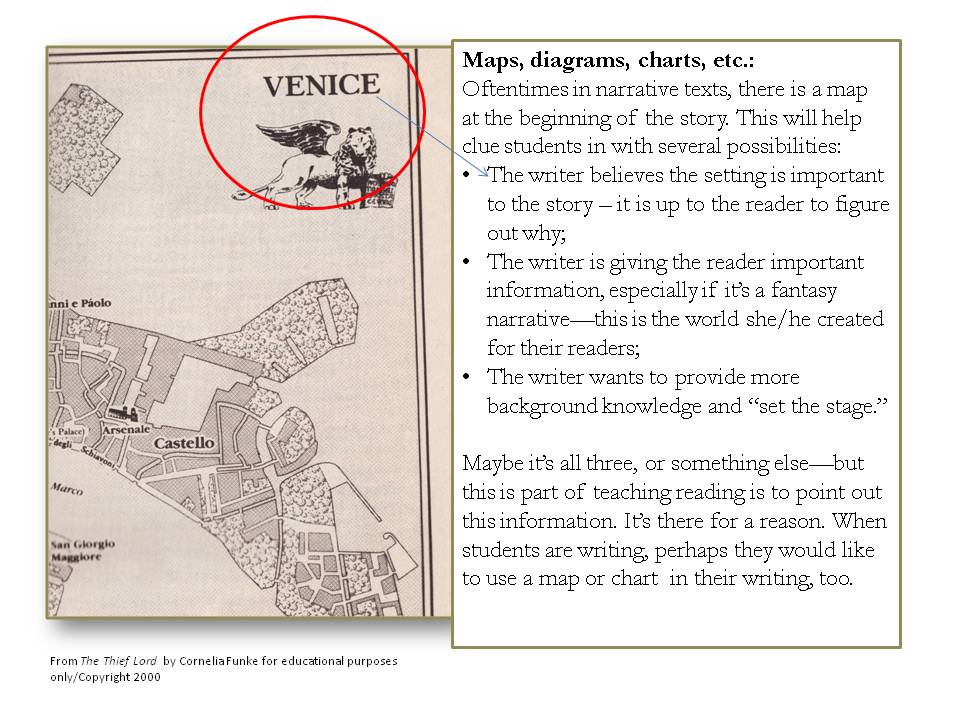
  • The story takes place in Venice. How do I know? This is when you STOP — time to teach some background knowledge:

MapYou can click on this image to view larger, of course. Here’s where some decisions need to be made: depending on your students and access to technology/information, you will want to decide how much you want to give and how much inquiry you want them to create. Here’s the deal, though, with our brains, we love patterns. So, if students get misinformation or misconceptions about what they’re inquring about, to re-wire these pathways will be doubly difficult. Inquiry and constructivism are wonderful tools–but remember, if someone doesn’t know anything about a topic, the potential for missteps grows. Imagine you’ve never been to Venice (like I have never been) or seen a picture, or been on a canoe, or little boat, or imagined a city built entirely around canals, with bridges, and ancient pathways, nooks, crannies, or have ever heard of Italy at all? This is part of a safe environment of learning. It’s okay not to know, but not okay not to learn. (I didn’t know for a long time that the ‘underground railroad’ wasn’t like a subway. I’ve had students who believed the same thing. I had a student from New York City tell girls about subways, and they didn’t believe him. It goes on…)

So, short or long lessons, and time spent on Venice. Your choice, and your students’ needs.

Next, annotating text: I had a big lesson myself when teaching annotating text. Thought students were ‘getting it,’ and doing okay. Asked a girl how her annotating this one Greek story was coming along, and she answered confidently, “great!’ Something told me to stop and ask her to explain the first paragraph. She didn’t know every other third word. Okay, let’s try again – highlight the words that seem confusing. And I tried to sweeten the deal with reaffirming again that the more one reads, the more automatic understanding/fluency becomes, and the more fun it is to read.

Like I said, I can’t read a book anymore in the same way. It’s just now my job means I make my brain processes as transparent as possible so students can look inside my head, so they are better at looking inside theirs.

There are many ways for annoating text; you may decide you want to teach one specific strategy at a time, such as a vocabulary skill for reading comprehension strategy: Vaporetto In this particular example, the word “vaporetto” is used. I’ve never seen that word before, but the image I put together demonstrates some of my thinking process.

Another vocabulary buggaboo are context clues. We assume, too often, that students know more than they do.  For example, this sentence:

“A party of tourists (blank) past the (blank) while their guide described the (blank) above their heads in a (blank) voice.”

There are four words in that sentence that are potential mental gopher holes: shuffled, confessional, mosaics, and muted.

How would you teach those? Have student act out “shuffled,” look up a confessional, make a connection if they’re Catholic or have been to a Catholic church, infer, what a mosaic is, or look it up, and then maybe make one, and make an educated guess (inference) on if they are in a church, would they be yelling in a loud voice (questioning text)? Not one single reading ‘strategy’ can effectively be taught in isolation, but we don’t think ‘in isolation.’

(*The ‘say blank’ strategy is Dr. Schulhauser’s.)

Allusions are one of my all-time favorite concepts to teach, even though inevitably I will be corrected by a student telling me it’s “ILLusion, Mrs. Love, not ALLusion.” Um, well, no, my darling middle schooler, let me continue…) So far I haven’t found any specific allusions in The Thief Lord, although there are plenty of connections. An allusion is a specific reference to another work/character. The connections are abundant. It’s Oliver Twist, The Goonies, and The Pink Panther/Inspector Clouseau to start. But, boy howdy, when you use your strong metacognitive skills and spot an allusion, it’s like a reading golden ticket. Allusions to other works show us that we are not learning in isolation, that we are connected, and our thinking, based on knowledge. Now I can’t get Led Zeppelin’s Immigrant Song out of my head, when Robert Plant wails, “To fight the horde, to sing and cry, Valhalla, I am coming…” If you remember your sixth grade Norse mythology, you know what Valhalla is, and why you may want to go there someday. Or, at least, what the Minnesota Vikings might want to sing in the locker room showers. In my goofing-off summer, there are so many allusions in this game I play, but it makes me laugh when I recognize something, such as little goblin men speaking the words of Elton John’s Rocket Man to each other in conversational tones. (And for the record, Rocket Man is the only song I can sing and score big on Guitar Hero.) Allusions add a richness and texture to our reading/listening/viewing that would otherwise be lacking. Teach them as part of metacognition to students recognize those connections to other works when they read/see/hear them. We all feel smarter and more creative when we do.

Characterization and connections lead me to themes…

But another day. Ciao, bella!

Postscript: If you would like some of the excerpt .jpgs for your own classroom instruction, send me a Tweet @mrskellylove and your e-mail address; that is, if the links don’t work.

That's a horse of another color: Finding what makes us giddy-up and GO!

Vintage Cowgirl 2Deep breath. This is really a dicey area. How do we help students one, know they must read; two, know that they should read, and three, want to read? Well, perhaps it all gels into one colloidal ooze of humanity – we all have one thing universally in common: we are unique. And because we are unique, we all need to personalize, and internalize, those matters closest to our hearts and soul.

My first year of teaching I had a student who only wanted to read books about horses; primarily fantasy and realistic fiction, but some sort of equine overtone was always at the books’ core. In my earnestness, I tried to have her break out of what I perceived was a rut in reading. (And I was never a ‘horsey” type of girl–sure, would I have like a pony? Well, duh! Even Lisa Simpson has a weakness for pretty ponies, but still…) So, between my biases and trying to be a ‘good teacher of reading,’ I tried, unsuccessfully, in pulling the reins on the horse books. What I probably DID end up succeeding in was making this student feel bad. I could crop myself now, thinking back on it. What was I thinking?! She was reading! And, after all, perhaps if I was so bent on getting her to open up access to other themes, perhaps I just should have said, “Hey (is for horses), I see you like books that have horses. Let’s explore that in genres, and see where that takes you?” Or something like that. I don’t talk like that in real life. I did run into her a year or so after the fact, and a charming young lady was she, and very gracious when I asked her if she was reading other books besides horse tales. She said yes, but I was still a schmuck.

As I alluded to in the post yesterday, the ALA has a good reading interest survey, which I’ve modified over the years. For example: Question No. 6 puzzles me a great deal. “About how many books do you own?”

Well, I know already that many of my students don’t have enough socks and underwear, so I would imagine books are low on the priority list. But, I can’t assume anything. Perhaps the question should be, “Do you know anyone who owns a lot of books? Why do you think they do?”

I confess: I am a bookaholic. (At the risk of having John Spencer call me out on using the suffix “holic” on a word–I know it’s cliche….my apologies!) Anyway, I am. I have no willpower or any modicum of self-control when I am in any bookstore, whether it’s a big box chain bookstore or the local (and diminishing) locally-owned one, or if I’m on an on-line bookstore. Imagine a swirling, sparkling vortex of gauzy purple smoke hovering over my brain, and this ‘woooo—woooooooo……” sound humming from some unknown shadowy source.A wave of confusion and hypnotic command takes over my higher brain functions, and the next thing I know the debit card is in my hand, the order has been placed, and we are scrambling for groceries for two weeks.

I buy a lot of books.

And…I also collect a variety of reading materials, wherever I can scrounge them. If I’m in the city, and there’s one of those tourist pamphlet stands, I grab all I can. Business cards, menus, magazines, catalogs, fortune cookie slips, etc., I gather and horde. Their use is simple: when it comes to understanding that reading is everywhere, I simply put all of this reading material on tables around the room, and have students actively look through as much as they can. They categorize, analyze, and simonize. Well, not the last one. But, the goal is, if they find something that looks like a promising possibility, they write the title/type down. Then…read. And then, think. Did they like it? Why, why not? Who are they now and why did this book fit, or not? Then saddle up again.

But here’s the key: the grand conversation. It still comes back to conferencing with the students as much as possible individually, and the (dare I say it?) a whole-class discussion (which can look an awful lot like a lecture). And, as much as I wish providing students with a wide variety of genres would be the magic elixir to get them all just as stoopified and voo-doo’ed as I am when it comes to books, it doesn’t. The mojo only carries so far. But, it does lasso a few. The rest of the non-believers still have a greater understanding that they are readers, whether they like it or not. They read to live (while some of us live to read).

Now, there is friction with this, make no mistake. My husband has asked me, begged me, not to spend money on books for my classroom. I have tried to slow down. But when I’m at a full gallop, I simply take the fences and dead-head until dawn.

I still want to give a big “Yee-haw!” to DonorsChoose.org, whose participants equipped my classroom with thirty copies of The Lightening Thief by Rick Riordan two years ago. That truly is the gift for the long run.

If I blog it, they will read…

 Field of DreamsI think if I say it publicly, I’ll have to honor the promise to myself to write about reading. Disclosure statement: This is not everything I know about teaching reading, and I don’t know much, paradoxically! My experience is with “average” middle school-aged students, 11 to 15, with a large population of diverse languages, backgrounds, and cultural experiences. (I love it, by the way.) Oh, and they don’t have much money. But we’re not going to let that stop us from a world-class education! Take that, misguided ed reformers!

The thing is, for all of the great reading strategies, they cannot work independently. It’s like explaining how a carburetor works, and tires, and fuel injector, but not explaining all the parts go into making a vehicle GO. So, let’s see if we can build something together–all comments, resources, and insights are welcome!

Monday (later today): In the Zone: Proximal Development and Background Knowledge

Tuesday: The view from here: Understanding a child’s reading interest, abilities, and desires

Wednesday: Dr. Watson, I infer? Using inferences, allusions, connecting, metacognition, and clues

Thursday: Sass Back:  Questioning and talking back to your books/writers

Friday: Reading like a writer, and writing like a reader: How language connects us all

On Friday, I’ll provide a list of some of my favorite professional development books, too.

Now — for some more coffee.

Leveling up: Pathways to reading

mc escher

Wonderful colleague posts this question to the universe:
Calling ALL opinions: students are reading below grade level (anywhere from 5 to 1 year behind) and I want to do a book study to meet some CORE standards. Can I use one that isn’t at grade level? Or is that just making it too easy? Is it OK to use any book as long as it is higher than their current level of performance? Weigh in…and not just teachers!

My quick response:I have a lot to say about this, but Lucy Calkins said it well: “I want to know when I am about to ski down the black diamond slope.” In other words, make the reading levels AND the student’s current reading abilities as transparent as possible, with the key ingredient: Once they know, teach the hell out of how they can improve. I have “let go” so much regarding levels as far as what they “should” be reading – I encourage ANY kind of reading–comic books, picture books, fairy tales, graphic novels, cereal boxes, video game quest logs, you name it. In fact, on the MSP there is a place for “functional” reading–which I agree with. Being able to read a functional document means a functional adult (or a greatly improved chance). I stress, stress, stress to my students if you don’t understand it and can’t talk about it, you’re not “reading” –you’re faking it. So, encourage them if they want to read something higher than their “level” but let them know they are going to have to approach it a bit differently. And, they can get deep meaning out of any narrative or information they find interesting and meaningful to them.

So, here’s what I’m thinking: In order to get my own head on straight for this upcoming, topsy-turvy year, this week I will do a series all about reading, and my reflections on its process, purpose, and perpetuating the pursuit.

I would love any guest bloggers to engage with their philosophies, strategies, and reflections on this as well — what have you tried that worked with the majority of your students, and what have you tried that worked with the minority of your students?

Send me an e-mail: lovesblog0rama@gmail.com

Books You Should Read:

language_custom

Excerpt:

Chapter 20: Dying Languages

Speaking, writing, and signing are the three ways in which a language lives and breathes. They are the three mediums through which a language is passed on from one generation to the next. If a language is a healthy language, this is happening all the time. Parents pass their language on to their children, who pass it on to their children … and the language lives on.

Languages like English, Spanish, and Chinese are healthy languages. They exist in spoken, written, and signed forms, and they’re used by hundreds of millions of people all over the world. But most of the 6,000 or so of the world’s languages aren’t in such a healthy state. They’re used by very few people. The children aren’t learning them from their parents. And as a result the languages are in real danger of dying out.

When does a language die?

Remember to read.

martinamis1No matter who you are, your ability to read is so important to making who you are. I have spent hours myself, reading about my burning question of “Why should we read?” and its sister question, “How do we read?”

So, why should you?

The reasons for reading are as many as there are words on a page.

When I read, I feel that I am allowed access to a space that is unlike any other. I read other people’s voices on the page, screen, or cereal box. It doesn’t matter. I am a strong reader. And because I am a strong reader, I am a strong thinker.

I want you all to be strong thinkers, too.

Now, how do you read? Please do not continue your bad habits of saying you understood something when you didn’t. Please continue our good habits we’ve spent a year building of questioning the text, writing notes, considering and using new vocabulary, and if you feel that something has sparked you, even a little, do a little more investigation: for example, I reading a book called Arabat by Clive Barker. A student, a brilliant, beautiful, charming student, recommended it to me. I remember thinking Clive Barker was the man who directed the Freddy/Nightmare series a long time ago. But that wasn’t right – he did the Hellraiser movies. (How did I learn that? By reading.)

Arabat is an amazing book. Every time I read it, I feel as if I’m stepping into another world–that’s such a cliche to say, but Barker’s writing style creates a visual and textual world that I literally can almost reach out and touch. The salt air, fear, flying, hope, courage, and barnacles are so perfectly paced, described, and not overdone; I could only aspire to write such as he. His original illustrations leave me in awe. His villains are complex, cruel, and like all good villains (nice oxymoron, eh?) they want to destroy the light: one with creating a perpetual midnight, the other with creating a world of mindless purchasing and consuming zombies.

Whew. That was a ramble.

How did I go from admonishing you to read to writing a brief review of Arabat?

I guess the real question is, how would I not?

barker_arabat

P.S. This book is out of print now. My quest? To seek as many copies I can.

Killing mockingbirds in secret gardens: Or, how books kick our fannies. (And Sammy Sosa, too.)

This is every teachers’ dream (or it should be): a student comes up to me this morning, and hands me back my copy of To Kill a Mockingbird, telling me it “won.” He couldn’t finish it. He said he had to keep flipping back to the beginning to remember what was going on. He wasn’t assigned this book per se; it was intended for a novel project we’re working on over many weeks. He just had to find a ‘classic.’ He tried TKAM.  This particular student has enjoyed some notoriety of being the ‘smart one’ in his group. And for him to a. Remember to bring me back my book after a shortened spring break and b. Having attempted to read it, waved the white flag is remarkable. You’re thinking right now: Why is Mrs. Love happy about that? A kid gave up! He didn’t demonstrate stamina, or perseverance! But, he did do something I’ve been all about all…year…long:

meta-cognition

The ability to think about our thinking.

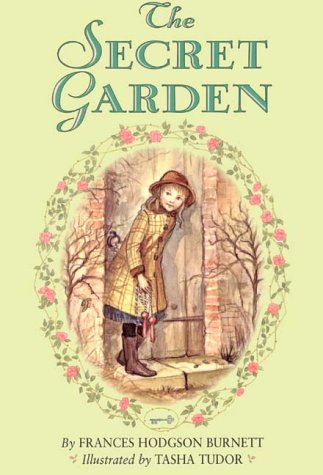
I shared with our young reader a shorter version of this tale: When I was around 8 or 9, my beloved great-grandmother Rushie, a fellow bibliophile, gave me a copy of The Secret Garden by Frances Hodgson Burnett. I had a very high reading level, so the text itself wasn’t problematic. But when I began the novel, it tasted like bitter collard greens. What? She’s in India? Her parents died? She has NANNIES? And who is the little sick kid, and why does he whine so much? I couldn’t for the life of me figure out why Rushie would give me something so boring and weird, but was conflicted because I loved her, and normally her gifts of books were big hits. (She also smelled of menthol cigarettes, book pages, and Avon lotion. I’m getting a little weepy just thinking about it. I miss you, Rushie!) Flash forward a few years, and I mean a few – I’m about 10. I have nothing else to read, and with a mixture of trust and boredom, pick up The Secret Garden again. Oh! I get it! I GET IT! This little bitter, sour girl warms and grows like a garden! They all learn to trust! They have friendship and warmth! And even death cannot conquer hope, and life! What a difference a few years make. Developmentally I may have been able to define words and read them with robotic fluency,

The Secret Garden

but I didn’t have the slight edge of life experience yet to appreciate or relate to the nuances of character, setting, mood, and conflict. I loved The Phantom Tollbooth when I was 10, too, but probably wouldn’t have understood the jokes at 8 either. I will never forget how intrinsically proud I was of myself for trying again, and being so greatly rewarded with a book such as The Secret Garden. I made this young man promise me at some point in the future, he would put up Mockingbird again, and he gave me his word.

The bigger “meta” in all this is WHAT IN THE NAME OF FRANCES HODGES BURNETT ARE WE DOING TO STUDENTS? There are two things I want to put out there for consideration:

1. Please don’t raise the bar so high, so developmentally inappropriate that a child has no hope in succeeding.

2. Please don’t give children a sense of false self-esteem that they believe all they have to do is show up and receive a reward. This goes for students of poverty and privilege: guilt feeds inauthentic self-esteems of poverty, and entitlement feeds the hubris of privilege.

 It’s a balancing act, folks. Getting rid of all drill and direct instruction is no more appropriate than just having children talk about how they “feel”about the number seven. You are all expert teachers and educators, right? So, do you know when a text is kicking your students’ fannies? Better yet, have you taught them how to recognize when THEY are in trouble, so they can readjust? And for the love of Twain don’t tell them just to re-read it. Case in point: today in reading group we’re reading a story about Sammy Sosa. I know the rudimentary basics of baseball. My small group of students knew less than I did. There was one pun in the story, “Sammy left the ring for the dimond.” Hardy-har-har- that was in reference to when Sammy went from a boxing RING to the baseball DIAMOND. Okay. Check. My background knowledge is secure in those. But then there was another question: How would you list some of the mistakes he made? And one of the answers had to do with “cutoff man.” What? Does he wear jean shorts? Does he sweep-kick players when the ref, um, I mean umpire, isn’t looking? So, it’s almost the end of class, and I’m tired. I was flipping through the glossary, and there, is a definition for cutoff man. Hey kids, you know what, I got in trouble here with my understanding of how to answer this question – work with me here. So we had a mock baseball game in the class. I was Sammy Sosa, of course, working the in-field, and having to make a judgement about who to throw the ball to. It all made perfect sense. I told everyone then to remember next time they read something they don’t understand – act it out, say it out, think it out. It takes practice, and time. But if we really want to give our students access, we need to check in with them from time to time. Don’t let it slide by. Be their cutoff man. Because not everyone can have a Rushie.


Top 10 Reasons Why I Hate Reading Logs:

log rolling


  1. Cheating: In order to get the grade for the “reading,” kids cheat.
  2. Inauthenticity: Is a student really reading something they love? Does counting pages read mean there’s a true connection?
  3. Competition: Measuring students’ success by minutes read=factory-made, robotic readers
  4. Parent accountability: Reading logs put a lot of the responsibility on parents’ shoulders. I’ve said it once, I’ll say it a hundred times: My mom never had to sign math homework sheets or reading logs, and she was STILL an excellent mother. I sure would hate to see how she would have coped raising three little girls while her husband traveled 5 days/week on business AND helped her daughters remember to have her sign a reading log.
  5. Student accountability: Oh, so it’s the kids’ complete responsibility? So, what if the parent isn’t available? That’s teaching responsibility, or just a reminder that your parent is working 3 jobs to put food on the table. More reinforcement of “you’re unworthy, irresponsible” labeling.
  6. Distracting: Why does a book need all of these “flags” to make it more enjoyable?
  7. Epic fail: You don’t do your reading log, even if you read all the time, you fail.
  8. Resistance: Puts a damper on the whole “love of literature” thing
  9. Time waster: See number 6.
  10. Annoying: For everyone involved.

Talk to me about the books you’re reading; tell me why you love them. Write me a note in your composition book, or send me an e-mail. I’ll teach you about plot, irony, paradox, and punctuation in class, okay? And why I love books, too.

Read on.

I stumbled across this blog awhile ago: “…and we also read.” URL: http://readkl.blogspot.com/search/label/at%20a%20cafe

Its premise is to capture people reading, all over the world.

When I visited this morning, the Live Feed included:

Philippines

Australia

Jakarta

Petaling Jaya, Kual Lumpur

Johor Bahru, Johor

Ulm, Baden-Wurttemberg

Singapore

and those were the ones just on the screen.

This young man was waiting to get an x-ray because of his headaches: he was reading Richard Pryor, an American comedian, to pass the time and hopefully to laugh, to get his mind off of his health problems.  I can’t tell from the post where he’s from, but it’s not the United States, (although we tend to think we are the center of the universe).

reading around the world

One can only guess at what the center of his universe is. Perhaps he has a girlfriend he’d like to marry; perhaps he helps support his mom and siblings; maybe he just gets migraines occasionally, and the doctor will fix him right up.

Notice: he could be playing a GameBoy, or PSP, or watching movies on 3-G phone. But he’s not. He’s reading a book. Richard Pryor passed away in 2005; and I can tell you, although his humor was definitely R rated, he was really funny. He had many personal demons of his own, as many comedians do.

The founders of this blog are on a mission: to find and photograph people reading, all over the world, for many different purposes. They’re not teachers (I don’t think-there’s nothing on their blog that would suggest this), they seem to be interested in people reading, and their reasons for reading; perhaps they are interested in others’ burning questions, and this is theirs:

Why do people choose to read?

Make sure you have that choice, too, and that freedom.

What's in a name?

galileo

From the Writer’s Almanac, February 15, 2010:

It’s the birthday of the Father of Modern Science, Galileo Galilei, (born in Pisa, Italy (1564). It was Copernicus who suggested that it was the sun, and not the Earth, that was at the center of the universe. But Galileo became a famous public defender of that theory, called heliocentrism. The pope and Galileo were on friendly terms, and the pope encouraged Galileo to write a book outlining the controversy. But of course the pope instructed Galileo that he must not promote heliocentrism, and asked that his own beliefs be represented. So Galileo wrote Dialogue Concerning the Two Chief World Systems, which purported to be a debate between two philosophers; but one of the two, Simplicio, sounded stupid, and it was this figure that acted as a mouthpiece of the pope. No one knows whether Galileo deliberately attacked the Pope — it’s probable that he just couldn’t write as convincing of an argument from a philosophy that undermined his own scientific beliefs. In any case, the pope was definitely not a fan of the book, and Galileo was put on trial for heresy. He publicly renounced his views, but he still spent the rest of his life under house arrest, and his books were banned.

Wow.  Talk about your author’s bias and purpose. Remember the other day when we talked about characters, and how writers purposefully and intentionally name their characters? Simplicio? Simple? As in simple-minded? Consider that when we begin fictional narratives in the next few weeks. The characters in your writing all matter, whether they have a major or minor role. And they are your creation–name them accordingly.

One more note: heliocentrism. Remind you of anything? Helios? Hmmmm?