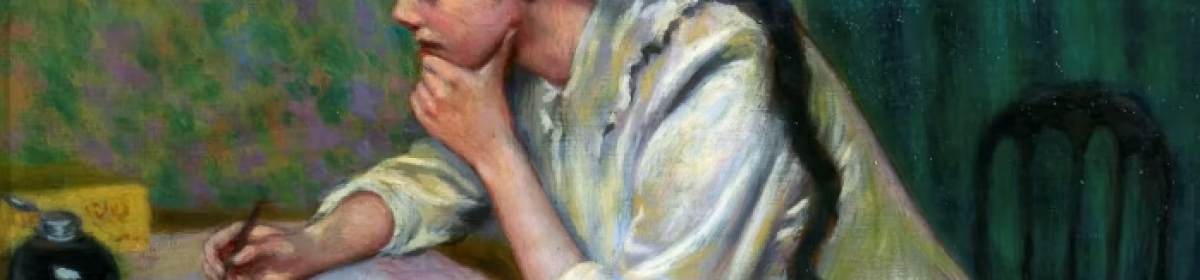
I love to write. I’ve been scribbling since I was tiny.
And it hurts.
And heals.
Creating is a paradox. We read to become better writers and we write to become better readers, all in the service of moving and navigating through this space, this world.
And it hit me hard. I am not Mormon; I do not, and have not, had a community like this outside of my job, except for the rare occasions I worked with the now-defunct Puget Sound Writing Project (National Writing Project). But now I feel isolated, siloed, and micromanaged, and it’s not healthy. It’s not healthy for me or my students, which some folks don’t understand; it’s not healthy for them, either.
At this juncture, I am desperately seeking allies and community. I can count on many friends and family members who support me and my work and others who support the communities around us. Also, my anxiety and pattern recognition of danger is through the emotional cortisol roof. I remarked the other day that I do not understand my district’s culture, or perhaps I do, and I don’t want to see it or speak it out loud.
My ask: if you are interested in building a community with me, a community that supports inclusion, diversity, equity, knowledge, love, and action, don’t hesitate to get in touch with me privately, start your own WordPress blog, come make zines with me, let’s hang out and write our congresspeople, drink coffee and eat snacks. I am open to ideas.
I am promising now: I do not care who you voted for*; I only care about your actions. If your actions harm me and my ability to provide for my family and students, I will gather my community and work to make things right.
*I care, but I must compartmentalize that and focus on the current situation. Your vote for him is a massive obstacle to peace and love. Either help fix what you broke or get out of the way, please.
Key phrases I learned from his video, ones I knew, and all of them I need to share with students:
Ideological fragment: Dr. Cruz explores how a piece of media can be an ideological fragment, meaning a piece or artifact that represents an larger ideology (belief system).
Yes, I did Venmo him some cash for his content. You should, too.
Now, next school year when I provide instruction on analyzing media (literature, poetry, videos, etc.) and through the lens of facts, opinions, and truth, as well as poetry instruction (revised from Mud & Ink) What an amazing #mentortext to discuss our purposes for analyzing and discussing the media we consume.
There is a passionate Shakespearean scholar on TikTok, and she does a phenomenal job of analyzing Shakespeare.
But damn, she’s a little mean. If she had been my teacher back in 1980 or whenever I had to read Romeo and Juliet, I would never have picked up another one of his works.
Allow me to explain.
This is the first year I feel like a “real” high school English teacher. Yes, a dash of imposter syndrome along with circumstances. This is year 17, and while years 14-16 were at an alternative high school, many of my instructional chops got a little rusty. And I’m not here to debate the merits or disadvantages of my district’s curriculum policies: each ELA grade teaches core texts. And as common practice, from what I understand, Romeo and Juliet is often taught in freshmen year. I’ve done “light” mentor text instruction with excerpts and plot years ago (the use of cause and effect is a wonderful structure to explore with R&J); we middle school ELA teachers were roundly told to back off and not touch. Okay, okay! Onward.
Now, one of the stories I shared this past year, and will share again, is that for me, Shakespeare was hard when I was in high school. That was back in the day when the teacher would assign a text and walk away. Having been the ‘smart kid’ and a voracious reader all my life, getting Elizabethan language tossed in my lap was daunting. I am sure I drove my ’73 Buick LeSabre (a gift from my grandparents) to the nearest bookstore and snatched up a copy of the Cliff Notes. That saved me, but I felt like a fraud and, quite frankly, stupid. But at least I understood the story. It wasn’t until many years later that I watched a version of Hamlet, and the light bulb went off: I got it. These are plays meant to be seen. And heard. And felt.
ALSO: and this is huge — they are meant to be triangulated*. Through watching, listening, reading, discussing, debating, contextualizing, and, dare I say — translating — using all of my skills as an ELA teacher, ELL/MLL, and as simply a human who loves good stories and hearing what folks have to say about them.
And, look, I know I get just as frustrated with other teachers as this creator does about the teacher to whom she replied. I get frustrated when other teachers continue to use racial slurs ‘because it’s in the text.” I get frustrated when other teachers are fascists. *Shrug.* I get frustrated when teachers tell students to put quotation marks inside the ending punctuation. But I never get frustrated when teachers or students are doing their best to contextualize. (Hope that’s some good scotch or whiskey in her glass.)
Here are a few anecdotes from our recent unit on Romeo & Juliet:
Students asked why, in the Luhrmann version of the play/film, he used modern settings/clothing and kept the Shakespearean language: and I demonstrated Romeo falling on his knees, crying, “I am fortune’s fool!” versus “Wow, I am a chump.” It allowed us to see the story’s timelessness and not focus on clothing from the late 1500s.
Before the scene where Juliet’s father strikes her mother and tells Juliet she can die on the streets for all he cares, I gave a content warning. Many students witness domestic violence, so I must provide context to this scene. So, in the TikTok creator’s argument about how the parents were not disconnected, she makes a good point. But students are also going to judge stories by the context of their own histories and generational structures, and even though Lord Capulet shows his love and care for his daughter by finding her a good match, I hate to say it, lady, but kids these days aren’t going to think he’s a good dad. But that would be a really good question for them to discuss: are the parents disconnected?
We also considered (because the ELA department came up with it) this question, “Who’s to blame for the deaths of Romeo and Juliet?” and the students did not fail when discussing it. I offered that because Tybalt is so angry and ready to fight with Romeo at the ball, but Lord Capulet stops him; what would have happened if Tybalt had never sought Romeo out? In our opinion, Tybalt continues the generational trauma/feud. A case could be made for Tybalt being “at fault.” I think this is a distracting question in some regards, but it does help students begin to frame strong argumentative writing/thinking.
By allowing myself to be real, vulnerable, and honest about my relationship with reading Shakespeare, I allowed the 15-16-year-olds in my instructional care to take risks. They trust me. It’s okay to not be the smartest person in the room, and collaboratively make meaning about something. And they always have some new insight to share. I certainly would never say to them they’re being reductive and pointless. I’m going to go back to Louise Roseblatt’s concepts of transactional reading:
“Through the medium of words, the text brings into the reader’s consciousness certain concepts, certain sensuous experiences, certain images of things, people, actions, scenes. The special meanings and, more particularly, the submerged associations that these words have for the individual reader will largely determine what the work communicates to him. The reader brings to the work personality traits, memories of past events, present needs and preoccupations, a particular mood of the moment, and a particular physical condition. These and many other elements in a never-to-be-duplicated combination determine his response to the peculiar contribution of the text.” ― Louise M. Rosenblatt, Literature as Exploration
So, perhaps that’s my own ELA/NBCT, M. Ed., flex that I’m leaning on Rosenblatt.
Some quick ways to encourage students to find, create, and use #fanart to demonstrate love of literature and reading.
The other day I saw a wonderful IG post by the author Neal Shusterman displaying some of the #fanart he receives from some very talented artists. I am a huge fan of his writing myself. A little background: I earned a BFA in 1982, and when I became a teacher in the mid-2000s my BFA earned me an endorsement in teaching art, too. This past school year, during the building closure, was the first year I was able to add teaching a Drawing class to my schedule. My schedule included Drawing, ELA/ELL, ELL Study Skills, and a Check/Connect time (which, by all metrics, was a collaborative disaster, but that’s a story for another day).
Incorporating visual arts into my English/Language Arts design is embedded in my work. And the ‘skills’ of drawing are something, the fear of “I can’t draw a straight line” is addressed swiftly and soundly. Guess what? I can’t draw a straight line, either. I use a ruler. I use digital tools. My stick figures are quirky. Oh well. Art and writing are closely connected to telling a story. And when we ELA teachers have asked our students to shut their eyes and visualize a story*, to see the movie in their minds, we’re asking a daunting task for many students now. Consumption of audio/visual content is a full-time pursuit for many students (and ourselves) so being able to imagine characters and scenes in a book feels impossible to some.
Reminder: always give credit to the original author, too.
We English teachers have asked students to create movie posters and one-pagers for a long time. Adding #fanart to the mix supports inclusion for multi-modal approaches to texts. Please comment with questions and ideas, and “dog food” this — create your own FanArt!
My next projects include Greek Mythology with my Box of Destiny materials, and perhaps other units of study, such as Thesis Writing 101 and Thematic Discussions, and curated content about one or two big questions. Stay tuned!
I remember how during sophomore year, my English class read Night by Elie Wiesel while we learned about the Holocaust in World History. After we finished the book, we read the author’s Nobel Peace Prize acceptance speech. I don’t remember the exact words, but I remember how he said something about how if people don’t speak out when something wrong is happening—wherever in the world—they’re helping whoever is committing that wrong by allowing it to happen. Our class discussed the idea, and almost everyone agreed with it, even me. At least, we said we did. Never mind the fact we all knew most of us didn’t even say shit when we saw someone slap the books out of a kid’s hands in the hallway. In fact, the most outspoken supporter of the idea during the discussion was a kid who did that kind of dumb stuff all the time and thought it was hilarious.
Patron Saints of Nothing by Randy Ribay
One of the countries I know little about is the Philippines, and I’m ashamed of this. The only thing I was aware of is the death toll from Duterte’s dictatorship, a man our current “president” admires. Well, makes sense: both are vile, sexual predators with a knack for domestic terrorism. My former student teacher, L, family is from the Philippines, as are over a hundred thousand in Washington State, and during the election year her fears for her family for supporting Tr*** were well founded. In other words: there are a lot of parallels.
But we all know these aren’t abstract headlines: the terror they inflict and promote affects our students’ lives in concrete and harmful ways. However, I am not a spoiler: so no more plot points, or character analysis. I will leave you to enjoy this masterful novel. What I will do, though, is gather and curate some of the other art and poetry mentioned in the novel, so if you decide to add this to your classroom library, these resources will be available:
Artwork:
The Spoilarium by Juan Luna, 1884, National Museum of Fine Arts, Manila
For those of us who live at the shoreline standing upon the constant edges of decision crucial and alone for those of us who cannot indulge the passing dreams of choice who love in doorways coming and going in the hours between dawns looking inward and outward at once before and after seeking a now that can breed futures like bread in our children’s mouths so their dreams will not reflect the death of ours;
Is anyone going to understand, aside from other teachers, how amazing what happened is? For all the ills of social media, there is so much good. Note to new and veteran teachers: find your PLN (professional learning network) via social media, and expand your thinking and horizons.
Here is what happened: my district uses packaged novel units based on another district’s work, or now a business, called EL or Expeditionary Learning. The program has many benefits, one of which each student (or scholar as they are known in the district) receives a copy of the central text. There are four modules, each with more lessons than is possible, and the intent is to provide some flexibility and professional judgment in the how to teach, but not the what, and the assessments are ironclad. We first taught Inside Out and Back Again by Thanhha Lai, and I followed the pacing guide and time frame and came out of it three weeks ahead of my PLC colleagues. No matter–I forged ahead with more essay and creative writing until winter break began on December 21.
Well, break is over on Monday, January 7th, and To Kill A Mockingbird by Harper Lee is our next Module of Study, titled “Taking a Stand.” Being a Grants/Wiggins fangirl, I am all about the concepts of Enduring Understandings and Essential Questions. But–
…but–To Kill A Mockingbird?
My relationship with the novel is probably typical of a little white southern girl with liberal, progressive parents–I loved it. I loved Scout. I loved the bravery, and the characters, the mystery, the strength, and the suspense. I can’t remember when I first read it if it was a choice or assigned, but I see a wavering fog of memory of some teacher and I connecting over my lightbulb moment of why Mrs. DuBose chose to go off her morphine toward the end of her life. The novel taught me so many things, and I am grateful to Harper Lee for this novel. And to this day, it holds a special place in my heart. However, we paradoxical humans can and should hold two or more truths at once, and over the past year or so (long before I knew I would switch districts and be mandated to teach the novel), many respected educators questioned and criticized this novel. I learned and listened to new perspectives and considerations, many of which hold important truths. Truths about race, racism, misogyny, and injustice masquerading as justice.
I had this amazing professor in college. He was Sri Lankan, teaching the required Brit Lit class from the POV of colonized people. He gave us “Heart of Darkness” and said:— Tom Rademacher (@MrTomRad) January 2, 2019
“This book is a racist piece of crap. I want you to read it because I want you to know what a racist piece of crap it is.” We read the book and had amazing discussions, using it as a central text to talk about white gaze and other things. So, teach, but teach context.— Tom Rademacher (@MrTomRad) January 2, 2019
I’m just listening in but I do think if you have to teach a problematic text, then you teach it as a vehicle to learn a critical reading process that allows kids to identify other problematic texts out in the world. Because they WILL encounter them.— Jess (@Jess5th) January 2, 2019
When Jess@Jess5th tweeted this –I knew I found the center focus.
The responses received fill my heart. With the deepest of gratitude, I must acknowledge @MrTomRad, @Jess5th, @debreese, @Ebonyteach, @CrazyQuilts, @Caitteach, @ShanaVWhite, @JenniferBinis, @spencerideas, @TheJLV, @ValerieBrownEDU, @triciaebarvia and if I missed anyone, my apologies. You all came to the conversation, and this-this is what I’ll share with my scholars first — we are all learning together, and trying to do better, and ask the big, tough questions.
The plan, such as it is, when we come back on Monday, January 7, in the midst of adolescents who’ve been homebound for two weeks (most of them) caring for younger siblings and doing whatever it is kids do over rainy breaks when resources are limited, and the building expectations PowerPoints that must be shown, is to let them first take and get reoriented, but also–share what happened. How other teachers discussed their ideas, openly and freely. I intend to pair this text with my #projectlit collection, of course, and allow students to find their own relationship with To Kill A Mockingbird along with other paired texts and discussions. I want so much for them.
If you would like the resources and ideas shared, please go to Twitter and follow me, and click on the discussion thread: @mrskellylove
We teachers have full, wonderful lives outside of teaching. I think. Sure we do! YES! We most definitely do! And why let all the wonderful folks such as Barack Obama create a list!? Here’s my challenge, inspired by @jarredamato, the leader of #ProjectLit:
What if all leaders — politics, education, business, you name it — shared their own lists each year? https://t.co/6N9bkDI2aY
When a friend posted Obama’s list today, I immediately went to i-Tunes and grabbed some of the songs I liked. Dang, I used to be such an aficionado of new music! What happened?
What did we watch? Well, Black KKKlansman, Black Panther, Hereditary, A Quiet Place, Isle of Dogs, Bird Box, (read the book first, dang it!) Game Night (eye roll), Solo and whatever comes out on Netflix. Shows include Ozark, Sabrina, Black Mirror, Stranger Things, The Haunting of Hill House, Making a Murderer, Jessica Jones, Series of Unfortunate Events, Vikings, Game of Thrones, all of the American Horror Stories, Better Call Saul, Barry, and started Dark. (I feel like there are some missing, but oh well.)
Music
Some songs I added (not new to 2018 necessarily, but new to me):
In addition to consuming media, I like to create media, too! I love to write and make collage images.
@cmclymer tweeted this fun thing – what would your two accessories be?
A toy company makes a replica action figure of your likeness. What two accessories do they include?— Charlotte Clymer🏳️🌈 (@cmclymer) December 27, 2018
So thank you, Jarred and Charlotte, for some fun ideas. I’m not anyone important, but I am a teacher, and living my best, creative life helps me, my family, and my students. It is my personal oxygen mask.