In conclusion….

 Patrick the Author

One buggaboo that boggles me is how to really explain to budding authors why it’s not stylistically adroit by ending any piece of writing with a statement such as “this is my story about and I hope you liked it” or “this is my paragraph assignment for today.” Yes, I do this, yes, I teach many lessons, model, set examples, etc., but why is this not an innate act? Perhaps that’s my real question: why do we communicate so differently, so awkardly,  while we’re learning the craft of writing, than from our conversational tone?

Analyzing the act of writing itself perhaps provides an answer: young writers are disconnected from the flow of language, from the symbolic noise of speech to text in print (and I mean any type of  “print” – digital or cellular). No one has ever lifted up the veil to show them that writing is talking…the toddler sitting on a mother’s lap, having “Itsy Bitsy Spider” meeting its tenacious but tenuous hold in a water pipe, or little piggies that must be counted to and from market, or other rhythmic, melodic speech patterns that exist in all languages and cultures, learns how to connect with humans in a most fundamental and sublime way. Those little piggies sure do work hard and create loving bonds as they wee-wee-wee all the way home.

So, I tried an experiment today: a mini-lesson that took all of five minutes, so it was truly a mini-lesson. Bite-sized. I explained to students that first, do not write those types of endings. Don’t. Sorry. Gotta give it up for style sometimes, folks. (I can forgive white shoes after Labor Day, but a girl’s got her limits!) I shared with students my insight into the development of language, and I pantomimed a phone call with my husband:

“Hey, sweetie, would you please unload the dishwasher? Oh, and thank you for listening to my phone conversation. The end!”

Or ending a text message: “Thank you for reading my text message. This text message was about this story. Then End! 3>!!!!LOLZ”

As a writer, we are in our moment, our thoughts, and we want to bring our readers there, too. Being intentional –do we choose obscurity, pop the bubble, or scratch the needle, or invite our readers in, is up to us. I guess I just want my students to experience that level of control in their voice.

Dear Readers, you may disagree with this blog posting and my stringent view of this stylistic misstep. This is my blog posting. Thank you for reading it. I hope you liked it. THE END!!!!

Pass/Fail

I am one of thousands of teachers who tried to reach for the brass ring of National Board certification this year. I had told myself repeatedly that if I didn’t pass my first time through, I was still in good company. I have heard between 50-70% of teacher do not pass their first time through. (That is quite a wide margin of rumor-mill error – I would like to confirm this, but to what end?)

On a sleepless Friday morning, a cold blue and white computer screen electronically handed me the news – I missed the mark by five points. One entry, number four, was scored the highest, but not weighted the same as the others. The one entry that really mired me was the one that to me, provides the most sour-grape bitter taste– teaching reading and writing. At first glance at the comments, the sting of not “knowing my students” or “not knowing how to teach writing/reading” are going to leave a mark, that’s for sure.

Well, I know I know my students. I know them inside and out. I know their hopes, dreams, worries, and abilities and potential. But articulating that? Perhaps not. If I can’t succintly surmise this big concept in the framework of the certification process, then perhaps I’m not the writer I thought I was, but more importantly, perhaps I’m not seeing my students as clearly as I thought.

St. Sebastian attended by St. Irene

This morning a student came in whose grandmother just passed away, asking for my help with an eulogic poem. She asked her grandmother’s children and friends to sum up her character in one word. The words shared by the family are powerful and just by reading those, I had a strong sense of who this woman was in life, and I wish I had met her. Perhaps it is not MY skill at being a teacher, but at being a listener, and a fellow human, and those who want my guidance will seek it, just as I seek knowing who they are. What is the essence of guidance? It can’t possibly be knowing a tired, worn path and trudging through it, like a trail horse who’s never going to gallop again, unless it’s just to get back to the barn. It can’t be reading the same script, doing a daily matinee and evening performance without nuance and change. I am not a robot.

Perhaps the essence of guidance is keeping the lamps lit, the shoes dry, and the gear in good repair. It’s having a roadmap, but also a compass, and GPS, too. But it’s also allowing students to explore on their own, find their own path, and mark new territories, because they will never come this way again. I will reflect once again on what it means to be a ‘master teacher,’ and play the guessing games on how others define it, too. This shouldn’t be a second-guessing process, but it is, and is for everyone I know. Not a single colleague has said they nailed it, they know it, and they get it. Those who passed are sitting on a big fluffy cushion of relief, but hopefully are still humble. Though I wish I was sitting at the big kids’ table too, I am not alone: http://teachersol.blogspot.com/2007/11/national-board-certification-moment-of.html

Game on.

Get Ready Pac ManGreat conversation the other day: student in my “struggling” reading comprehension group reminded me once again that many kids aren’t necessarily “bad” readers, but not motivatedto read. We had a few moments just to talk about what we were reading, a topic at hand, a bird-walk, so to speak, and he and I discussed a high-level, critical analysis about: games.

We talked about the genres and analyzed the varying classification of the wide variety of video/computer games. (The student sent me this link, by the way: http://en.wikipedia.org/wiki/Video_game_genres) Recently, I had a conversation with my husband about this very same topic, in the context of  deep critical analysis of World of Warcraft. I know – many of you (teachers) are scoffing or rolling your eyes. (By the way, eye rollers – grow up.)

What is fascinating to me is this question: why are we humans participating and practicing in the worlds that yield no results or product?

Or do they?

One Alpha game that has come on the scene in MineCraft.  MineCraft scares the snot out of me, and I’m not sure why. Our Robot Overlords are busy working on enslaving human productivity and time to create Lego-esque worlds and kill zombies. When I can find the link to the article, one enterprising young man went as far as to create a world, a virtual world, that ran on its own “red dust” electrical power. Can you say “Mr. Anderson?”

Another virtual world is obviously Farmville.  Millions of Facebook users work diligently on this (distopian) commune,

We all have burning questions, and it is job 1 for teachers to help students identify and recognize those questions and motivations. We are given low basal readers for checkpoints and reading strategy instruction. I have a certain amount of buy-in and fear. The fear comes from the thought of NOT adhering “with fidelity” to the “system” somehow any failure or lack of progress of my students will be squarely on my shoulders. Which, it would be. If I can honestly report that I kept the program in its inherent and intended form, then perhaps that will shield me from any negative results.

A term my husband has been using recently is “emergent behaviors.”  The context he uses this in is the explained best just by thinking of ways that humans, animals, forms and functions do or create the unexpected.

The words that come to mind when thinking about the activities of these types of games far exceed the simple, violent FPS label:

1. Resource management

2. Professions

3. Product and Productivity

4. “Keeping up with the Joneses” mentality: Elitism and bragging rights (talk to anyone who’s flying around on a Onyxian Drake.

But what even scares me more is the next generation of “games,” and this puts the word “generation” in a different context. Both the same student and my husand informed me of this little AI darling, who is programmed to make moral decisions based on squishing, or not, snails: Milo, the Computer Boy.

Think I may be sick.

Now, I must also write this: While we are so busy creating fake boys and girls, and getting fake jobs, and getting fake results, we are neglecting our real boys and girls. Student informed me the other day: “Mrs. L, did you know the band member of KISS are Jewish?” Reponse: Yes, as a matter of fact I did. Follow up: “And did you also know they had to wear that make up to hide from Hitler during the war?”

Satisfied.


Alice Quote

How do I know I’m mad, indeed? Well, I keep coming back for more. I am tired, I am somewhat exhausted, and I smell smoke; a sign of potential burn-out. Too many voices in the forms of e-mails, tweets, blogs, push-back, cattiness and manic, agenda-fueled piracy. Leave me alone. I’m fading out and leaving only an enigmatic smile behind.


But lately I’ve been thinking that true satisfaction, smug, self-reliant satisfaction, is possibly the best option for sanity. Or survival.


The other day I just got so teary. Voices I respect are telling me I don’t have the right to be tired, or telling me I am not being professional if I’m feeling exhausted. I realize it’s ‘only October,’ but I need to find my reset button. I haven’t been teaching that long, to be sure. I am not a veteran or old war horse. This is only my fifth year; I counted up the number of students I’ve had, and it’s close to 800 collective souls. They came in waves of years, each class thinking they are the only ones who have tried a trick on me, or been disrespectful with their special, unique brand of sass, or proudly waved their illiteracy banner, or alliterate masthead, of “I hate to read! Ha! Now try to reach me! I’m falling through the cracks, and you can’t reach me…neener neener neener!”


Everyone is working their fannies off right now. And at the risk of sounding like an entitled, whiney, unprofessional teacher, there are many colleagues who would testify on my behalf that I have done and given more than my fair share. I have spent hours creating meaningful, relevant, and engaging curriculum–nights, weekends, planning time, mornings, vacations — you name it. I have neglected balance and health in my own life to ensure I am “prepared.”

It is with some sense of satisfaction that I can dutifully and happily report that all the hard work is paying off, that I am reaping the educational harvest I have sown. Lots of creative lessons, on-line, technologically integrated lessons, rubrics and checklists galore, along with the big questions and the targeted assessments.


So why the frown, clown?


The half-lit thought of change has crossed my mind. I don’t really want to teach anywhere else, though. What I do want is for you, my friends and colleagues, to tell me how you keep things fresh, avoid burn-out, and still maintain strong, foundational instructional practices for all students? I remind myself that even though that even though this may be my 786th student, this is Student #786’s first time in 8th grade.

We are all balancing families, friends, health, happiness, and hope. Maybe seeking satisfaction isn’t the answer. But a little more peace and creativity sure would help.


Waiting for Superman? Nah. Lois Lane already had a life before he showed up.


Mrs. Love's terrible, no good, very bad day.

Ah, human failings.

Why are the Japanese trying to invent/perfect a robot teacher? Perhaps to avoid teacher days like the one I had last Friday.

Changes in schedule, random bells, anxious students, pep assembly, discipline, and longer class times with no “bio” break for anyone, and falling apart, crackling, splitting headache…

I don’t really give a toot about the Oprahs, Bills, or Arnies. They have “people” who have “people” who take care of those things for them, and when their schedules don’t run as they desire, heads roll, I’m sure.

But when it’s my big mouth, my tension, and my attitude, who controls those but me?

And sometimes I just don’t have that control.

So, to all my students who not only pushed my buttons, but broke the safety glass and set off the alarms to do so on Friday, I still wish I had risen above, gone beyond, and taken the high road.

But I didn’t.

And I’m sorry.

Little Red Hen gets her feathers ruffled.

chickenI’m not sure I really want the answer to this question, but: How do you balance sharing your creativity with maintaining some personal intellectual property/boundaries? This is not limited to teachers, either. All of us share, or don’t. The more spongy we are, the more we share without thought to our own resiliency or resentment levels.

This internal dilemma came up over the weekend. Let me be clear: No one in this scenario is wrong, or rude. Except for maybe me. These are my own reactions to a commonplace scenario that I put myself in, no one else. If you can relate or have another perspective, one I didn’t cover in this reflection, please – comment away.

With excitement and enthusiasm, I have created many mini-units, lessons, tested and tasted dozens of ways and means to get students engaged, and keep their motivation fresh. If other teachers are interested in these lessons, and ask, I share. Sometimes I share without asking.

But I found myself feeling a little resentful over the weekend: colleagues were requesting lessons, and wanting to know what resources were out there, and seemed annoyed with me for stating that many of the resources were mine in the making, and clarifying what was district provided. Now, this is also a case for misreading e-mails.I grew to hate e-mail over the weekend. Its limited razor-wire curt and cut communication did not help me say what I needed to say with good, old-fashioned face-to-face discussion. Resentment is the plaque that builds over the enamel of the soul, and doesn’t make itself a nuisance until the gums start to bleed. Resentment is the stalagmite on the cave ceiling (or is it the cave floor?) slowly building to meet the stalagmite in the middle of the hole. Resentment is sent in a millisecond through the electronic universe, clashing with hurt feelings and sore “send” fingers. This kind person asking about resources did not realize the resentment land-mine field she stepped in with me.

As I was sitting there wondering “what the heck was wrong with me,” I read one of my favorite bloggers, Teacher Tom. This post discussed his preschoolers’ reaction to the Little Red Hen, and a surprising one for him. The preschoolers thougtht the LRH should have shared her food, no matter how much she worked, poked, and prodded the other friends to do their fair share. I told my teenage son about this reacion this morning and his response: “The Little Red Hen is a jerk.”

I am the Little Red Hen.

But then I reflected – perhaps I am the bread.

No one likes the LRH because she is a scold and a nag. When I think I’m clearly stating boundaries (in order to floss the resentment away), perhaps I am just coming off as a jerk. There is definitely something of a “pay your dues” mentality amongst teachers, with the mantra, “If you don’t suffer and sweat as I did, you are not worthy of my esteemed creativity and genuis.”

I have taken hours and spent thousands on my professional development. I have spent hours reading books for my age group of students, and thousands on books for my classroom library. I have e-mailed, distributed, shared, and bound and binder-ed comprehension curriculum documents. And it got a little irksom when my perception distorted that others just wanted more of me, more than I was willing to give.

But bread is meant to be broken with friends; it tastes like sawdust when kept to oneself. Perhaps this is why the LRH is a jerk. “What do I really want?” is always the question: I want to be acknoledged that I bake good bread, that it takes time and effort, but I also want to enjoy it with friends. That’s what makes it nourishing.

 To read about how preschoolers understand more about fairness than I do, please read:

http://teachertomsblog.blogspot.com/2010/09/fairness-and-democracy-in-action.html

Questioning Authority: How to use questions/discussions in reading

https://giphy.com/embed/MF3fDJIFZ0ORO

via GIPHY

I will stay married to my husband for as long as we both shall live. Yes, we made altar-born promises, but what gives us the stamina is really this:  no one is as interesting or as insightful as I find him to be. He is inquisitive, and questions/seeks answers. I have learned more about the core of teaching , the heart, of Language Arts from him than just about any resource or expert. If we are watching a movie, even it’s a silly ‘no brainer’ like Point Break, we have so much fun dissecting and anaylyzing the antagonist friendship between Johnny Utah and Bodhi. We were flipping through trailers the other night, and when it came to the final two Harry Potter movies, I must admit I got a little misty–my son asked why, and I said it’s because I read the books. (He and my husband were reading those together, but time got away from them. Probably because we were watching Point Break.) Here’s where it gels: we need each other to talk about what we’re seeing, and feel safe to question/discuss our world around us. Questioning texts/media is not an adjunct to critical thinking; it is critical thinking.

One of the more successful lessons a few years back was having students write their own questions about the books they were reading. But teaching the art of ‘questioning’ comes first. It’s all part of Bloom’s, Costa’s, and a myriad of other resources. A caution: try not to dismiss the foundational ‘knowledge’ step while climbing up the taxonomic mountain. Students will adjust the pace of their critical thinking climb, but knowledge is an important step.

Knowledge:

“The main character of this novel is named Hannah.”

Comprehension:

“Okay, now you’ve defined the word — now explain it in your own words, and develop some comparing words and some contrasting words. Remember our ‘cupcake’ versus ‘brocoli’ comparison.”

Application:

“Mom, do you know how straws work?” Well, we learned in Science class about air pressure…”

Evaluation:

“Cinderella was really kind of a doormat, I mean, why did she take that kind of abuse from her stepmother and stepsisters?”

Analysis:

“A fable’s purpose is really to use personification to describe common, universal human traits, while a fairy tale really uses magic and human wishes/desires to empower children.”

Synthesis:

“Let’s combine what we heard in the newspaper story and our novel–what would our perspective be, combining these main ideas, in an original story?”

Creating:

“I really love this painting you created based on that poem; it really speaks to me.”

Questioning Resources

Finding a variety of questioning resources is as easy as stubbing your toe on a coffee table; it’s the pain afterward that’s bothersome. Students who begin to have those enlightened moments while questioning texts are the reason I teach, to stay with for the long haul, because someday they and their partners in life may be analyzing Point Break. No need for marriage counseling.

Some on-line resources:

http://utminers.utep.edu/rslindley/strategies/costas.htm

http://daretodifferentiate.wikispaces.com/file/view/NoelleCombsInquiryLesson.pdf (What I don’t like about this one is its connotation that knowledge is “basement” or “low level.” All knowledge is a good, but it is a handy chart.)

This one helps with integration of content areas:

http://www.sdcoe.net/lret/avid/Resources/costa_quiz.pdf

I have so many questioning resources: if you would like to share yours, or talk about questioning specific texts, please e-mail me! You can send a comment to this blog, too!

Land of the Lost: Allusions, Annotating, and Anagnorisis


Metacognition is the mind-map that is the survival tool in reading comprehension: it is that ‘thinking about thinking,’ the big picture, and knowing where you’re going, and, perhaps more importantly, when you’re lost:

Anagnorisis is the moment in the story where the character, usually the protagonist, says, “Uh-oh.”

According to Merriam-Webster, it is:

Main Entry: an·ag·no·ri·sis
Pronunciation: ˌa-ˌnag-ˈnȯr-ə-səs
Function: noun
Inflected Form(s): plural an·ag·no·ri·ses

–ˌsēz

Etymology: Greek anagnōrisis, from anagnōrizein to recognize, from ana- + gnōrizein to make known; akin to Greek gnōrimos well-known, gignōskein to come to know — more at know
Date: circa 1800

: the point in the plot especially of a tragedy at which the protagonist recognizes his or her or some other character’s true identity or discovers the true nature of his or her own situation

We teachers are merely the sherpas to our students’ quests for higher learning, deeper thinking, with all the oxygen and rations they need at K-2, or Knowledge Exponential 2 Base Camp. The reason this post begins with with ‘metacognition’ and ‘anagnorisis’ is because we want our students to realize that they’re doing both — they need to recognize that ‘oh, snap!’ moment when they’re lost in their understanding of any reading material. And, it’s our worthy task to help them find their way up, and safely back down, the moutain.

Any. Reading. Material.

And before I go further, I am compelled to acknowledge and recognize one of the greatest teachers, my master’s mentor, Dr. Candace Shulhauser. She helped synthesize for me everything I know about metacognition, Before, During, and After, and helped guide me through my first novel guide/unit. She took all of the great information out there, made us all see clearly and with strength, and added her own personal experiences and narrative to the mix to make it truly meaningful. She was there, making it happen for the hardest and most challenging of students, and showed us that it can be done with grace, courage, and wisdom. Thank you. (And yes, I think it’s super cool that her name takes on a Dickensian edge meaning “candy schoolhouse.” How sweet!)

Over time, one of the most fundamental alterations that has taken place in my own brain is I have a hard time reading books now without looking at them through the eyes of a teacher. In some ways, this kind of stinks, like a busman’s holiday. I am constantly looking for a myriad of functions and examples in books. This summer, for the first time in years, I put my book-brain on ice. Yesterday I was vindicated for doing so by a quote from Charles Bukowski–in essence, sometimes it’s good to do nothing for awhile. And this summer, I did, oh boy, did I. But more on my ‘do nothing’ summer later.

So, the point is, while I have a hard time reading anything without making a novel guide out of it, I will share some of my processes, and how I synthesized the processes of other great reading teachers, such as Jim Burke, Kelly Gallagher, Nancy Atwell, Kylene Beers, etc. (There is not much of a difference, in my estimation, of teaching a novel and teaching someone how to read. It’s all about access. To get into the nuances between teaching great “literature” and teaching reading, well, I’m just not up for that one right now.)

So, I have never read The Thief Lord by Cornelia Funke. It was a very popular book several years ago, and she is a wonderful children’s author. This summer, in between long stretches of some serious goofing-off, I decided to read it. (My younger son said it was a read-aloud when he was in fourth grade. That’s too bad, because now he won’t touch it. Again, blog posting for another day.) I haven’t finished it yet, so don’t be a spoiler.

  • The front cover tell me has a person wearing a cloak, making only a shadow with a full, bright moon. Hmmm, I wonder if that person is the thief lord?I know what a thief is, and a lord is someone powerful…
  • The back cover has a blurb. STOP – introduce the book and show students all of these things. This is how they might find something they want to read. Yes, teach them to judge a book by its cover, but take time to make an informed decision!
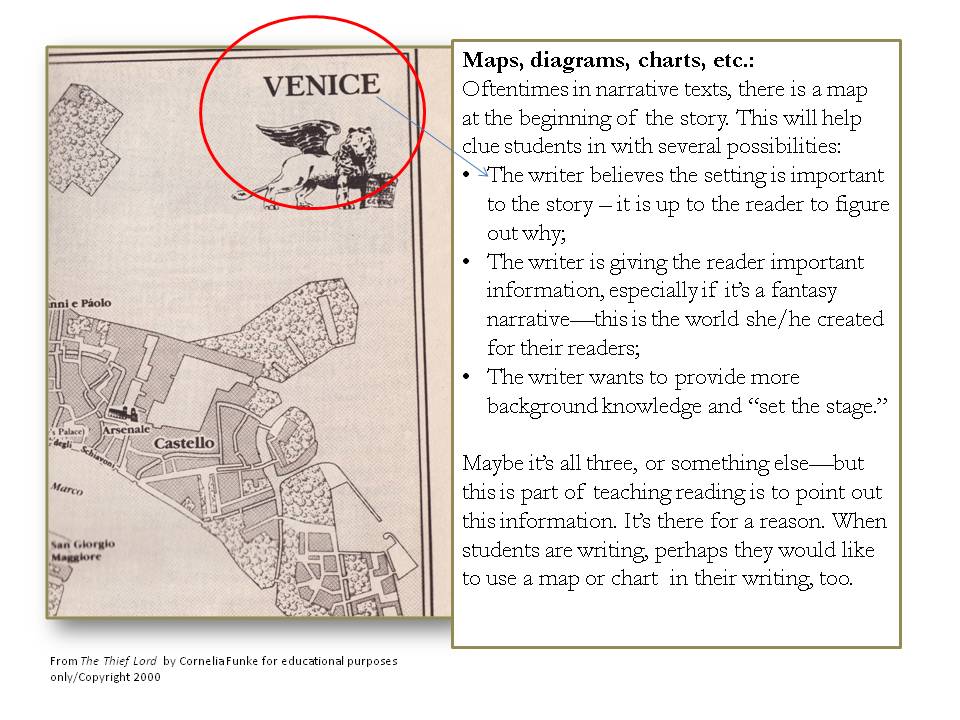
  • The story takes place in Venice. How do I know? This is when you STOP — time to teach some background knowledge:

MapYou can click on this image to view larger, of course. Here’s where some decisions need to be made: depending on your students and access to technology/information, you will want to decide how much you want to give and how much inquiry you want them to create. Here’s the deal, though, with our brains, we love patterns. So, if students get misinformation or misconceptions about what they’re inquring about, to re-wire these pathways will be doubly difficult. Inquiry and constructivism are wonderful tools–but remember, if someone doesn’t know anything about a topic, the potential for missteps grows. Imagine you’ve never been to Venice (like I have never been) or seen a picture, or been on a canoe, or little boat, or imagined a city built entirely around canals, with bridges, and ancient pathways, nooks, crannies, or have ever heard of Italy at all? This is part of a safe environment of learning. It’s okay not to know, but not okay not to learn. (I didn’t know for a long time that the ‘underground railroad’ wasn’t like a subway. I’ve had students who believed the same thing. I had a student from New York City tell girls about subways, and they didn’t believe him. It goes on…)

So, short or long lessons, and time spent on Venice. Your choice, and your students’ needs.

Next, annotating text: I had a big lesson myself when teaching annotating text. Thought students were ‘getting it,’ and doing okay. Asked a girl how her annotating this one Greek story was coming along, and she answered confidently, “great!’ Something told me to stop and ask her to explain the first paragraph. She didn’t know every other third word. Okay, let’s try again – highlight the words that seem confusing. And I tried to sweeten the deal with reaffirming again that the more one reads, the more automatic understanding/fluency becomes, and the more fun it is to read.

Like I said, I can’t read a book anymore in the same way. It’s just now my job means I make my brain processes as transparent as possible so students can look inside my head, so they are better at looking inside theirs.

There are many ways for annoating text; you may decide you want to teach one specific strategy at a time, such as a vocabulary skill for reading comprehension strategy: Vaporetto In this particular example, the word “vaporetto” is used. I’ve never seen that word before, but the image I put together demonstrates some of my thinking process.

Another vocabulary buggaboo are context clues. We assume, too often, that students know more than they do.  For example, this sentence:

“A party of tourists (blank) past the (blank) while their guide described the (blank) above their heads in a (blank) voice.”

There are four words in that sentence that are potential mental gopher holes: shuffled, confessional, mosaics, and muted.

How would you teach those? Have student act out “shuffled,” look up a confessional, make a connection if they’re Catholic or have been to a Catholic church, infer, what a mosaic is, or look it up, and then maybe make one, and make an educated guess (inference) on if they are in a church, would they be yelling in a loud voice (questioning text)? Not one single reading ‘strategy’ can effectively be taught in isolation, but we don’t think ‘in isolation.’

(*The ‘say blank’ strategy is Dr. Schulhauser’s.)

Allusions are one of my all-time favorite concepts to teach, even though inevitably I will be corrected by a student telling me it’s “ILLusion, Mrs. Love, not ALLusion.” Um, well, no, my darling middle schooler, let me continue…) So far I haven’t found any specific allusions in The Thief Lord, although there are plenty of connections. An allusion is a specific reference to another work/character. The connections are abundant. It’s Oliver Twist, The Goonies, and The Pink Panther/Inspector Clouseau to start. But, boy howdy, when you use your strong metacognitive skills and spot an allusion, it’s like a reading golden ticket. Allusions to other works show us that we are not learning in isolation, that we are connected, and our thinking, based on knowledge. Now I can’t get Led Zeppelin’s Immigrant Song out of my head, when Robert Plant wails, “To fight the horde, to sing and cry, Valhalla, I am coming…” If you remember your sixth grade Norse mythology, you know what Valhalla is, and why you may want to go there someday. Or, at least, what the Minnesota Vikings might want to sing in the locker room showers. In my goofing-off summer, there are so many allusions in this game I play, but it makes me laugh when I recognize something, such as little goblin men speaking the words of Elton John’s Rocket Man to each other in conversational tones. (And for the record, Rocket Man is the only song I can sing and score big on Guitar Hero.) Allusions add a richness and texture to our reading/listening/viewing that would otherwise be lacking. Teach them as part of metacognition to students recognize those connections to other works when they read/see/hear them. We all feel smarter and more creative when we do.

Characterization and connections lead me to themes…

But another day. Ciao, bella!

Postscript: If you would like some of the excerpt .jpgs for your own classroom instruction, send me a Tweet @mrskellylove and your e-mail address; that is, if the links don’t work.
In the Zone: Brain research, reading, and responding

swirlEvery teacher worth his salt knows about Piaget and Vygotsky. And I am not going to pretend or fake that I understand everything about their theories on cognitive development. When I was studying their work, it just made so much clear sense, that I embedded a golden nugget into my own brain, and that was this: we learn from our world/each other. The more interaction, or appropriate interaction at the right times in our lives, the better. It doesn’t work for every brain/person, but I’m making a generalization. Take a baby. Cuddle, talk to him, give him safe, warm shelter, (thank you, Maslow!) show him the world, name things, tell stories, and guess what? Baby learns, and thrives. It’s like we’re all born in a bubble – and the bubble gets bigger to accommodate our experiences, memories, and surroundings. We are social creatures.

Now, as much as I would like to get into a diatribe about how poverty, malnourishment, abuse, and fear affects our abilities to function well cognitively, not here, not now. John Medina has gathered all the information you may need if you want to explore this further; the holes in the hippocampus, the amygdala responding to stress, and why you need a nap. The effects of poverty on children’s ability to function are well documented. 

One of the frustrating aspects of my daily life is I cannot go in my time-machine (it needs some parts) and take my students in their toddlers selves and read picture books to them. Many of their parents did read to them, but many were fighting for survival. My students have not been to an art museum, library, park, or attend preschool, or had time with a lot of print (picture books) or see their parents read.

The other factor is even if they did read when they were younger, adolescence brings on its own set of challenges, and becoming a reluctant reader may happen. It is my thought that this happens because playing and succeeding in a video game can be much more satisfying than reading someone else’s narrative troubles in a chapter book. Think about it; if you’re having trouble with girls, your mom’s nagging you about cleaning up your room, and you’re not the cute adorable baby anymore, then who would want to read about Harriet the Spy and her missteps? (Well, I did.) Who gives a darn about Harry and his battles with a stalking, scar-giving lunatic? And for the love of armageddon, what’s so entertaining about a group of kids being stranded on a deserted island, just fighting over a conch shell and what to serve at a luau?

 So, here are some steps I take so that students recognize and reflect on their own reading:

  • Individual reading inventories: Yes–with sometimes 130-160 students this has been a Herculean task. We (teachers) sometimes complain about all of the assessing that is done TO our students, and it is not informing our instruction FOR our students. This is true. But since testing isn’t going away any time soon, let’s use it to our advantage. Show the students exactly what they’re being assessed on, and do your own.
  • Each student should have their own reading portfolio: Include in this a reading interest survey (if you’re ‘techy’ you can do this on line using a myriad of survey sites; however, make sure the results are visually available, tangible – oh, heck, I’ll just say it – have it on a piece of paper, man! It’s not for you, it’s for your students. The whole point is for them to chart and see their own progress.What goes in a portfolio? They should be able to draw on it, customize it, place their own test scores, surveys, reflections, book “wanna-reads” and “have-to reads” lists, creative book projects (I have another ‘boatload’ of these!) and their progress/goals.

Reading coaching, when it’s done well, is an incredible assesst to have in a school. If you are fortunate enough to have a literacy/reading coach in your building, district or state, hunt them down and have a conversation with them!

  • Understanding assessments: There are a boatload* of reading assessments and data numbers out there. Here are just a few, and some thoughts:

DRP: Degree of Reading Power – quick and easy – will really tell you how broad their vocabulary is, which for English language learners, is challenging to get a fair assessment on their reading abilities. But, if this is what you have to work with, again, be very clear and transparent with students about what their scores mean and how to improve them.

DRA: Developmental Reading Assessment: http://www2.scholastic.com/browse/article.jsp?id=10216

Lexile:Lexile measurements are, in my opinion, one of the most accurate assessments out there. Check it out: http://lexile.com/ We had a program in our district which quickly measured Lexile reading levels. It was too expensive, and went ‘away,’ as many great resources do. (Why is that? The ones that we really use and help us help students are canned too fast, while the ones that are confusing linger on, solidly entrenched? Or maybe that’s just me.) You can find out what the Lexile reading level is on many titles with quick searches, but here’s one resource: http://www.barnesandnoble.com/reading-level-reading-books-lexile/search.asp

And then again, there are just good, old-fashioned books that can help you find reading levels: http://www.fountasandpinnellleveledbooks.com/Marketing/resources.aspx

(And if you don’t know Fountas and Pinnell, you don’t know Jack. And you should know Jack.)

AR: AR stands for Accelerated Reader and is a commercially-based program. It may be all right for a thumb-nail sketch of reading abilitiy, but I cannot endorse its use. I can’t tell you how many students I had who would take the AR “test” on a book and through sheer intelligence and cleverness pass the test without cracking the book.

Reading Rockets is also a phenomenal website/resource for all things reading. One article, “A Critical Analysis of Eight Informal Reading Inventories” may be helpful.

The thing is, the real, deep, this is where it matters thing is: You MUST hear your student read, you MUST conference with them, one-to-one. I say this in this strident, finger-wagging way because I am really pointing the finger at myself. But there is no way around it. If you really want to know your students’ individual strengths/weakness in their zones of proximal development, or rather, how big is their bubble, you need to know where they are, and take an individualized measurement.

So, how does one find the time? I am still working this one out, but it takes a lot of mental elbow-grease and planning. No way around it. You must intentionally,  and explicitly, tell students what you’re doing, why you’re doing it, and how it will benefit them. Having said that, I have still had the flare-ups from extremely needy students who interrupt me while I”m conferencing with other students. This may just be the time you let them play computer math games, or use some other electronic babysitter. Hopefully not: other creative solutions are to use this time for them to write, go through a variety of genres/reading materials, and critique what they find. Or, have them work on vocabulary/grammar instruction during this time. A little skill-drill never killed anyone. Really.

Okay – where can it all go horribly wrong?

  • Students will answer with one-word responses: “I hate to read, I don’t read, no, never, etc.” Many of them are doing this for shock value. Let them know and reinforce this is a safe place. You don’t expect everyone will be sitting around cafe tables discussing great literature if that’s not their thing. You just want to give them the CHOICE. They CAN talk about great literature, but they can choose NOT TO when they’re older. But for now, it’s choice time.
  • Students are ashamed of a low test score. True story: had my ‘honors’ students look up and analyze their DRP scores. Many were competitive and compared notes with others, and some were truly embarrassed by a lower than a peer’s score. Explain ahead of time what they might find, and that they may have an emotional reaction, but don’t let that become an obstacle. (Yeah, I have a lot of luck with that – stupid self esteem!)

Finding low-level, but high interest books is a huge factor, too: http://www.readingrockets.org/article/374

Things you should just know before the first pencil is sharpened:

Make sure you believe with your heart and soul that teaching reading, using textbooks, anthologies, maps, diagrams, other content areas, informational texts, narrative texts, poetry, fairy tales, cereal boxes and phone books are all forms of reading, and check your personal biases at the door. Students are looking to you to model a love of reading. If they love you, and they will, they will judge as you do, and be ashamed if they like a book that you have stated you don’t. Let them find their own path, and reflect on their own journey. Nothing is more personal or important than that. Perhaps they will only ever read video game logs or Facebook postings. So be it.

Also, know that reading standards are not evil. If you really look at your state’s and the national standards, they are not out to ‘get you.’ I am one of the most paranoid persons I know, and I believe there is no conspiracy here. It is good and right to teach students about text features in a textbook, or how to access information using a glossary, index, table of contents, etc. It is good and right to teach students the difference between a fable, folktale, and fairy tale. It is good and right to teach students to question and critique writers (including me).

http://www.corestandards.org/

If you need any further inspiration on customizing your students’ reading needs, look no further than Kylene Beers and Kelly Gallagher:

Kylene Beers, especially when Kids Can’t Read, What Teachers Can Do: http://www.heinemann.com/products/0519.aspx

Kelly Gallagher: http://kellygallagher.org/, especially Readacide: http://www.amazon.com/Readicide-Schools-Killing-Reading-About/dp/1571107800

Resources:

Read-Write-Think: http://www.readwritethink.org/classroom-resources/calendar-activities/

International Reading Association: http://www.reading.org/General/Default.aspx

http://ehlt.flinders.edu.au/education/DLiT/2006/Lstyles/Vygot.htm

*”Boatload” in an internationally recognized unit of measurement which means “a lot.”

If I blog it, they will read…

 Field of DreamsI think if I say it publicly, I’ll have to honor the promise to myself to write about reading. Disclosure statement: This is not everything I know about teaching reading, and I don’t know much, paradoxically! My experience is with “average” middle school-aged students, 11 to 15, with a large population of diverse languages, backgrounds, and cultural experiences. (I love it, by the way.) Oh, and they don’t have much money. But we’re not going to let that stop us from a world-class education! Take that, misguided ed reformers!

The thing is, for all of the great reading strategies, they cannot work independently. It’s like explaining how a carburetor works, and tires, and fuel injector, but not explaining all the parts go into making a vehicle GO. So, let’s see if we can build something together–all comments, resources, and insights are welcome!

Monday (later today): In the Zone: Proximal Development and Background Knowledge

Tuesday: The view from here: Understanding a child’s reading interest, abilities, and desires

Wednesday: Dr. Watson, I infer? Using inferences, allusions, connecting, metacognition, and clues

Thursday: Sass Back:  Questioning and talking back to your books/writers

Friday: Reading like a writer, and writing like a reader: How language connects us all

On Friday, I’ll provide a list of some of my favorite professional development books, too.

Now — for some more coffee.