What's in a name?

galileo

From the Writer’s Almanac, February 15, 2010:

It’s the birthday of the Father of Modern Science, Galileo Galilei, (born in Pisa, Italy (1564). It was Copernicus who suggested that it was the sun, and not the Earth, that was at the center of the universe. But Galileo became a famous public defender of that theory, called heliocentrism. The pope and Galileo were on friendly terms, and the pope encouraged Galileo to write a book outlining the controversy. But of course the pope instructed Galileo that he must not promote heliocentrism, and asked that his own beliefs be represented. So Galileo wrote Dialogue Concerning the Two Chief World Systems, which purported to be a debate between two philosophers; but one of the two, Simplicio, sounded stupid, and it was this figure that acted as a mouthpiece of the pope. No one knows whether Galileo deliberately attacked the Pope — it’s probable that he just couldn’t write as convincing of an argument from a philosophy that undermined his own scientific beliefs. In any case, the pope was definitely not a fan of the book, and Galileo was put on trial for heresy. He publicly renounced his views, but he still spent the rest of his life under house arrest, and his books were banned.

Wow.  Talk about your author’s bias and purpose. Remember the other day when we talked about characters, and how writers purposefully and intentionally name their characters? Simplicio? Simple? As in simple-minded? Consider that when we begin fictional narratives in the next few weeks. The characters in your writing all matter, whether they have a major or minor role. And they are your creation–name them accordingly.

One more note: heliocentrism. Remind you of anything? Helios? Hmmmm?

Allusions are no illusions.

Pinchy, from "Lisa Gets an A" episode

In the Simpsons’ episode, “Lisa Gets An A,”, Homer becomes discouraged by the price per pound of fresh lobster, and seeks to “grow” his own lobster for his consumption. However, he bonds with the lobster, caring, feeding, talking to it, and even taking it for walks.

As I’m watching the episode, it strikes me as odd that Homer would grow to care for his potential dinner so much that he would take it for a walk, but it’s funny nonetheless.

As most things, I didn’t realize really how clever the good writers of the Simpsons were at the time, until….

…I was reading Mary Karr’s novel, Lit.

It’s a definitely a “grown up” book–she battles her long-standing deep emotional scars of her past. Her crazy, butcher-knife wielding mother and wild-cat, alcoholic daddy play key roles, and she must come to terms with her own choices, and try to improve on being a wife and mother, before it’s too late. She’s trying to find the power of prayer right now; and it dawned on me, that if you’re battling demons, you probably need a few angels on your side, in whatever manifestation that takes.

ANYWAY…..(sorry). There is a section where she ALLUDES to the father of surrealism, who, YOU GUESSED IT…used to take his PET LOBSTER FOR WALKS.

I thought I bookmarked that passage in my Kindle, but I didn’t. However, because of the POWER OF THE E-READER, I can do a search for “lobster,” and voila! It was “Apollinaire in Paris, just in from walking his lobster down the street on a leash.”

In fact, three instances of the word “lobster” appear in Karr’s novel: 1. lobster grip, location 2167; 2. lobster down the street, location 3392; 3. we boil lobsters and stuff ourselves with…location 4856.

 So, now the reference to Homer being such as Apollinaire in the early 20th century Paris, is even funnier. I get it. And that is the power of allusions – increasing comprehension by increasing and deepening connections.

Now, I am even more curious. Who was the father of surrealism? And who was Apollinaire?

When I searched for the “father of surrealism” I found: http://www.vincesear.com/giuseppe-arcimboldo-father-of-surrealism/

Giuseppe Arcimboldo, who painted paintings such as this example:

 winter1


But, Karr is referring to Guillaume Apollinaire: http://www.poets.org/poet.php/prmPID/737

From continuing research, it seems like he liked to draw poems:

apollinaireToday we call this Shape Poetry.


Want to know more about “surrealism?” Check this out:

http://library.thinkquest.org/J001159/artstyle.htm

Salvador Dali, Henri Matisse, Rene Magritte are a few artists who created in the style of surrealism.

magritte_redmodel

Heureusement pour moi.

Congo

As many of you know, I did not take a straight path to becoming a teacher. I did not set up my stuffed animals and Barbie dolls as if they were in a pretend classroom, teaching them lessons and sending them to Principal Teddy Bear’s office. I did not graduate from high school and go straight to a teacher’s college, such as Columbia, Ohio State, or Joe’s Teach-N-Fix School. So, I wasn’t in a frame of mind to prepare myself for the brave, new world that was coming my way. During my time in high school, the language classes I took were French. Ah, je regrette!

Que devais-je penser?

In our district, there are over 100 languages spoken. Many students come from the gamut of countries where there are few or no opportunities for small economic growth to countries ravaged by war. The majority of students speak both Spanish and English. If I had been thinking in high school, I would have taken Spanish. Spanish is the second most common language spoken in the United States. We would probably notice Canadians, but the majority of them speak English, too. Sans manquer de respect, les Canadiens français.

Needless to say, I never had the opportunity to practice speaking French. I have never been to Paris, France, or even Paris, Texas, for that matter. When Spanish-speaking students whose English skills are on the edge of greatness, but they are still straddling the bi-lingual abyss, I have often wished I had taken Spanish instead to nudge and support them.

But now we have a student who speaks French, from the Congo. C’est fantastique! And my team teacher brought her in yesterday morning to ask me to tell her that school doesn’t start until 8:25.

Uh oh. To say my French was a bit rusty is a understatement. I gestured and said ecole, and huit heure vingt cinq, but I am not sure she understood. I said, Mon nom est Madame Love, and sent her on her way.

And immediately went to Google Translator for other phrases, such as:

I want to practice speaking French: Je veux pratiquer parler français.

and

The building doesn’t open until 8:25: Le bâtiment n’a pas ouvert jusqu’à 8h25.

I can only imagine what this confused, scared, and overwhelmed young lady must think of me, the school, and the U.S. But I want to help. I don’t know if Google translator can handle all of the questions she has, or can help me guide her to all the answers. I don’t even have them myself. But we’ll try. Nous allons essayer de comprendre les uns les autres.

There are other questions, such as, “Why do people in the Congo speak French?” And there we get into cultural diffusion/assimilation: http://edsitement.neh.gov/view_lesson_plan.asp?id=340 and more poignantly, “What is happening in the Congo now?” I know Google can’t answer that.

To try Google translate: http://translate.google.com/#


Thrown.

thrown

I read another blog named “Musings from a Not so Master Teacher” by a teacher named John Spencer. His audience, I believe, is primarily other teachers, so students, many of you may not be interested.

However, consider this: remember what I said yesterday about “filters?” That sometimes you need to get out of your past, and especially your present, and think a little bit into the future, and filter news and information that might benefit or harm yours? (Your future, that is.) Well, this is one of those times, but I’ll do some filtering for you, and give you the big chunks.

He recently wrote a post on competition, using the allegory of a parent talking to a child. (Remember: allegory-when characters/animals/objects represent something larger or other than themselves.) The parent says to the child that the child will receive food, clothing, etc. if they are competitive and earn it. It was just an essay, an opinion, a viewpoint. Mr. Spencer wasn’t suggesting that parents actually withhold food and love from their children. Another teacher wrote lengthy, multiple responses to this post, named Empowered Teacher. I like Empowered Teacher’s blog, too, because this masked-avenger also writes about issues and considerations that affect education. And as you know, dear children, education is a big deal to me.

Of course, I had to weigh in my opinion too. To me, competition isn’t bad or good, it exists, and I believe the most important question is we examine who is making the rules of the game, and then judge to see if the game is worth playing.

That led me to a nighttime conversation in my own mind last night, as I was drifting off: What is my relationship with competition?

Here are a few thoughts:

  • In 9th grade, I tried out for the cheer-leading squad. I practiced for weeks, was able to jump, dance, do the splits, whatever I needed to do. I rocked it. On try-out day, a friend of mine, short, blond, and perky, twisted her ankle and was unable to compete. She got a slot on the squad; I didn’t. Did it have to do with the fact that I was tall, (I wasn’t heavy then,  just tall), had a brown hair, and wore an ugly outfit? Or did the judges (mix of teachers and coaches) know this girl, and liked her, and didn’t know me, and wanted her on the squad? I will never know. Was it fair? No. Was it funny? No, not at the time. What did I learn? That sometimes, it doesn’t matter how hard you try, practice, work, study, etc., someone will still get the object that you desired. I think that perhaps not making the cheer-leading squad was one of the best things that happened to me, because it made me feel more confident and independent in high school. I had to learn to navigate the other 3,000+ personalities on my own, and find my own place and style.
  • Competing with myself: I have always been a hard, creative worker. I love to produce creative projects: writing, paintings, drawings, whatever. I have always been pleased when my hard work “pays off.” The pay-offs come in many forms, though, from getting a job that I wanted, to just feeling internally happy. But here’s the thing: There are many jobs I haven’t gotten. I even was fired once from a waitressing job in Colorado because supposedly I didn’t clean the salad area. This was devastating at the time, because I was living in Boulder, Colorado, and there are thousands of college kids there (University of Colorado). Jobs were scarce. Because another waitress decided she didn’t like me (Why? Have no idea, but another waitress told me) I lost that very rare and much needed job. I had never been fired in my life. My hard work, intelligence and loyalty had always paid off before, so why not now? I ended up finding a job delivering pizzas. My friend/roommate made fun of me because I had to wear brown polyester.

A few weeks ago, while getting my lunch, a few boys had had a tussle, and there was blood spilled. All I saw was two kids who were tired, upset, and hurt. Whatever they had been fighting about must have seemed really important at the moment, so much so  it didn’t stop with words, but physical pain. What were they competing for? Turf? Honor? Milk money?

People who have suffered from a natural disaster usually must compete for basic survival: food,water, shelter. It’s not “looting” when it’s “survival.”

People who come from cold, harsh families have to compete for their parents’ love.

People who are waiting in the grocery store lines are competing for time–heaven forbid if the person in front of them has one too many items in the express line or writes a check. We’re on a fast track! Hurray! Get out of my way!!!

Here’s what I want you to walk away with: the world is competitive. And many times, the rules are not shown or given to you. You have to figure it out. Many times you will do your best, you will be loyal, you will work hard, and someone else will get the job, the girl, or the guy, the house, the place in line in front of you, or the last scoop of tater tots. That doesn’t mean you should ever give up. Do what you love, learn as much as you can, and no one will ever be able to take that from you.


Or, I’m taking my ball and going home.

No excuses book blogs…

Illustration from The Seattle Times

Please don’t ever say to me you can’t find SOMETHING to read. After we’ve exhausted the possibilities in my classroom library, and in the school’s library, you may want to check out these blogs. In reality, you should be checking them out anyway to keep up with new titles, authors you love, new authors, new genres, etc.:

Featured book blog: http://missprint.wordpress.com/

Glancing over a few of the reviews on this blog, I had the feeling that here is someone who really reads the books, and enjoys YA (young adult) literature (that would be you, kids).

One of my other favorite book blogs is: Dog Ear, which goes under the URL: http://nicolepoliti.wordpress.com/

Myth-of-the-Month Club: Janus

Janus My fellow bloggers out there in the technosphere have taken up the challenge to write a post-a-day on their blogs for the month of January. (“I can do that!” Mrs. L thought to herself.) So what if there’s laundry to do, meals to prepare, and holiday decorations to take down? I can do this! Or can I?

And like any good resolution, which is also part of the “resolve” word family (resolution, resolve, resolute) I am going to give it my best.

But I needed a theme. I love themes. Those are the universal truths and connections among all cultures, societies, time, and beliefs that allow us not to float away, untethered, distracted, or isolated.

Don-da-da-da! (That’s supposed to be trumpets blaring):  The theme for January is the “Myth of the Month Club.” Each day I will feature a myth, legend, folktale, deity (remember? polytheism? deity? gods…goddesses…demi-gods, etc.? Come on…you remember, right?) And what better or more appropriate way to start off January with that two-faced deity himself, doesn’t know if he’s coming or going, looking back to look forward, JANUS!

Roman god of doorways, gates, and transitions, who faced forwards and backwards. The name January comes from the name of Janus. Janus statues show twin faces. – http://ancienthistory.about.com/od/religionmyth/ig/Greek-Mythology/Janus.-_Qs.htm


Two-faced rock.
Two-faced rock.

Janus imitates its two-faced Greek god namesake by catching light on two sides.

The brighter side of Janus is lit by the sun while light reflected off Saturn dimly illuminates the rest of the moon and reveals the non-spherical shape of this small satellite.

This image has been scaled to twice its original size. This view looks toward the leading hemisphere of the Janus (179 kilometers, or 111 miles across). North on Janus is up and rotated 22 degrees to the left.

The image was taken in visible light with the Cassini spacecraft narrow-angle camera on Feb. 12, 2009. The view was obtained at a distance of approximately 1 million kilometers (621,000 miles) from Janus and at a Sun-Janus-spacecraft, or phase, angle of 112 degrees. Image scale is 6 kilometers (4 miles) per pixel.

Janus is one of Saturn’s (the planet) satellites (moons).  Remember, Saturn is, in mythology, the old man who grunts and grumbles at Baby New Year. It is no accident that French astronomer Audouin Dollfus who discovered this tiny, two-faced moon in 1966 named it Janus.  Janus and Saturn are connected to the same myth: that time turns, we look to our past, and to our futures, all at the same time, in the present moment.

Here is another thought about Saturn:

Vouet completed the piece “Father Time Overcome by Hope, Love, and Beauty” (1627).: 

Old Man Time

(I’m not sure if time can be overcome by love, beauty, and hope. That’s what is advertised to us. If we buy wrinkle cream, we HOPE that we will still have BEAUTY and we can keep LOVE.)

In any case, Happy New Year. Like Janus, I think it’s important to honor the past, learn from mistakes, and appreciate the experiences we’ve gained, while simultaneously looking forward to the future.

Charting your journey.

tuareg-tribesman-libya-052009-sw

This article link content is NOT about your personal  beliefs, or mine.

It is about what we talked about (briefly) the other day — in addition to books, poetry and songs can also help us find answers to our questions–they speak to us. Another path is reading what other great thinkers/philosphers reflect upon, and consider. This article has three minds considering an historical figure, and the possible significance, all from their own cultural perspectives.

If you read this article, consider the questions the writers were attempting to explore. I don’t say “answer” because rarely do we find definitive answers to anything- life is all about exploration. That’s what makes it interesting.

Consider that when you are seeking answers – be open-minded, flexible, and critical – what is the person saying? What is their purpose for saying it? And, what is your deeper purpose for reading it?

Fire good. (Or Saturn, Snow White, and Baby New Year share a Yule Log.)

Feeling mighty low...

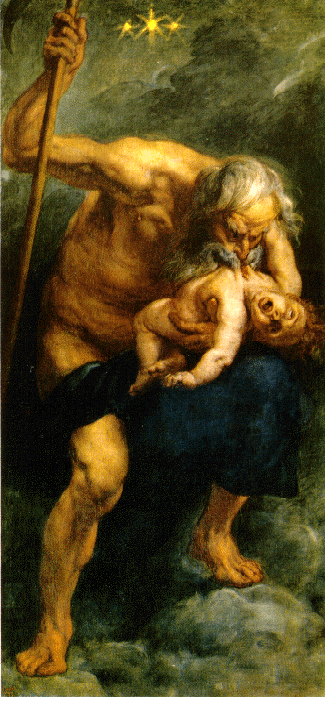
I have a hemispheric bias. I understand my northern hemisphere, its traditions, and its quirks. We northerners personify the dark days.When I see an image of Chronos/Saturn using one of his children as a midnight snack, it’s a metaphoric munchie , and innately I understand its cultural roots and the darkness of December–it’s time eating our lives.

It is near logical to me that people, in their complete and “advanced darkness” (thanks, Spongebob) would make finding out when the darkest day of the year would be a really…big…deal. Time to cut down some evergreen branches and put another log on the fire. Heck, sacrifice a young maiden if you need to, it’s dark! We want light! Sun, come back! Come back, sun!! I can set my Stonehenge to it.

And how do I connect Saturn to Snow White? When the Queen, with one tenuous hold on her youth and beauty, all due to the subjective whims of a rhyming mirror, decides that the ebony-haired beauty, with nary a grey hair or wrinkle,  is encroaching on her territory, well, then, Snow’s heart is the price she must pay! What is it with older folks symbolically ‘eating’ the young? Hey, dude, I can buy an i-Pod too – so what if I break a hip trying to dance to it?

Enter Baby New Year. Crackling. Colicky. Cranky. Abandoned by old man Saturn, this kid grows up all over again on his own, to learn the same lessons, to touch the burning stove again, and stick the proverbial fork in the proverbial light socket repeatedly. No wonder why we never learn anything, really.

chronos2

Both Chronos/Saturn and the Queen should have a chat, compare notes. Getting older isn’t all that bad, is it? Reminiscing on past triumphs and errors–it’s as someone said: “It all works out okay in the end. If it’s not okay, it’s not the end.” I can’t think of a more paradoxically optimistic/pessimistic quote as that one.

The sun will come out tomorrow.

 National Geographic Winter Solstice 2009 Link

The Writer’s Almanac Winter Solstice Link (December 21, 2009)

In the northern hemisphere, today is the Winter Solstice, the shortest day of the year and the longest night. It’s officially the first day of winter. It’s officially the first day of winter and one of the oldest known holidays in human history. Anthropologists believe that solstice celebrations go back at least 30,000 years, before humans even began farming on a large scale. Many of the most ancient stone structures made by human beings were designed to pinpoint the precise date of the solstice. The stone circles of Stonehenge were arranged to receive the first rays of midwinter sun.

Science World

Hey, you, get off of my cloud.

Impulsivity + Meanness=Regret.

I am still trying to find forgiveness for something I did when I was about seven or eight years old. When I was on the playground, one cold, crisp Texan school yard afternoon, the bell rang, and we went to line up. One of my classmates, a sweet, shy boy, while running to line up, was tripped by me. I impulsively stuck out my leg, and down he went. The look on his face when he was getting up was so sad – the meanness was so unexpected, so abrupt, that I knew, I knewI had done something near unforgivable. I will never forget the look on his face. (I know I helped him up, said sorry, but the damage was done.) I am the one who provided that kid with the experience of people are jerks, and sometimes do cruel things for no reason. Yea, me.

Since I can’t find the little boy (who’s obviously not little anymore) that I tripped in first grade, since the vast detective work of Google, Bing, or others will not find this one soul out of billions, and, I don’t remember names, exact dates or locations, I may never be able to find him and say, “I am sorry. I acted rashly, impulsively, but it may have hurt your feelings, and you still may remember it, and it hurt you for a long time.” 

Sharing this anecdote with students, one girl commented (several times), “that’s mean, Mrs. L,” until I finally had to say, “Yes, I know…it was mean, and I regret it, feel guilty and remorseful every time I think of it. Now let’s move on.” I would like to think that one act of impulsive, yet intentional bullying was out of character for me. That perhaps I was just ‘trying it on,’ and answering an inner curiosity about what is it like to do something wrong…totally, and absolutely outright wrong. But that sounds like a lot of mental justification.

 Trolling for interesting podcasts the other day, I came upon a This American Life episode called “Mind Games” that made me think about how people treat each other, and how if it’s based on lies, it usually doesn’t work out. At all.

This led me to listen to another episode from May, 2002, titled ‘Devil on My Shoulder.’  The premise or theme is that we humans are in constant struggle to choose right versus wrong, moral versus immoral behaviors, and we have so many outside influences pushing us, tempting us, this way and that, that sometimes we are compelled to blame it on a ‘devil on our shoulder,’ feeding us tiny lies and whispering small, but powerfully motivating ways to act unkindly. While my personal philosophy doesn’t include a personification of immoral judgements sitting on my left shoulder, I do believe in a dash of free will along with decision making, cognitive abilities thrown in with a cup of destiny, frosted with fate. Meaning, whether or not you believe in devils and angels, deities and do-gooders, we humans are still faced with the burning question, “what does it mean to do the right thing, and why do we sometimes NOT?”

 When I think about what I did, my heart hurts. That’s guilt. I might be a bit mired (stuck) in this one event, true. I am not sure why I’ve had difficulty finding atonement. If one of my children did something like this, I would tell them to learn from it, not to behave in a mean way again, and move on. So, I guess in that way, perhaps if I took my own advice, I can say I did learn from it. I never tripped anyone else again, and certainly never intentionally hurt anyone again. I just hope that somewhere out there, that boy knows I am sorry.bored angel

“Safety and happiness can only come from individuals, classes, and nations being honest and fair and kind to each other.”-CS Lewis


Tumble. Polish. Shine. Repeat. Any questions?

ThumblerTumbler-1Many patterns in teaching and learning emerge over time. The pattern of knowing what you don’t know is one of those long-term, polishing-a-rock patterns.  Every time you, my students, take a test, write a paper, talk about a book you’ve read, or create reasons why you didn’t, you give me answers. You answer questions such as, “does she understand how to generalize?” “Does he know what this word means?” “How can I help them understand an abstract concept such as making an inference?” And the time-honored, “?” written on a test or quiz. Even knowing when you don’t know something is helpful to me, so I can help you.

I just finished reviewing your latest reading assessment. Here’s what I know now: Most of you know more than you think you do, but you’re still struggling on how to express it. Also, many of you  need help working on big ideas, such as “what does it mean to generalize information?” or “is this a reasonable conclusion?” I guess many adults are not asked to perform such higher level thinking as we demand of eighth grade kids.  You are little diamonds in the rough, my gems, and let’s bring out your best! It’ll take some time, but teaching is truly a patient, faithful process…I need to believe that if you don’t get it now, someday you will. Otherwise both of us will be ground down for not much but some fool’s gold. Your knowledge and education is your mental gold, and you want the most ka-ching!! as possible. It’s worth it to put forth your best effort, and have faith in yourself, too, and patience.

These are your gems of wisodom for today.