Summer Series of Saves: S.O.S.

I am going on my twelfth year at the same Title I middle school. That is not said as a martyred projection or badge of honor, but a statement of fact, circumstances, decision making, and choices. Every teacher I know has had a rough time this past decade. Some have gone to “easier” schools, or districts, where they found a comfortable home. Some have expressed to me survivor’s guilt, and some have ‘ghosted’ our friendships, probably because working at a school like mine is hard, and it takes an emotional toll, causing me to leak out stress. Occasionally those leaks become straight-up tsunamis. I don’t blame them for not wanting to be around me: I don’t want to be around myself sometimes.

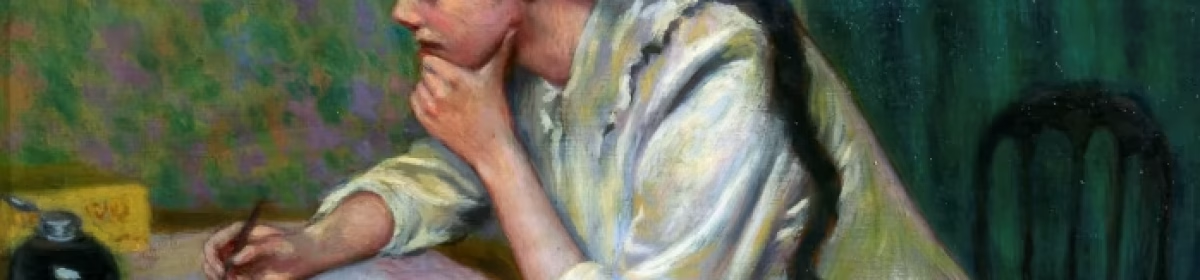
This video got to me. She maintained her composure while rubbing her hands, refocusing on her paper, and staying the course, to its climatic ending of her resignation. Her paper may well have been a white flag, and her hands in surrender. When my husband watched it, he commented how he knew I had felt this same level of pain.

No one is to blame for this: administrators do their best, district-level personnel want and desire excellence. However,  in the championed cause of “students come first” the heads of teachers become the stepping stones across this mighty gulf. Teachers are sometimes not considered the human connection between student and world, but merely the middle management, with no real authority. And some teachers do not deserve respect. I would wager, though, that any social-emotional well-being for teachers is considered superfluous. Teachers should just ‘have it.’ If you’re a parent, you know that the hardest job in the world is given to amateurs, (as my dad likes to say), and so is teaching. We make mistakes: but dang, so do our students. So how do all of us learn to do better?

We are never to take anything personally, always build relationships, and create safe places. And we do. Or we try to. But being human, we have amygdalas, too: keeping in control of our frontal cortexes in the moment is challenging. The smatterings of misogynistic, sexist, ageist, and disrespectful things said to me by a small group of students is nothing compared to the national stage of police violence, political decrepitude, and social media bruising. But I am still charged with teaching ‘soft skills’ in a world so racist and vile it hardly seems to matter.

We were all feeling something this year. No matter who you voted for, or if you didn’t vote at all, something shifted, violently and without justice.

Maybe it’s time we’re honest with one another. If we reach out for help. platitudes and trope quotes won’t help. Prayers and thoughts are sweet, but not helpful. Listen. Truly listen. Good advice: click the link.

One of my favorite episodes –not so much hope, but we are all of us in this together:

Grow up.


https://www.facebook.com/plugins/video.php?href=https%3A%2F%2Fwww.facebook.com%2Fviralthread%2Fvideos%2F824556247717060%2F&show_text=1&width=560

This was a post from TeenVogue on Facebook this morning.

Now: TeenVogue is amazing. Its editorial and content have been one of the few media sanctuaries for many of us, young and old, in these troubled times. The magazine tackles politics, social justice, and yes, fashion issues. Its holistic approach to youth and news is refreshing.

But dang, kids, really? Ageism? 

My 8th-grade students often comment on how fast I type and text. I learned the QWERTY method when I was a sophomore, in a room full of electric typewriters, staring at an overhead projector screen with our typing tasks for one full semester. Since keyboards and keyboard layouts remain in this configuration, I can still type pretty dang fast. My highest typing speed is around 75/80/WPM. They also marvel at how I can type and not look at the keyboard. I confess I do need to look at the cell phone’s “keyboard” when I text, but I manage just fine.

My mother, in her 70s, has worked for technology companies from the beginning. My father, in hospital equipment sales. My husband is a self-taught programmer, UX designer, and technological pioneer: in fact, he and I both bristle at the term “digital natives” and want to bring in more use of ‘digital pioneers.’

We’ve both noticed the subtle but constant ageism when it comes to technology: ultimately these fixed mindsets and assumptions about “old people” and what they don’t know about technology becomes boring, and take away from creative pursuits. For the commenter who said “I literally had to show my mom where the right click button was” all you showed your mom was contempt, and now if she’d like to try some new things she’ll think twice. Glad she didn’t say that to you when you were learning how to ride a bike or brush your teeth. “I literally had to show her where to put the toothpaste!”

Sigh.

Look, I’m a huge defender of younger generations. I caution myself toward falling prey to Juvenoia,  and try to take risks with new ideas and learning. I don’t want to be afraid to ask students to help me with Snapchat, (which I have, and they’ve created a monster, and now I use it in creative lessons), nor do I want them to be afraid to ask me how to type a five-page short story formatted for publication.

I’m working on the digital curriculum for next year, and it’s kind of a big deal. We all can learn from one another: ultimately, we’re trying to make connections and communicate. Rock, paper, scissors or keyboards, we’re all doing the best we can.


Saving Summer: Our country, tis of thee….

This September, right from the get-go, around Constitution Day (which falls on a Sunday this year), I shall share a unit on the Declaration of Independence, sparked by this exchange.  And it’s here, too. 

And from this thread, I learned so much.

//platform.twitter.com/widgets.js

So folks didn’t know that NPR’s annual reading of the Declaration of Indepence was just that: a reminder of what our nation is founded upon, what were the reasons for the Revolutionary War, and throwing over a tyrannous ruler.

Here is the first draft of potential discussions, lessons, etc.

[embeddoc url=”https://blog0rama.edublogs.org/files/2017/07/Declaration-of-Independence-Discussion-1ssdvbq.pptx” download=”all” viewer=”microsoft” ]

Saving Summer: Where the Stories Are

https://giphy.com/embed/r8GaguhRgiwH6

via GIPHY

If you follow the Notice and Note site on Facebook (and why are you still reading this if you’re not?!), you will see many teachers asking for recommendations on a variety of themes, theme topics, units, and niche text recommendations for a variety of grade levels and kids. It’s fantastic.

There are many places to get good stories and texts, and here are just a few:

Open Culture

//platform.twitter.com/widgets.js

Book Riot:

//platform.twitter.com/widgets.js

CommonLit

Free texts — how awesome is that?

BrainPickings

Excerpts, recommendations, etc.

Project Gutenberg

Thousands of free books and other texts.

Actively Learn

You can control a variety of texts and upload Google Docs and links from the Internet.

NPR-Ed

https://www.facebook.com/plugins/post.php?href=https%3A%2F%2Fwww.facebook.com%2Fpermalink.php%3Fstory_fbid%3D966672790139913%26id%3D402441646563033&width=500

Podcasts: (make sure age appropriate)

These are a smattering of my favorites:

And if you browse for ‘free short stories’ over a million entries come up:


Saving Summer: Let's dance.

https://www.facebook.com/plugins/video.php?href=https%3A%2F%2Fwww.facebook.com%2Fajplusenglish%2Fvideos%2F993745847433589%2F&show_text=0&width=560

What about an enduring understanding about the history of dance as an answer to societal issues?

Possible Teaching Point: Music and dance are considered humankind’s earliest language. Dance speaks with the whole body and the whole community. In order to understand culture, society, and communication in physical forms we must study the effects and purposes of dance in social justice, protests, and acknowledgment of community’s needs.

Question: Do you think people should focus on dance over violence, and if yes, how should the message spread?

Here are some resources that may help you if you wish to put together a unit on dance and its place in human communication. This could easily lend itself to a Humanities/Physical Education cross-content unit.

Beyonce’s Formation is annotated in this article in the Washington Post by Yanan Wang.

//www.washingtonpost.com/video/c/embed/869d749c-ce88-11e5-90d3-34c2c42653ac

Published on Apr 14, 2016

Seattle Dances in Solidarity with Standing Rock.

https://embed.ted.com/talks/camille_a_brown_a_visual_history_of_social_dance_in_25_moves

https://embed.ted.com/talks/the_lxd_in_the_internet_age_dance_evolves

https://embed.ted.com/talks/trevor_copp_jeff_fox_ballroom_dance_that_breaks_gender_roles

Though these movies get a lot of play, I’m including them as a contrast for discussion with students. What is being ‘protested’ in these movie clips? Does the majority of white actors influence the lack of gravitas or does it make any difference?

One idea that lingers for me is the dance scene from the Titanic: the third class steerage looks like they’re having so much more fun than the stuffy dinner party:

Saving Summer: Fake News (Revised)


https://giphy.com/embed/3VSM58Eu7kR4A

via GIPHY

(Northwestern me in the summer…)

For summer, between walks and mini extensional crisis, I shall produce a series of posts designed to curate some of the key and critical ideas.

First up: Fake News.

A few weeks ago, I fell trap to a fake news story. As my husband says, the amygdala is the boss. Wait. The Amygdala is the Boss. My amygdala took over, after the daily onslaught of anxiety-dipped 31-flavors of horrors froze my brain, and I posted a story (about a hate crime that may or may not had taken place) and a friend (whom I frequently joust with regarding politics) called me out on it. Imagine my embarrassment. However, our unwavering vigilance needs reinforcement, what with the take-over of multiple news outlets spouting the same thing, the news is no longer journalism but continued, biased rhetoric.

The Resources and Lessons:

Possible teaching point:

Gathering credible, verifiable information is critical in making decisions, including life or death decisions. Understanding how writers and sources manipulate readers into believing falsehoods and lies are critical to survival. In order to know the difference between truth, facts, and opinions, and fake news from credible journalism, many factors must be understood and analyzed. 

  1. Find four news stories, two fake or questionable, and two from a reputable site.
  2. Review Fact, Opinion, and Truth.
  3. Discuss how fake news uses all three to bolster their credibility.
  4. Use the Fact, Opinion, and Truth annotation/note document. Change the left column into the articles you’re using.

[embeddoc url=”https://blog0rama.edublogs.org/files/2017/07/fact-opinion-truth-2ignpez.docx” download=”all” viewer=”microsoft” ]

https://www.facebook.com/plugins/video.php?href=https%3A%2F%2Fwww.facebook.com%2FWIREDNational%2Fvideos%2F10154815910728721%2F&show_text=0&width=560

And I got this link from the Notice and Note site:

http://factitious.augamestudio.com/#/


Other ideas:

  1. Have teams of students challenge each other with fake and credible news stories and determine which ones are which.
  2. Students find important articles and discuss why people want to believe them. What is the nature of these beliefs? Fear? Cultural? Monetary? Then – have students write credible journalism to counter the fake.
  3. Make it matter: students need to be able to share what conspiracy theories they think might be real and do the research.

Disrupting Thinking: Why How We Read Matters by Kylene Beers and Robert Probst


Add graphic literacy, too!

https://www.facebook.com/plugins/video.php?href=https%3A%2F%2Fwww.facebook.com%2FTEDEducation%2Fvideos%2F1655113627835170%2F&show_text=0&width=560

Pledge.

These are to re-read, read, and organize: the binders need to be gutted and reorganized. Oh, sticky tabs and Sharpies: how I love thee.

I always have this summer break lag–it takes me a bit to realize it actually is break time, and not only relax, but reflect. And just not think at all.

Last summer I had everything planned out, and offered my time and expertise to go over the CCSS and come up with a menu of critical ones I knew our PLC should take a look at and consider for the common/formative/assessments. Well, that didn’t work, and that’s okay: the team decided to focus on one skill through the lens of one or two standards. Am I going to stop coming up with ideas? Did I learn my lesson? Nah. I can’t help myself. I love designing good curriculum.

Next year I’ve been tapped to construct Computer Essentials for 7th grade, and will be teaching only one class of 8th ELA. (Just can’t quit you, Humanities….). To say our students need the computer skills is an understatement. (I’ll post my ideas on that later.) In the meantime, this post serves as a pledge to myself to read: I have the trifecta of my summer: a hammock, sometimes blue sky, and time. My focus is to create a curriculum map that is more reflective of what ELA students are truly expected to know. The horizontal, silo-approach doesn’t work. I’m actually envisioning a circle map, updated, and global: a way to teach units that are connective and authentic, with a heavy dash of choice and design. Give me a week or two, and I’ll have something figured out.


Oh, and I need to add some new videos to the list:

What is one thing you taught more than one year, and feel it is a “must?”

"Fear less, build more."

This post is dedicated to my crazy teacher friends who try everything they can to help our students, even at the expense of their colleagues’ goodwill. Based on a recent email thread, we’re all trying so hard, but we’re trying too hard alone.

That has to change.

Do you have departmental/content issues? Does the history department turn up their noses at the math teachers or is the elective crew treated like a tertiary annoyance? Supporting our colleagues is more than bringing in a few shoeboxes and glue sticks. It requires deep, drilled-down communication and understanding, and allows for every department to support and connect with one another. Of course, an administration is an integral part of an overall vision: communicating to staff may require multiple messages, reminders, little check-ins of how the vision is progressing once the vision has been shared. It doesn’t mean lockstep. It doesn’t mean one size fits all. It doesn’t mean one ring to rule them all, either. Throw that garbage in the fires of Mordor and carry on, Samwise.

It does mean that departments are talking to one another, and know an overall vision of the school Like other PBL projects before, the Zombie unit was the 8th grade ELA department’s attempt, and we learned a lot. We have some refinement to do, and it was clear based on all of us whose students had more time to dig in, whose students had someone helping with hands-on skills, and whose had lipstick “infection” marks on their faces and played tag (cough).

When everything is important, everything becomes jammed up: think of a school day more like well-run traffic and flow engineering, or flocking science: when kids can move with a flexible, responsive schedule, or when a big PBL project is being conducted, perhaps that is the day when there is a shift in time; better yet, they can go to each class and work and consider through that lens.

(Students are trying to avoid predators, after all–aka going to class.)

It’s going to require some brave teachers and administration to put aside egos and come to solutions that are best for students. We have the skill sets and the drive to do something like what Emily Pilloton does with her girls. We need to include all, however. I am wondering if we have the will. 

Can we build this together?

https://www.edutopia.org/article/changing-who-gets-make-world-tom-berger

Girls’ Garage’s slogan, “Fear Less, Build More” is an appropriate anthem for our times.

http://girlsgarage.org/


Preparations for departure…


We have one more week of school.

Laptops are being returned on Monday. (Thank goodness. I’m tired of battling the distraction.)

The students have been irritable, anxious; some who began with some growing to do, some maturity to gain, have regressed. Some have grown. That’s middle school: they have a few short weeks between now and the looming monster that is high school. (I doubt many of them have my option of hiding under a cabinet, listening to Dark Side of the Moon for hours. In the dark. With bucket headphones. And a bad haircut.)

My two sons experienced at least one fantastic real-life voyage in their lives, away from the tedium and mediocrity–one went to France for his senior trip, and one to Costa Rica (with his dad). But most kids don’t have access to trips outside of their own apartment courtyards. Many are riddled with anxiety they can’t name for fear of being disloyal to their hardworking parents and the guilt for feeling envious of how the media portrays summer. If I can tell them one thing before they go: it’s a lie. We make our own magic.

Some folks encourage boredom for kids, with advice to privileged parents to “let” their kids be bored. And though I see where this advice is coming from and would be cynical of me to think it comes from a place solely of privilege, in a way it does. Many of my students have plenty of chances to be ‘bored’ simply because the expectations in summer include watching siblings, cleaning. They do not include safe rolling parks to gaze up and imagine cloud shapes, nor long hikes in local national parks with sturdy REI hiking boots and toxicity-free mosquito repellent.

Boredom is not the same as drudgery. Boredom leads to flow. Creative constraints lead to production (a paradox, but yes, giving oneself boundaries encourages creativity, not dampens). Drudgery leads to despair and anxiety. So how do we sell students, no matter their status or privilege, think and grow their brains, breaking out of drudgery chains?

Idea List:

  1. Get a notebook. Use the composition notebook I gave you. Clean up your notes, and annotate what you thought about.
  2. Make a list of 50 things you want to do this summer.
  3. Have a dance party.
  4.  Think of a problem or conflict you have, and brainstorm ways to solve it using math, science, writing, drawing, etc.
  5. Keep five blog/websites handy: http://www.kerismith.com/
  6. Give yourself a ‘creative constraint’ such as no phone or another electronic device for one hour, and
  7. Learn origami. Learn how to tie a Windsor knot. How to serve proper British tea.
  8. What do words like ‘colonialism, social justice, imperialism, etc.’ mean?
  9. Come up with a new exercise routine.
  10. Learn about another religion, country’s history, or why a news story may have impact
  11. Find three old black and white ‘film noir’ films to watch — what do you notice? Does the absence of technology affect the plot? How? Ask a lot of what if questions.
  12. Start a book club with one or two friends, or join Goodreads.
  13. Learn about Japanese bookmaking.
  14. Make your own Illustrated Interview about yourself, or one of the members of your family

https://static01.nyt.com/video/players/offsite/index.html?videoId=100000004033427

 Even if you don’t have access to a computer over the summer, you can and should sketch this out on paper first.
What else? Any other ideas you can share would be most welcome!

Wish.

I wish I could tell you about my students.

The one who brings home books to her brothers from my classroom library.

The one who desperately tries to ignore the loud ones.

The one who understood completely when I said how many students let others dictate their love of learning.

And the one who did the memoir project, both the written and the podcast version, and asked me not to share.

To me, it was This American Life, Invisibilia, and StoryCorp level amazing. Perhaps, even more amazing because she didn’t have producers, writers, engineers, or Ira Glass prompting her on. Just me, telling her (and everyone) “just tell your story.”

It is enough.

More than enough.


I’ve used my goodwill on all-staff emails. There is no time, nor is it on the agenda, to share in a PLC. I know, and I can tell her thank you. I won’t think about the smell of blackberries or the lack of smell of sunflowers again.