“Humans have always shared the world with animals and, as prehistoric cave paintings attest, animals have always exerted an endless fascination over people’s minds. We have hunted animals, worked with them, and even worshipped them.” —The Illustrated Book of Myths, Tales and Legends of the World retold by Neil Philip.
Queztzalcoatl is the Mayan bird/serpent god who started off as “perfect good.” He was so good, in fact, his brother, Tezcatlipoca, was rather put off by his sibling’s insufferable righteousness. Long story short, Queztzalcoatl ends up in the Land of the Dead, and returning to create mankind out of his bones and blood. He helps them navigate their way through learning how to grow maize, polish jade, weave, and become great artisans.
Then it was time to go; humans needed to fend for themselves. This is one of the most perfect explanations for a deity’s absence I have ever read. “You can do it, folks! Promise! I have given you all the tools you will need to build a happy, peaceful existence for yourself!”
But…if he returns, does it signal the end of the world, or another renewal?
Circles, rings, and spheres encompass us all. The dog will circle his bedding before he lies down. We spin around, we measure in degrees of 360, we affect change in concentric patterns. The ring will go on the finger to seal a promise of fidelity. The crop circles will be seen from vantage points before mankind had the technology to witness them. And, at one time, we were afraid of falling off the edge.
As if.
Rings signal to the world, “Hey–look! I am connected to another soul!” Or, “Hey, look at me! I’ve got too much corn and need to trample it down in artistic mega-scale patterns!” But perhaps, “Hey, Martians! The landing strip is over here!” is the best reason for a circle. Crop circle, anyway.
Other things come in circles, too: fairy rings, Stonehenge, circles of life, and of course, pi.
Or pie.
pi = 3.14159265
P.S. My ring says “infinite potential” on it, stamped in the silver. It reminds me that anything is possible.
As long as there has been a collective consciousness, dragons have ridden on our dreams. From China, to Europe, Scandinavia, to Africa, dragons have embodied power, strength, and perhaps the most important symbolism: freedom from obedience. Dragons do what they want to, when they want to, and how they want to.
We know that storytelling is one of the greenest energies on earth; yes, our stories are recycled. From the story of Perseus saving Andromeda from that rock and sea-serpent, we get the quintessential St. George rescuing the fair maiden from the cave, guarded closely by a nasty dragon.
What about from the dragon’s perspective? It’s ALWAYS about the princess! Can’t a reptile get a break around here? The dragon will forever represent uncontrolled power, muscle without heart or intellect. The dragon represents our “lizard brain” inside of us. Dragons are dangerous. It’s my theory that people dug up dinosaur fossils eons ago, said to themselves, “Uh-oh…hope these creatures still aren’t hanging around!” and though they did not know the paleotologists’ theory that dinosaurs basically become birds over time, early humanity was onto something with that whole flying dragon thing. I love when a plan comes together!
(But, like good storytelling, nothing is ever that linear; there is no clear-cut path. My theories are sociological in nature, not paleontological, and might be as squished as our poor friend, Mr. Archaeoteryx here:)
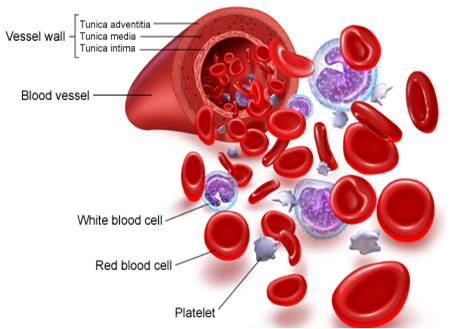
Blood, sweat, and tears–three bodily fluids that represent our lives, efforts, and emotions.
If you review any resource on mythology and simply search for “blood” you will discover almost 200 findings. Mixing these three together creates a powerful potion. It is our primordial soup.
Origin myths use these three elements for the emulsifier of many a great beginning:
The first living thing was P’an Ku. He evolved inside a gigantic cosmic egg, which contained all the elements of the universe totally intermixed together. P’an Ku grew by about 10 feet each day. As he grew he separated the earth and the Sky within the egg. At the same time he gradually separated the many opposites in nature male and female, wet and dry, light and dark, wet and dry, Yin and Yang. These were all originally totally commingled in the egg. While he grew he also created the first humans. After 18,000 years the egg hatched and P’an Ku died from the effort of creation. From his eyes the sun and moon appeared, from his sweat, rain and dew, from his voice, thunder, and from his body all the natural features of the earth arose.
So, it wasn’t which came first, the chicken or the egg, it was P’an Ku.
The combination of the words, “blood, sweat, and tears” is also an idiom for something that requires monumental effort, but is usually worth it at the end. There is a battle, there is exertion, and there is heartbreak/disappointment, but all of these sacrifices will be rewarded. But you don’t have to cry about it.
According to Joseph Campbell, it’s essentially this arc:
There is a call to adventure–refusal of the call–crossing the threshold–initiation–road of trials–belly of the whale—add a dash of apotheosis, atonement, fight that final battle, receive a little rescue from without, cross the return threshold, get the ultimate boon, become master of two worlds, and voila! Hero!
But the hero is more than just a man or woman on a trip around the game of Life. The hero does the thing that the community cannot do for itself. However, the hero is not perfect. The hero has flaws, which his or her naysayers, detractors, and antagonists will work to remind us all for the eternity that the heroes’ good deeds live on. Words like “sacrifice,” “mentor,” and “quest” are commonplace in our vernaculars, and may have lost some of their deeper meanings.
A few months ago, my students worked very hard to dig out the themes of the journey of the hero during a class discussion. I worked very hard to keep my mouth shut, so I could let them struggle, squirm, and think on their own. And their thinking was brilliant. They said the theme of the journey of the hero is “people need to believe in the power of hope.”
Mind you, there were no photographs of Abe Lincoln, President Obama, or Dr. King during the discussion. There were no mass-market media messages displayed in the room.
And that, to me, is the real power of a hero. That their struggles, fight, battles, message, and meaning lives on, even when they’re not in the room.
Just about every belief system has some sort of official “time out” for its believers. And it seems the further we detach ourselves from each other, through technology, busy-ness and business, and the electronic and technological strangulating hugs (yes, my laptop has a grip on me like an anaconda dancing with a capybara), we can barely breathe anymore–we’re being loved to death by our own inventions and ways of life.
Taking these times to re-focus on our beliefs takes many forms. For some, it’s Friday evenings, others Saturdays, some Sundays, and some a combination depending upon sun-up and sun-set. Some take a few times a day to re-focus their thoughts on their beliefs and faith, others have intermittent rituals throughout the day, week, or month, and year.
Regardless, perhaps you should also take some time for yourself. It’s not selfish. It’s a good thing. As I was reminding a student the other day, you have to put your own oxygen mask on first in order to help others survive.
Breathe.
Find a few moments each day where you demand nothing of yourself, and others ask nothing from you. Just be. Even if it’s for 30 seconds. Don’t write, talk, call, ask, laugh, or consider.
The archetypal Jack is mischievous. He is the joker, the wild card, the surprise, the one with the spark. He starts things, but seldom finishes them. He is restless, fidgety, edgy, but not anxious. He’s not worried about anything, he just wants things to move along.
He is known by many incarnations: Jack O’Lantern, Jack the Pumpkin King, Jack Skellington, Jack Black, Jack Springheels, Jack and the Beanstalk, nimble, jumping over candles Jacks, Jack Sparrow, Jack Frost, Jack of Hearts, Diamonds, Clubs, and Spades; he’s Jumpin’ Jack Flash, Jack Sprat, Jack of “Jack and Jill,” and the house the Jack built, the man Jack,not to mention Little Jack Horner who sat in a corner…
Little Jack Horner sat in a corner...(Illustration by Arthur Rackham)
Jack jumps. Jack jostles. Jack juxtoposes and jiggles.
It is uncharacteristic of him to be reflective, or remorseful, as one of my favorite Jacks, Jack Skellington of Nightmare Before Christmas fame:
There are few who deny,
At what I do I am the best,
For my talents are renowned far and wide
When it comes to surprises
In the moonlit night
I excel without ever even trying
With the slightest little effort
Of my ghost-like charms,
I have seen grown men give out a shriek
With a wave of my hand
And a well-placed moan,
I have swept the very bravest off their feet!
Yet year after year,
It’s the same routine
And I grow so weary
Of the sound of screams
And I Jack, the pumpkin king,
Have grown so tired of the same old thing…
We have all know a “Jack” at one time or another. He is seldom the muscle, but the brains; quick-witted and high-spirited, Jack is, and will always be, the friend we need to help us bend the rules.
In Norse mythology, Yggdrasil is the tree that represents all levels of above, middle, and below for mankind:
In Norse mythology, the World Tree called Yggdrasill runs like a pole through this world and the realms above and below it. Yggdrasill is a great ash tree that connects all living things and all phases of existence.
Trees represent life, growth, and perhaps greatest of all: potential. Trees symbolize strength, honor, as well as other less-attractive human qualities such as jealousy, greed, and death:
Trees—or the fruit they bore—also came to be associated with wisdom, knowledge, or hidden secrets. This meaning may have come from the symbolic connection between trees and worlds above and below human experience. The tree is a symbol of wisdom in stories about the life of Buddha, who was said to have gained spiritual enlightenment while sitting under a bodhi tree, a type of fig.
Two sacred trees—the Tree of Life and the Tree of Knowledge of Good and Evil—appear in the Near Eastern story of the Garden of Eden, told in the book of Genesis of the Bible. God ordered Adam and Eve, the first man and woman, not to eat the fruit of either tree. Disobeying, they ate fruit from the Tree of Knowledge and became aware of guilt, shame, and sin. God cast them out of the garden before they could eat the fruit of the Tree of Life, which would have made them immortal. Thereafter, they and their descendants had to live in a world that included sin and death.
A traditional Micronesian myth from the Gilbert Islands in the Pacific Ocean is similar to the biblical account of the fall from Eden. In the beginning of the world was a garden where two trees grew, guarded by an original being called Na Kaa. Men lived under one tree and gathered its fruit, while women lived apart from the men under the other tree. One day when Na Kaa was away on a trip, the men and women mingled together under one of the trees. Upon his return, Na Kaa told them that they had chosen the Tree of Death, not the Tree of Life, and from that time all people would be mortal.
Odin's Ravens: Huginn (Thought) and Muninn (Memory)
Oops. Kind of puts a whole new spin on “poison apple.”
Grumpy, apple-throwing talking tree from the Wizard of Oz
Humans need trees, and yet our relationship with them has been somewhat strained, at best. Humans who try to help the environment are lambasted as “tree-huggers.” I wonder what would happen if they actually did talk, threw apples at us, or used their switches for a humanity-spanking. What if they could walk and wage war like the mighty trees in the Lord of the Rings? It’s all the trees’ fault. They just don’t grow fast enough for the speed of humans. We needs our houses NOW. We need our teak tea trolleys NOW. We need our toothpicks NOW. (Say the NOW in the voice of Veruca Salt.) Trees measure the planet by their own standards, not man’s, and those two cultures clash. Can trees have a culture? Well, personification aside, perhaps. They are such an important part of our survival and existence on this planet, that perhaps they deserve to be revered, perhaps even worshipped. We have not done a very good job of being their caretakers, but they have not faltered in their gifts to us.
We climb trees. We live with trees. We use their breath for our breath, and they use ours. We should never use trees for harm, or for death. In the words of the late, great Shel Silverstein:
Once there was a tree….. and she loved a little boy. And every day the boy would come and he would gather her leaves and make them into crowns and play king of the forest. He would climb up her trunk and swing from her branches and eat apples. And they would play hide-and-go-seek. And when he was tired, he would sleep in her shade. And the boy loved the tree…….very much. And the tree was happy.
Pandora’s “box” is a modern invention going back only as far as Erasmus. According to Hesiod, the evils of all men were shut up in a storage jar (pithos) buried in the ground. This is connected by some with the Athenian festival of pithoigia, – when the great vats (pithoi) of new wine were opened. Perhaps that’s really where all mankind’s troubles spring from! [from wine, not Pandora] She, as the first woman, created after man, is sometimes compared to Eve in Hebrew myth. Pandora was originally a title of the goddess Rhea (the name means all gifts) – but the story of Pandora and her jar (not box) was probably an anti-feminine invention of the poet Hesiod.
Curiosity killed the cat, you know.
This is all about curiosity, or disobeying orders. It’s about how women cause trouble when they think for themselves, and keeping it all in a box, jar, back-pack, purse, pantry, or Rubbermaid storage container is where it should all stay.
Now, in the words of my mom, wait a red-hot minute. I’m a little tired of the ‘blame-game.’ Life is always a balance between:
Following the rules or…
Taking a risk
Following your heart or…
Thinking it through
Seeing what’s behind Door #3 or…
Taking the prize that’s offered.
The brand-new, first woman on earth is given a box/jar, depending on which snooty professor’s of mythology version you want to believe. (I am always suspicious when anyone has the “definitive” translation of anything that’s over five minutes past–you can’t trust all communication; things get lost in translation.) Cut the girl a break! It was a GIFT! Her name means ALL GIFTS, for goodness sakes! What was she supposed to do? Return to sender? C’mon. So now we can conveniently blame ALL OF MANKIND’S TROUBLES ON GIRL’S DECISION TO OPEN A BOX?!?! Yeah. Well, I’m going to grab my keys, lipstick, and I’m outta here.
There’s always hope.
You go, girl.
(Don’t get me started on the apple thing. A piece of fruit shouldn’t take down all of humanity. It was a team decision.)
Pixies are described as small fairies, sprites, beautiful, exquisite little magical beings, who usually intend no harm. They can be mischievous, and though they can be tricksters, they are usually helpful and just darn cute.
More elegant than elves, funnier than fairies, and luckier than leprechauns, Pixies are charming: how can anything that has been known to turn into hedgehogs at will be anything less than sweet, like a big stick of flavored sugar in a plastic tube?
Now you may be wondering why I have an image of a Na’vi from the movie Avatar.
Pixies?
It’s a stretch of a connection, but see if you can follow my thinking:
Pixies are very much into nature. So are the Na’vi. Pixies might be blue as are some Na’vi. Pixies are sprightly, agile, and athletic. Again, the comparison continues. What does it matter that the Na’vi are over 7′ tall, and Pixies are reportedly about 7″? They’re also both make-believe.
There is some controversy over the design of the Na’vi. Are they representing another race, the noble savage, is their depiction as a humanoid (part human, part another species) an affront to our earthly creators?
Hardly. Let’s not overthink this one, folks. Remember–we keep telling the same story again and again? Tales of springy little sugar-sprites being driven from their woodland homes, with no other defenses than to curl up in a ball, quills outward, is nothing new.
I think they are just pixies, and proportionally sized to their planet, Pandora. (By the way, the allusionary explanation regarding Pandora is on its way.) Even the name Pixie conjurs images of little things: leaves crunching. Frost on pumpkins. A lavendar petal unfurls. Things found only nature-made, not from a factory. A fireflies’ constellation.
Pixies: flavored sugar, no redeeming health benefits, just fun. Pure fun.
The Pixies
Little known fact about me: we have had two hedgehogs. One was named Juju, and the other SugarPop. They were both pooping pin-cushions. Not the best pets we ever had, but maybe we weren’t meant to own pixies.