And the Oscar goes to…

oscar-the-grouchThe Movie-in-a-Minute three-day blitz of movie making was successful. The best and worst of personalities came to light: the divas, dignitaries, and documentarians did their best. There were production over-runs, technical and emotional meltdowns, but I’ll be darned – they all completed it. Every single kid. And cared about it, too, and were worried and anxious if it didn’t seem like it was going to get done!

Now, I’m scratching my head. I told them this wasn’t graded. Why did they all do it, and do a really good job, and recognize where improvement is needed with honesty and accuracy? We teachers all know about motivation and engagement, but again I ponder – what have we been doing to kids? I asked one young lad, who has been having a lot of discipline issues over the past few months, why? Was he so afraid of failing that he just wouldn’t do anything? I am not kidding – he asked me if that was a trick question. Another student had to translate it for him. He wasn’t sure. He thought teachers just had it “in for him” and that’s why over time he just stopped doing assignments.

Now, I can’t make everything un-assessed (is that a word?). That’s not realistic for life. But for those of us who not only met the rubrics and mattrices of the world, but SOUGHT them, to measure our worth and value against them (yes, fellow over-achievers, I’m looking at you), what does this mean for many of our students who not only do not seek these measurement tools, but buck and fold beneath their weight? How can I tell them that most of the time, these measurements are just bloated, full of hot air, puffed up monsters?

I was very emotional last night over some small mistakes over a recent assessment I’ve taken. I mean, I was distraught. My husband for the umpteenth time had to remind me it’s a missile I’ve fired, fireworks that have been launched, and keys in the lava…baby, it’s GONE. And then all of a sudden, enter Miss Epiphany….NONE OF THE MISTAKES I MADE HAVE ANYTHING TO DO WITH HOW I AM AS A TEACHER. Not. A. Single. One.

So–perhaps we can let our students know–none of the mistakes you make have anything to do with you, either. They’re just a way to learn. They’re your mistakes, along with your successes. Both teach us. But who we are, well – that’s for you to measure.

Movie-in-a-minute

movie clapboardWhat does one do with a flirtatious, frisky, and fidgety group of 8th grade students?

Well, what would Spielberg do?

He would make a movie, that’s what.

So, the challenge: In three days’ time, form a production company, write a script, cast parts, rehearse, film, edit, and post a one-minute film.

But it can’t be just some advant-garde staring-at-a-blank-wall-because-I’m-so-darned-full-of ennui-thing. Oh, contraire, Pierre! Zat ees not sineemah! It must have EXPOSITION! CONFLICT! RISING ACTIONS! CLIMAX! And, of course, a serving of resolution and dénouement, YOU! So far, so good. Aside from a few teachers understandably and respectfully requesting the enthusiastic filmmakers quiet their oeuvres,production seemed to run fairly smoothly. From what I can tell, we’re going to run the gamut; everything from re-enactments, documentaries, random dancing, saloon brawls, you name it. It’s going to be grand.

Story starters.

Did you know that sourdough bread has ancestors?

It’s true.

There is a yeast mixture that is passed down to start the next batch of baking. I don’t understand much about it. We had some hippy friends a few years ago who proudly showed us their jars of opaque, bubbling concoctions of ancient yeast. The location or origin of the yeast also affects taste and texture. Who knew?

sd_starter_good

Anyway, this isn’t about how to make traditional sourdough bread. It’s about story starters. How do we get our writing moving, taking “starters” and watching our ideas rise into something new and delicious?

This moring, while reading the “paper,” (which isn’t on paper, it’s on a computer screen. Can’t wrap fish in it, but hey, I don’t have any fish, so it doesn’t matter) I found these three stories:

The first one is about some sled dogs that broke free of their sled, and were rescued a few days later.

http://seattletimes.nwsource.com/html/nationworld/2010643281_dogs31.html

The second is about the symphony that may go on strike.

http://seattletimes.nwsource.com/html/thearts/2010642769_symphony31m.html

The third is about a fancy-schmancy famous restaurant in New York city that is going out of business.

http://seattletimes.nwsource.com/html/businesstechnology/2010642784_tavern31.html

There is always a ‘story behind the story,’ or even a completely new narrative waiting to be written. If those dogs could talk, what were they saying to one another? If the instruments of the musicians had something to say, what would they say? How do they feel about their musicians going on strike? And, the restaurant? How many couples got engaged there? How many tears were shed over a broken heart? How many tourists saved up every last penny just to eat, no…dine…there once in their lives?

Now get started and write.


Charting your journey.

tuareg-tribesman-libya-052009-sw

This article link content is NOT about your personal  beliefs, or mine.

It is about what we talked about (briefly) the other day — in addition to books, poetry and songs can also help us find answers to our questions–they speak to us. Another path is reading what other great thinkers/philosphers reflect upon, and consider. This article has three minds considering an historical figure, and the possible significance, all from their own cultural perspectives.

If you read this article, consider the questions the writers were attempting to explore. I don’t say “answer” because rarely do we find definitive answers to anything- life is all about exploration. That’s what makes it interesting.

Consider that when you are seeking answers – be open-minded, flexible, and critical – what is the person saying? What is their purpose for saying it? And, what is your deeper purpose for reading it?

Fire good. (Or Saturn, Snow White, and Baby New Year share a Yule Log.)

Feeling mighty low...

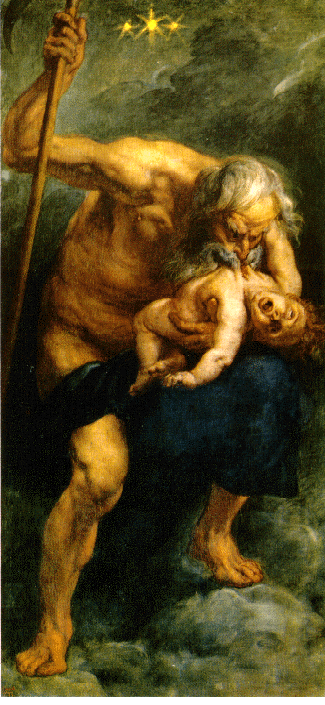
I have a hemispheric bias. I understand my northern hemisphere, its traditions, and its quirks. We northerners personify the dark days.When I see an image of Chronos/Saturn using one of his children as a midnight snack, it’s a metaphoric munchie , and innately I understand its cultural roots and the darkness of December–it’s time eating our lives.

It is near logical to me that people, in their complete and “advanced darkness” (thanks, Spongebob) would make finding out when the darkest day of the year would be a really…big…deal. Time to cut down some evergreen branches and put another log on the fire. Heck, sacrifice a young maiden if you need to, it’s dark! We want light! Sun, come back! Come back, sun!! I can set my Stonehenge to it.

And how do I connect Saturn to Snow White? When the Queen, with one tenuous hold on her youth and beauty, all due to the subjective whims of a rhyming mirror, decides that the ebony-haired beauty, with nary a grey hair or wrinkle,  is encroaching on her territory, well, then, Snow’s heart is the price she must pay! What is it with older folks symbolically ‘eating’ the young? Hey, dude, I can buy an i-Pod too – so what if I break a hip trying to dance to it?

Enter Baby New Year. Crackling. Colicky. Cranky. Abandoned by old man Saturn, this kid grows up all over again on his own, to learn the same lessons, to touch the burning stove again, and stick the proverbial fork in the proverbial light socket repeatedly. No wonder why we never learn anything, really.

chronos2

Both Chronos/Saturn and the Queen should have a chat, compare notes. Getting older isn’t all that bad, is it? Reminiscing on past triumphs and errors–it’s as someone said: “It all works out okay in the end. If it’s not okay, it’s not the end.” I can’t think of a more paradoxically optimistic/pessimistic quote as that one.

The sun will come out tomorrow.

 National Geographic Winter Solstice 2009 Link

The Writer’s Almanac Winter Solstice Link (December 21, 2009)

In the northern hemisphere, today is the Winter Solstice, the shortest day of the year and the longest night. It’s officially the first day of winter. It’s officially the first day of winter and one of the oldest known holidays in human history. Anthropologists believe that solstice celebrations go back at least 30,000 years, before humans even began farming on a large scale. Many of the most ancient stone structures made by human beings were designed to pinpoint the precise date of the solstice. The stone circles of Stonehenge were arranged to receive the first rays of midwinter sun.

Science World

Taking stock.

One of my BFFs recently posted her highlights of her summer, most, if not all, included time spent with friends and family. Her wonderful words made me stop and think what would I be grateful for about these past few weeks? I need to step out of the mud miring the beginning of this school year, forget about all the people who say, “oh, you get summers off!” and show some gratitude and count some blessings.

Before I can get to the chewy center, though, I need to get this off my chest: teachers get the summers off because our students do. We are not paid. We are not under ‘contract.’ We are on a forced vacation. Many teachers take summer jobs. Many teachers teach summer school. Most teachers do some sort of professional development, paid for out of their time and pocketbooks. If I added up the hours I spent working during the school year, it would equal any high-level executive, including being accessible to students practically 24/7 on e-mail, voice mail, and in person before or after school (unless of course I am in a meeting, which is often the case…we have meetings to talk about how to help students while the students are standing outside in the cold, literally and figuratively). I put in my time well beyond my contract day, and I love my job, so it doesn’t feel like a sacrifice or burden. And, one of the reasons I became a teacher (as opposed to going back into a higher-paying position) was I knew the sacrifice of salary would allow me to spend time with my family, too. So, fine. Yes. I’m lucky to have ‘summers off.’ But it is kind of hard to be a teacher when the students are not there! Most schools in the United States still run on an agrarian calendar, meaning we don’t have school when the children need to be working the farms with their parents. What? You say you don’t have a farm? Oh.

Anyway, here are the highlights of my summer:

  • Meeting new friends during my three-week writers’ workshop
  • Discovering the UW campus at that workshop
  • Seeing my youngest sister and her family
  • Having our portraits taken by a talented photographer who captured a beautiful photo of me and my two sisters (my parents will LOVE it!)
  • Enjoying time in Texas
  • Being there when my grandmother had her 90th birthday
  • Getting the garage cleaned out and finding all of my Halloween decorations for a spooky October this year
  • Learning how to make glass pendants
  • Reading some great books
  • Spending time with my dad
  • Learning about a variety of good news from friends and colleagues
  • Getting some of my sleep issues taken care of
  • Spending time with my boys and my husband, and actually having time to cook meals, talk, and enjoy each others’ company (this isn’t last because it’s the least important, it is the most important one of all, and supports everything else I do)

So, it’s time to enjoy the mental ‘harvest’ I’ve collected over the summer, and use it to nourish me throughout the school year. I am honored to be a teacher, and get to meet this next group of young adults. See you soon!

Creativity as a commodity…

Biscuits

Here’s my burning question of the day, and of my life: Can anyone be creative? It has always been my belief that yes, anyone can be creative. What do you think?

First, I think we need to think about what is your definition of creativity. It’s kind of like your definition for what you find beautiful, painful (emotionally anyway: I think we can all agree that anything that involves blood or bruising is physically painful), or interesting. Creativity comes from inspiration, from thinking, from connections, and I must say–admiration of others’ creativity. Is that mental or artistic stealing? Only if you claim the idea as your own. Would you want others to take your flashes of genius and steal them from you? (I didn’t think so.)

Moving forward – you’ve now defined what creativity means to you. Do you think you have some? How do you know? If not, why not? Creativity is another form of curiosity, of inquisitiveness, and we all know curiosity killed the cat. If you’re not a cat, you have nothing to worry about. The point is to ask questions…and then seek answers that may satisfy.

Where some of my frustration sets in is when I get jealous of other people’s creativity and their successes that go along with it – the great book that someone else wrote, the breathtaking painting that someone else produced, the movie script that is the funniest thing I’ve ever seen. I think, actually, a lot of us get frustrated that we’re not rich and famous due to our creativity, so we give up, and settle for mediocrity and boring routines. If you feel yourself mentally flatlining, shake things up! Find out why others created what they did, and find your own spark. Creativity builds on connections.

I believe we all have a level of creativity to share, simply because we are all individuals that take up our own space, time, and energy. And I guarantee you, you do. Prove it to yourself.

You've got style, babe…

You know, my Washingtonian darlings, you won’t start school until Monday, August 31. And you will complain, although I have it on good authority you’re actually excited to be back. It’s okay. You don’t have to tell me.

Anyway, one of my favorite cousin’s sons has already started ninth grade English. I’m not sure if he’s in honors or not, but my cousin asked me if I could help him with an assignment. Apparently, his class is reading Alas, Babylon and Lord of the Flies. I have never read Alas, alas, but I am fascinated and fond of Lord of the Flies.

Lord of the Flies by William Golding

He asked me to help him develop questions based on stylistic elements of literature. Um, yeah. That was kind of like asking me to pull apart the richness of a thick, gooey, chocolate cake with chocolate chips, chocolate frosting, and a side of chocolate–LOTF is so rich with symbolism, motifs, allusions, allegory, foreshadowing and all-around awesomeness of writing, it’s almost impossible to pull it all apart–but not totally. This is the challenge of discussing amazing literature–novels, short stories, poetry–all deep and interesting texts that connect us as humans. Lord shows us that we, in our deepest hearts, can be cruel, savage, and bloodthirsty bullies. It also shows us that evil may take many forms, but it can be fought: when it’s left unchecked, our society and connections fall apart.

Oops. This wasn’t about me writing a thesis paper on Lord of the Flies. It was about finding and understanding literary terms, so you can apprecitate, understand, and desire reading:

Fairly comprehensive glossaries of literature terminogy: http://classiclit.about.com/od/literaryterms/Glossary_Terms.htm

http://www.virtualsalt.com/litterms.htm

Embrace your literary style.

Ooo-ooo– another literary terms website that, well, rocks: http://www.tnellen.com/cybereng/lit_terms/

Don't Irritate Your Readers…

Frank Conroy:  He directed the Iowa Writers’ Workshop for 18 years. He once scolded a student for using irrelevant details in her short story.

 He said: “The author makes a tacit deal with the reader. You hand them a backpack. You ask them to place certain things in it — to remember, to keep in mind — as they make their way up the hill. If you hand them a yellow Volkswagen and they have to haul this to the top of the mountain — to the end of the story — and they find that this Volkswagen has nothing whatsoever to do with your story, you’re going to have a very irritated reader on your hands.”