Thrown.

thrown

I read another blog named “Musings from a Not so Master Teacher” by a teacher named John Spencer. His audience, I believe, is primarily other teachers, so students, many of you may not be interested.

However, consider this: remember what I said yesterday about “filters?” That sometimes you need to get out of your past, and especially your present, and think a little bit into the future, and filter news and information that might benefit or harm yours? (Your future, that is.) Well, this is one of those times, but I’ll do some filtering for you, and give you the big chunks.

He recently wrote a post on competition, using the allegory of a parent talking to a child. (Remember: allegory-when characters/animals/objects represent something larger or other than themselves.) The parent says to the child that the child will receive food, clothing, etc. if they are competitive and earn it. It was just an essay, an opinion, a viewpoint. Mr. Spencer wasn’t suggesting that parents actually withhold food and love from their children. Another teacher wrote lengthy, multiple responses to this post, named Empowered Teacher. I like Empowered Teacher’s blog, too, because this masked-avenger also writes about issues and considerations that affect education. And as you know, dear children, education is a big deal to me.

Of course, I had to weigh in my opinion too. To me, competition isn’t bad or good, it exists, and I believe the most important question is we examine who is making the rules of the game, and then judge to see if the game is worth playing.

That led me to a nighttime conversation in my own mind last night, as I was drifting off: What is my relationship with competition?

Here are a few thoughts:

  • In 9th grade, I tried out for the cheer-leading squad. I practiced for weeks, was able to jump, dance, do the splits, whatever I needed to do. I rocked it. On try-out day, a friend of mine, short, blond, and perky, twisted her ankle and was unable to compete. She got a slot on the squad; I didn’t. Did it have to do with the fact that I was tall, (I wasn’t heavy then,  just tall), had a brown hair, and wore an ugly outfit? Or did the judges (mix of teachers and coaches) know this girl, and liked her, and didn’t know me, and wanted her on the squad? I will never know. Was it fair? No. Was it funny? No, not at the time. What did I learn? That sometimes, it doesn’t matter how hard you try, practice, work, study, etc., someone will still get the object that you desired. I think that perhaps not making the cheer-leading squad was one of the best things that happened to me, because it made me feel more confident and independent in high school. I had to learn to navigate the other 3,000+ personalities on my own, and find my own place and style.
  • Competing with myself: I have always been a hard, creative worker. I love to produce creative projects: writing, paintings, drawings, whatever. I have always been pleased when my hard work “pays off.” The pay-offs come in many forms, though, from getting a job that I wanted, to just feeling internally happy. But here’s the thing: There are many jobs I haven’t gotten. I even was fired once from a waitressing job in Colorado because supposedly I didn’t clean the salad area. This was devastating at the time, because I was living in Boulder, Colorado, and there are thousands of college kids there (University of Colorado). Jobs were scarce. Because another waitress decided she didn’t like me (Why? Have no idea, but another waitress told me) I lost that very rare and much needed job. I had never been fired in my life. My hard work, intelligence and loyalty had always paid off before, so why not now? I ended up finding a job delivering pizzas. My friend/roommate made fun of me because I had to wear brown polyester.

A few weeks ago, while getting my lunch, a few boys had had a tussle, and there was blood spilled. All I saw was two kids who were tired, upset, and hurt. Whatever they had been fighting about must have seemed really important at the moment, so much so  it didn’t stop with words, but physical pain. What were they competing for? Turf? Honor? Milk money?

People who have suffered from a natural disaster usually must compete for basic survival: food,water, shelter. It’s not “looting” when it’s “survival.”

People who come from cold, harsh families have to compete for their parents’ love.

People who are waiting in the grocery store lines are competing for time–heaven forbid if the person in front of them has one too many items in the express line or writes a check. We’re on a fast track! Hurray! Get out of my way!!!

Here’s what I want you to walk away with: the world is competitive. And many times, the rules are not shown or given to you. You have to figure it out. Many times you will do your best, you will be loyal, you will work hard, and someone else will get the job, the girl, or the guy, the house, the place in line in front of you, or the last scoop of tater tots. That doesn’t mean you should ever give up. Do what you love, learn as much as you can, and no one will ever be able to take that from you.


Or, I’m taking my ball and going home.

No excuses book blogs…

Illustration from The Seattle Times

Please don’t ever say to me you can’t find SOMETHING to read. After we’ve exhausted the possibilities in my classroom library, and in the school’s library, you may want to check out these blogs. In reality, you should be checking them out anyway to keep up with new titles, authors you love, new authors, new genres, etc.:

Featured book blog: http://missprint.wordpress.com/

Glancing over a few of the reviews on this blog, I had the feeling that here is someone who really reads the books, and enjoys YA (young adult) literature (that would be you, kids).

One of my other favorite book blogs is: Dog Ear, which goes under the URL: http://nicolepoliti.wordpress.com/

Where are we going, and how are we going to get there?

mayflower-ship-ny-stewart-707610-102809-xl

Sometimes the toughest part of my job is deciding what to teach next. It’s a matter of  balancing what you need, what you will think is interesting (so you’ll stay motivated), and having personal enjoyment out of my day, too. I know that’s selfish of me, but trust me, if I’m happy, we’re all happy.

Many of you asked what our next unit was going to be. Let me tell you that question both enchanted and terrified me. How awesome it is that you want to know! How horrible it might be if I don’t come up with something really amazing, entertaining, and captivating! (Cue Mrs. L screaming and laughing hysterically at the same time…)

Mrs. L can be a crazy lady sometimes.

So, I am still struggling with “less is more.” (That is a paradox. We will be reviewing figurative language and its importance next week, and adding some new figurative language terms to your knowledge bag.)

Less is more means if we focus closely on one thing at a time, we get more out of it in the long run. So, in theory, spending a few weeks on the Journey of the Hero helps us go deeper with our understanding, and we can take that learning with us for the rest of our lives.

Let me just say a few things about that unit: there were huge successes, and one big failure. The failure, an “epic fail,” if you will, was that many of you did not even read one book for the unit. Your spotty attendance, lack of interest, or struggling with reading, all got in your, and my, way. Remember, the first and most important rule in my class is to never read something because I tell you to. You must identify your purpose for reading, think about the big questions, and read. It’s just that simple. Your purpose for reading during this past Journey of the Hero/Transformation of the Hero unit was to witness a character going through changes, making choices, and changing from the beginning of the story to the end.

You may need to make some brave changes yourself.

The huge successes were that many of you totally, absolutely, got it, and proved it in your essays. (Which I will finish grading once I’m done blogging — a girl’s got to have her priorities, you know.)

Your writing was spectacular. I know I pushed: I left some of the thinking/questions open-ended, more vague, but you really stepped up and demonstrated that you can think for yourself, you can feel uncomfortable and still take a risk. I couldn’t ask for anything more.

The student behaviors that you should value are asking questions, demanding to know why, and not accepting anything less than my best effort, or yours.

So, for this next unit, and units from now on, you will be given more time to read in class. I don’t know why I keep having to learn that lesson repeatedly, but I do. Now, many of you not only read one book, you read several. But for me, it’s not the quantity that matters but the understanding you take away. (Although the more you read, the more you learn, and the more you learn, the better you learn how to learn…huh?)

Insert Knowledge Here.

Here’s a preview of what’s next:

*Figurative Language: understanding the powerful uses of figurative language in your reading and writing is one of the best tools you can master. Figurative language is the language of poets, thinkers, artists, and communicators of all stripes and polka-dots: it includes metaphors, similes, euphemisms, paradoxes, alliterations, personification, idioms, cliches, analogies, allegories, oxymoron and my all-time comic book favorite, onomatopoeia:

bam

*Context Clues: Context clues are specifically about understanding and widening your vocabulary. Here’s the idea: You know words. But you need to know more. If you know more, your ability to read faster and understand more of what you read increases:

 An average American three-year-old has mastered about 1,000 words. By the time he reaches adulthood, this average American will have known between 30,000 and 60,000 words.

Now, you may be asking yourself, “why is reading so important, anyway?”
That’s a good question.
Why don’t you list that as one of your:
*BURNING QUESTIONS! Yes, I have devoted about two weeks to developing your independent reading lives, possibly three weeks. We’ll see how it goes. Once you know how to develop your own reading lists and do the projects independently, you will be released to read on your own.
Card-27---El-Corazon
You may have too many resources to choose from, and our goals will be to narrow down the lists, be focused, read, read, read, and talk/write about what we’re reading.
Oh, and add “listen” to the list, too. You will be listening, looking, and using your other senses to take in information about the world around you; this is all about you: making sense of your world, for your life.
*Mythology, legends, fables, folklore, and fairy tales: We’re going to get started on that, too. When? Not sure. It bugs me to start new units in the middle of a semester, but you know what? We are not bound by the arbitrary rules of time and space! We can decide our own pace, our own course, and have freedom of choice! Hooray!
Here’s what you need to start packing: Finish your Burning Questions Resource Log sheet. Start scoping out different blogs, websites, podcasts, and book sites for a list of what you might want to read. Think about what you’re curious about, things you just want to know, and let those questions be our guide.
jiminy_140x143
See you soon!
For a list of classic literature to help you gain greater vocabulary and background knowledge, check out this list:

Fire good. (Or Saturn, Snow White, and Baby New Year share a Yule Log.)

Feeling mighty low...

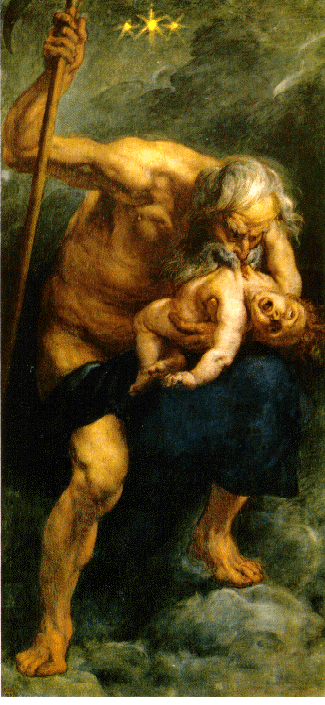
I have a hemispheric bias. I understand my northern hemisphere, its traditions, and its quirks. We northerners personify the dark days.When I see an image of Chronos/Saturn using one of his children as a midnight snack, it’s a metaphoric munchie , and innately I understand its cultural roots and the darkness of December–it’s time eating our lives.

It is near logical to me that people, in their complete and “advanced darkness” (thanks, Spongebob) would make finding out when the darkest day of the year would be a really…big…deal. Time to cut down some evergreen branches and put another log on the fire. Heck, sacrifice a young maiden if you need to, it’s dark! We want light! Sun, come back! Come back, sun!! I can set my Stonehenge to it.

And how do I connect Saturn to Snow White? When the Queen, with one tenuous hold on her youth and beauty, all due to the subjective whims of a rhyming mirror, decides that the ebony-haired beauty, with nary a grey hair or wrinkle,  is encroaching on her territory, well, then, Snow’s heart is the price she must pay! What is it with older folks symbolically ‘eating’ the young? Hey, dude, I can buy an i-Pod too – so what if I break a hip trying to dance to it?

Enter Baby New Year. Crackling. Colicky. Cranky. Abandoned by old man Saturn, this kid grows up all over again on his own, to learn the same lessons, to touch the burning stove again, and stick the proverbial fork in the proverbial light socket repeatedly. No wonder why we never learn anything, really.

chronos2

Both Chronos/Saturn and the Queen should have a chat, compare notes. Getting older isn’t all that bad, is it? Reminiscing on past triumphs and errors–it’s as someone said: “It all works out okay in the end. If it’s not okay, it’s not the end.” I can’t think of a more paradoxically optimistic/pessimistic quote as that one.

The sun will come out tomorrow.

 National Geographic Winter Solstice 2009 Link

The Writer’s Almanac Winter Solstice Link (December 21, 2009)

In the northern hemisphere, today is the Winter Solstice, the shortest day of the year and the longest night. It’s officially the first day of winter. It’s officially the first day of winter and one of the oldest known holidays in human history. Anthropologists believe that solstice celebrations go back at least 30,000 years, before humans even began farming on a large scale. Many of the most ancient stone structures made by human beings were designed to pinpoint the precise date of the solstice. The stone circles of Stonehenge were arranged to receive the first rays of midwinter sun.

Science World

Hey, you, get off of my cloud.

Impulsivity + Meanness=Regret.

I am still trying to find forgiveness for something I did when I was about seven or eight years old. When I was on the playground, one cold, crisp Texan school yard afternoon, the bell rang, and we went to line up. One of my classmates, a sweet, shy boy, while running to line up, was tripped by me. I impulsively stuck out my leg, and down he went. The look on his face when he was getting up was so sad – the meanness was so unexpected, so abrupt, that I knew, I knewI had done something near unforgivable. I will never forget the look on his face. (I know I helped him up, said sorry, but the damage was done.) I am the one who provided that kid with the experience of people are jerks, and sometimes do cruel things for no reason. Yea, me.

Since I can’t find the little boy (who’s obviously not little anymore) that I tripped in first grade, since the vast detective work of Google, Bing, or others will not find this one soul out of billions, and, I don’t remember names, exact dates or locations, I may never be able to find him and say, “I am sorry. I acted rashly, impulsively, but it may have hurt your feelings, and you still may remember it, and it hurt you for a long time.” 

Sharing this anecdote with students, one girl commented (several times), “that’s mean, Mrs. L,” until I finally had to say, “Yes, I know…it was mean, and I regret it, feel guilty and remorseful every time I think of it. Now let’s move on.” I would like to think that one act of impulsive, yet intentional bullying was out of character for me. That perhaps I was just ‘trying it on,’ and answering an inner curiosity about what is it like to do something wrong…totally, and absolutely outright wrong. But that sounds like a lot of mental justification.

 Trolling for interesting podcasts the other day, I came upon a This American Life episode called “Mind Games” that made me think about how people treat each other, and how if it’s based on lies, it usually doesn’t work out. At all.

This led me to listen to another episode from May, 2002, titled ‘Devil on My Shoulder.’  The premise or theme is that we humans are in constant struggle to choose right versus wrong, moral versus immoral behaviors, and we have so many outside influences pushing us, tempting us, this way and that, that sometimes we are compelled to blame it on a ‘devil on our shoulder,’ feeding us tiny lies and whispering small, but powerfully motivating ways to act unkindly. While my personal philosophy doesn’t include a personification of immoral judgements sitting on my left shoulder, I do believe in a dash of free will along with decision making, cognitive abilities thrown in with a cup of destiny, frosted with fate. Meaning, whether or not you believe in devils and angels, deities and do-gooders, we humans are still faced with the burning question, “what does it mean to do the right thing, and why do we sometimes NOT?”

 When I think about what I did, my heart hurts. That’s guilt. I might be a bit mired (stuck) in this one event, true. I am not sure why I’ve had difficulty finding atonement. If one of my children did something like this, I would tell them to learn from it, not to behave in a mean way again, and move on. So, I guess in that way, perhaps if I took my own advice, I can say I did learn from it. I never tripped anyone else again, and certainly never intentionally hurt anyone again. I just hope that somewhere out there, that boy knows I am sorry.bored angel

“Safety and happiness can only come from individuals, classes, and nations being honest and fair and kind to each other.”-CS Lewis

Monster spray.

“Courage is resistance to fear, mastery of fear – not absence of fear”–Mark Twain

On Wednesday, while we were reviewing the final Journey of the Hero project, I shared a personal story with some of you about when I was a little girl. My parents were renting a house, and I had a room somewhat separated from the rest of the family. My room had its own bathroom, which on the surface seems very luxurious. The closet in the bathroom, holding cleaners, towels, etc., had a crawl space, that hosted constant shadows, no matter how the light shone in, or how bright the sunlight glowed. There were monsters in that crawl space. No doubt, no question, no mystery. Monsters. Small, yes, but ferocious. Spiky, oozing, biting monsters. Luckily, I had a hero–my dad. When I brought him my worry and concerns about the crawl-space-bathroom-dwelling-monsters, he didn’t dismiss my fears; he solved them. Taking a can of Lysol, he thoroughly sprayed the inside of the monsters’ lair, and all around the bathroom. In my four-year-old’s memory, I can still see those monsters disintegrating like so much foul fog and smoke. He placed the can by my bed, in case I should ever need to kill monsters in the middle of the night. I haven’t had a monster problem since.

That’s kind of a silly story, I know. Just a small moment in time when someone who loved me made me feel braver. I guess I could think of the Monster Spray as being my own supernatural aid.

But we know that heroes face much worse–and that the definition of a hero/heroine is someone who does something for other people without thinking of themselves. But that’s the ideal hero. Humans are far more complicated than that. It’s the complications I want you to think about. We can’t relate to heroes who make it look easy all the time-it becomes unattainable. Maybe that’s why in Greek/Roman mythology, the gods/goddesses are flawed. Maybe that’s why in the Bible story of David and Goliath, David is this runt kid. Maybe that’s why in the legend of Joan of Arc, she’s this crazy teenage girl. There’s the Jewish story of a young girl named Esther, who saved her people through her bravery. Scheherazade used her brains and beauty to tell imaginative stories that not only saved her own neck, but showed her loyalty and faithfulness.

But what is the nature of bravery, and courage?

From Mr. Spencer’s Blog:  I saw a woman lose it at the grocery store the other day. She picked up a pink box  and slammed it to the shelf. I can’t remember the words exactly, but she said, “they’re using cancer to sell cereal. I’m sick of it. Why can’t they just have a celebrity?” And she started into a loud rant that quickly cleared the aisle and left her husband red-faced.

She stopped herself after knocking down a few of the boxes. I stared at Brenna and heard, “I’m sick of wearing pink and I’m tired of pretending. Cancer sucks.”

As I drove my cart off, she took off her hat and cried right there in the grocery store. Loud tears. Heaving sobs. Her husband held her.

Listen to these three stories, chosen because the storyteller met an obstacle, or had to overcome a fear:

http://www.storycorps.org/listen/stories/griselda-lemus-and-her-mother-papsy

http://www.storycorps.org/listen/stories/john-hope-franklin-with-his-son-john-w-franklin

http://www.storycorps.org/listen/stories/ezra-awumey-and-sam-harmon

Couldn't have said it better myself.

I enjoy these teachers’ blog about writing. One of them recently went to a conference, and I must admit, there is something about being surrounded by other teachers who share the same passions about this profession. Here’s what she had to say:

Swirling Thoughts from NCTE

Posted on Friday November 20, 2009 by Ruth

Today was a good day, but what day at NCTE isn’t?  Since we just finished our last session and have dinner plans in a few minutes, you’re getting a list of swirling thoughts.  Expect more blog posts about NCTE  in the future.

  • Choice matters.  Today I’ve been inspired to stand up and defend student choice in reading and writing.
  • Poetry parties are fun.  Stacey and I attended one this morning in honor of Lee Bennett Hopkins.  There was sparkling cider, cookies, and party favors.  A toast started the session and then a series of amazing poets paid tribute with words and poems.  I walked away with the reminder that it is OKAY to be passionate about something.  Lee’s passion was bringing poetry to children.  I was left with the question tumbling in my mind:  What am I passionate about? I’ll need to think more deeply about this, but off the cuff, I’d say:   I’m passionate about using everyday, ordinary stories from our lives to understand ourselves and the world more deeply.
  • At the end of my career, I want to look back and be able to say I stood up for things that mattered in the grand scheme of life; I spoke out against injustice; I did what I knew was best for students, even when it contradicted what “they” told me to do.
  • Stories matter.  My story. Your story. Their story. Reading stories.  Drawing stories.  Writing stories.  They all matter.
  • When all is stripped away, I find I want students knowing they matter in the world.  I want them to know their voice matters.  In order for this to happen, they must read widely, talk honestly, and write the tough stuff.  Only an individual knows the things which are important enough to read, talk about, and write.  My job is to foster the desire and provide the time for students to do this important work of living a literate life.
  • I will remember that a single person can make the world a better place.