Secret Identity

Unmasked...
Unmasked…

Blog posting content accumulates in my writer’s head until it forms into a concept mass: current line of thinking and consideration–secret identities. The disclaimer is I know you know all about this, and that this is nothing new, and has been analyzed and probed about a million megabytes previously. But I still need to write.

There is this other dimension we all live in  where we are not ourselves but also ‘meta” selves. Consider a Facebook chat or thread: we post comments, try to encourage others to think or smile, or challenge notions and ideologies. We must censure ourselves, watch our tone and meaning, and weigh carefully the ramifications of being potentially misunderstood. No wonder that so many play on-lines games or belong to chats where the quick response is almost as quickly forgotten and dissipates in the running stream of dialogue? The impermanence is deceptive. Just because the one drop of water cannot be distinguished from the rest doesn’t mean the river has gone. But we are driven to demarcate ourselves nonetheless, so be heard if even marginally.

Stop for a moment and think: how many times have you posted a comment to a news story? A Facebook post? How many screen names do you have? How many relationships do you have where you have never seen the other person’s face? In other words, how many (secret) identities do you have?
Lois Lane and Mary Jane Watson do not have the luxury of hiding behind a mask; this makes them a target and vulnerable. I imagine Mary Jane trolling MySpace behind her screen name “SpiderSquasher224” or Lois playing a MMORPG under the nom de plume, Kryptonite Killer. LOL, Lois, LOL indeed.
But humanity–hate to break it to you, but you are unmasked. Through those streaming chats every identity is exposed loud and clear. There are the bullies, the bigots, the peacemakers and the politics. There are angry, whining, intelligent and confused voices.
To my relationships with whom I have never actually met in person: thank you for the opportunity to know you in some way. Some of my most insightful epiphanies come from friendships that are 100% virtual. For those of you who use this medium to troll, harass, intimidate, or even simply discourage (discouragement is soul poison), pat yourself on the back and check-off “I know how to be a jerk” off of your life list and use this power for good, not evil. Even though the screen name is a drop, a mere blip of light, there is a human on the other side. Don’t lose your humanity in the sea.

Game on.

Get Ready Pac ManGreat conversation the other day: student in my “struggling” reading comprehension group reminded me once again that many kids aren’t necessarily “bad” readers, but not motivatedto read. We had a few moments just to talk about what we were reading, a topic at hand, a bird-walk, so to speak, and he and I discussed a high-level, critical analysis about: games.

We talked about the genres and analyzed the varying classification of the wide variety of video/computer games. (The student sent me this link, by the way: http://en.wikipedia.org/wiki/Video_game_genres) Recently, I had a conversation with my husband about this very same topic, in the context of  deep critical analysis of World of Warcraft. I know – many of you (teachers) are scoffing or rolling your eyes. (By the way, eye rollers – grow up.)

What is fascinating to me is this question: why are we humans participating and practicing in the worlds that yield no results or product?

Or do they?

One Alpha game that has come on the scene in MineCraft.  MineCraft scares the snot out of me, and I’m not sure why. Our Robot Overlords are busy working on enslaving human productivity and time to create Lego-esque worlds and kill zombies. When I can find the link to the article, one enterprising young man went as far as to create a world, a virtual world, that ran on its own “red dust” electrical power. Can you say “Mr. Anderson?”

Another virtual world is obviously Farmville.  Millions of Facebook users work diligently on this (distopian) commune,

We all have burning questions, and it is job 1 for teachers to help students identify and recognize those questions and motivations. We are given low basal readers for checkpoints and reading strategy instruction. I have a certain amount of buy-in and fear. The fear comes from the thought of NOT adhering “with fidelity” to the “system” somehow any failure or lack of progress of my students will be squarely on my shoulders. Which, it would be. If I can honestly report that I kept the program in its inherent and intended form, then perhaps that will shield me from any negative results.

A term my husband has been using recently is “emergent behaviors.”  The context he uses this in is the explained best just by thinking of ways that humans, animals, forms and functions do or create the unexpected.

The words that come to mind when thinking about the activities of these types of games far exceed the simple, violent FPS label:

1. Resource management

2. Professions

3. Product and Productivity

4. “Keeping up with the Joneses” mentality: Elitism and bragging rights (talk to anyone who’s flying around on a Onyxian Drake.

But what even scares me more is the next generation of “games,” and this puts the word “generation” in a different context. Both the same student and my husand informed me of this little AI darling, who is programmed to make moral decisions based on squishing, or not, snails: Milo, the Computer Boy.

Think I may be sick.

Now, I must also write this: While we are so busy creating fake boys and girls, and getting fake jobs, and getting fake results, we are neglecting our real boys and girls. Student informed me the other day: “Mrs. L, did you know the band member of KISS are Jewish?” Reponse: Yes, as a matter of fact I did. Follow up: “And did you also know they had to wear that make up to hide from Hitler during the war?”

Questioning Authority: How to use questions/discussions in reading

https://giphy.com/embed/MF3fDJIFZ0ORO

via GIPHY

I will stay married to my husband for as long as we both shall live. Yes, we made altar-born promises, but what gives us the stamina is really this:  no one is as interesting or as insightful as I find him to be. He is inquisitive, and questions/seeks answers. I have learned more about the core of teaching , the heart, of Language Arts from him than just about any resource or expert. If we are watching a movie, even it’s a silly ‘no brainer’ like Point Break, we have so much fun dissecting and anaylyzing the antagonist friendship between Johnny Utah and Bodhi. We were flipping through trailers the other night, and when it came to the final two Harry Potter movies, I must admit I got a little misty–my son asked why, and I said it’s because I read the books. (He and my husband were reading those together, but time got away from them. Probably because we were watching Point Break.) Here’s where it gels: we need each other to talk about what we’re seeing, and feel safe to question/discuss our world around us. Questioning texts/media is not an adjunct to critical thinking; it is critical thinking.

One of the more successful lessons a few years back was having students write their own questions about the books they were reading. But teaching the art of ‘questioning’ comes first. It’s all part of Bloom’s, Costa’s, and a myriad of other resources. A caution: try not to dismiss the foundational ‘knowledge’ step while climbing up the taxonomic mountain. Students will adjust the pace of their critical thinking climb, but knowledge is an important step.

Knowledge:

“The main character of this novel is named Hannah.”

Comprehension:

“Okay, now you’ve defined the word — now explain it in your own words, and develop some comparing words and some contrasting words. Remember our ‘cupcake’ versus ‘brocoli’ comparison.”

Application:

“Mom, do you know how straws work?” Well, we learned in Science class about air pressure…”

Evaluation:

“Cinderella was really kind of a doormat, I mean, why did she take that kind of abuse from her stepmother and stepsisters?”

Analysis:

“A fable’s purpose is really to use personification to describe common, universal human traits, while a fairy tale really uses magic and human wishes/desires to empower children.”

Synthesis:

“Let’s combine what we heard in the newspaper story and our novel–what would our perspective be, combining these main ideas, in an original story?”

Creating:

“I really love this painting you created based on that poem; it really speaks to me.”

Questioning Resources

Finding a variety of questioning resources is as easy as stubbing your toe on a coffee table; it’s the pain afterward that’s bothersome. Students who begin to have those enlightened moments while questioning texts are the reason I teach, to stay with for the long haul, because someday they and their partners in life may be analyzing Point Break. No need for marriage counseling.

Some on-line resources:

http://utminers.utep.edu/rslindley/strategies/costas.htm

http://daretodifferentiate.wikispaces.com/file/view/NoelleCombsInquiryLesson.pdf (What I don’t like about this one is its connotation that knowledge is “basement” or “low level.” All knowledge is a good, but it is a handy chart.)

This one helps with integration of content areas:

http://www.sdcoe.net/lret/avid/Resources/costa_quiz.pdf

I have so many questioning resources: if you would like to share yours, or talk about questioning specific texts, please e-mail me! You can send a comment to this blog, too!

Land of the Lost: Allusions, Annotating, and Anagnorisis


Metacognition is the mind-map that is the survival tool in reading comprehension: it is that ‘thinking about thinking,’ the big picture, and knowing where you’re going, and, perhaps more importantly, when you’re lost:

Anagnorisis is the moment in the story where the character, usually the protagonist, says, “Uh-oh.”

According to Merriam-Webster, it is:

Main Entry: an·ag·no·ri·sis
Pronunciation: ˌa-ˌnag-ˈnr-ə-səs
Function: noun
Inflected Form(s): plural an·ag·no·ri·ses

ˌsēz

Etymology: Greek anagnōrisis, from anagnōrizein to recognize, from ana- + gnōrizein to make known; akin to Greek gnōrimos well-known, gignōskein to come to know — more at know
Date: circa 1800

: the point in the plot especially of a tragedy at which the protagonist recognizes his or her or some other character’s true identity or discovers the true nature of his or her own situation

We teachers are merely the sherpas to our students’ quests for higher learning, deeper thinking, with all the oxygen and rations they need at K-2, or Knowledge Exponential 2 Base Camp. The reason this post begins with with ‘metacognition’ and ‘anagnorisis’ is because we want our students to realize that they’re doing both — they need to recognize that ‘oh, snap!’ moment when they’re lost in their understanding of any reading material. And, it’s our worthy task to help them find their way up, and safely back down, the moutain.

Any. Reading. Material.

And before I go further, I am compelled to acknowledge and recognize one of the greatest teachers, my master’s mentor, Dr. Candace Shulhauser. She helped synthesize for me everything I know about metacognition, Before, During, and After, and helped guide me through my first novel guide/unit. She took all of the great information out there, made us all see clearly and with strength, and added her own personal experiences and narrative to the mix to make it truly meaningful. She was there, making it happen for the hardest and most challenging of students, and showed us that it can be done with grace, courage, and wisdom. Thank you. (And yes, I think it’s super cool that her name takes on a Dickensian edge meaning “candy schoolhouse.” How sweet!)

Over time, one of the most fundamental alterations that has taken place in my own brain is I have a hard time reading books now without looking at them through the eyes of a teacher. In some ways, this kind of stinks, like a busman’s holiday. I am constantly looking for a myriad of functions and examples in books. This summer, for the first time in years, I put my book-brain on ice. Yesterday I was vindicated for doing so by a quote from Charles Bukowski–in essence, sometimes it’s good to do nothing for awhile. And this summer, I did, oh boy, did I. But more on my ‘do nothing’ summer later.

So, the point is, while I have a hard time reading anything without making a novel guide out of it, I will share some of my processes, and how I synthesized the processes of other great reading teachers, such as Jim Burke, Kelly Gallagher, Nancy Atwell, Kylene Beers, etc. (There is not much of a difference, in my estimation, of teaching a novel and teaching someone how to read. It’s all about access. To get into the nuances between teaching great “literature” and teaching reading, well, I’m just not up for that one right now.)

So, I have never read The Thief Lord by Cornelia Funke. It was a very popular book several years ago, and she is a wonderful children’s author. This summer, in between long stretches of some serious goofing-off, I decided to read it. (My younger son said it was a read-aloud when he was in fourth grade. That’s too bad, because now he won’t touch it. Again, blog posting for another day.) I haven’t finished it yet, so don’t be a spoiler.

  • The front cover tell me has a person wearing a cloak, making only a shadow with a full, bright moon. Hmmm, I wonder if that person is the thief lord?I know what a thief is, and a lord is someone powerful…
  • The back cover has a blurb. STOP – introduce the book and show students all of these things. This is how they might find something they want to read. Yes, teach them to judge a book by its cover, but take time to make an informed decision!
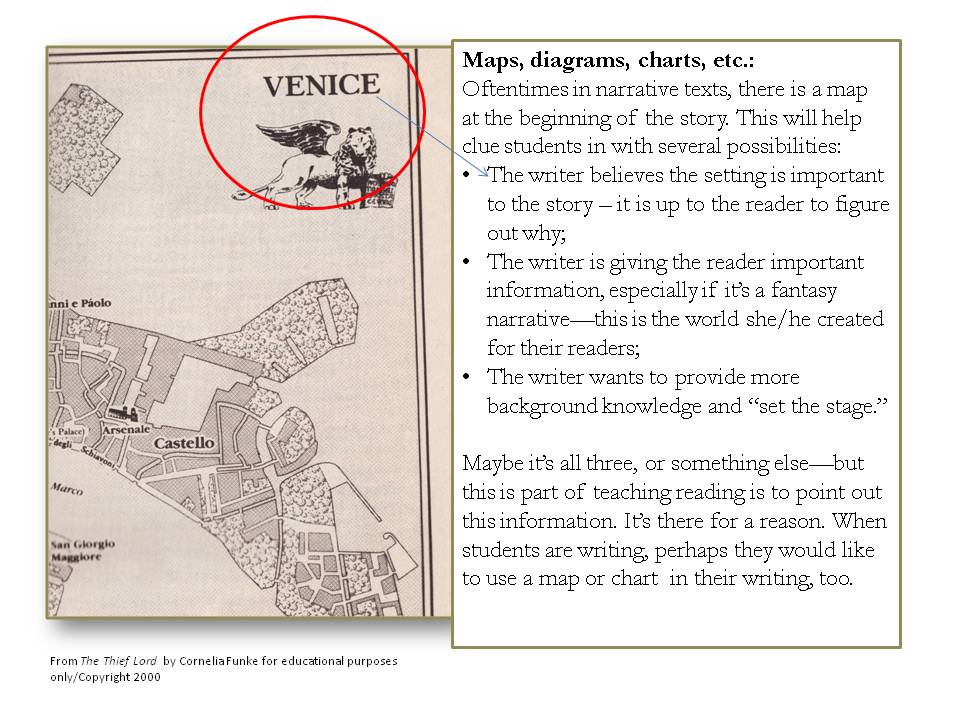
  • The story takes place in Venice. How do I know? This is when you STOP — time to teach some background knowledge:

MapYou can click on this image to view larger, of course. Here’s where some decisions need to be made: depending on your students and access to technology/information, you will want to decide how much you want to give and how much inquiry you want them to create. Here’s the deal, though, with our brains, we love patterns. So, if students get misinformation or misconceptions about what they’re inquring about, to re-wire these pathways will be doubly difficult. Inquiry and constructivism are wonderful tools–but remember, if someone doesn’t know anything about a topic, the potential for missteps grows. Imagine you’ve never been to Venice (like I have never been) or seen a picture, or been on a canoe, or little boat, or imagined a city built entirely around canals, with bridges, and ancient pathways, nooks, crannies, or have ever heard of Italy at all? This is part of a safe environment of learning. It’s okay not to know, but not okay not to learn. (I didn’t know for a long time that the ‘underground railroad’ wasn’t like a subway. I’ve had students who believed the same thing. I had a student from New York City tell girls about subways, and they didn’t believe him. It goes on…)

So, short or long lessons, and time spent on Venice. Your choice, and your students’ needs.

Next, annotating text: I had a big lesson myself when teaching annotating text. Thought students were ‘getting it,’ and doing okay. Asked a girl how her annotating this one Greek story was coming along, and she answered confidently, “great!’ Something told me to stop and ask her to explain the first paragraph. She didn’t know every other third word. Okay, let’s try again – highlight the words that seem confusing. And I tried to sweeten the deal with reaffirming again that the more one reads, the more automatic understanding/fluency becomes, and the more fun it is to read.

Like I said, I can’t read a book anymore in the same way. It’s just now my job means I make my brain processes as transparent as possible so students can look inside my head, so they are better at looking inside theirs.

There are many ways for annoating text; you may decide you want to teach one specific strategy at a time, such as a vocabulary skill for reading comprehension strategy: Vaporetto In this particular example, the word “vaporetto” is used. I’ve never seen that word before, but the image I put together demonstrates some of my thinking process.

Another vocabulary buggaboo are context clues. We assume, too often, that students know more than they do.  For example, this sentence:

“A party of tourists (blank) past the (blank) while their guide described the (blank) above their heads in a (blank) voice.”

There are four words in that sentence that are potential mental gopher holes: shuffled, confessional, mosaics, and muted.

How would you teach those? Have student act out “shuffled,” look up a confessional, make a connection if they’re Catholic or have been to a Catholic church, infer, what a mosaic is, or look it up, and then maybe make one, and make an educated guess (inference) on if they are in a church, would they be yelling in a loud voice (questioning text)? Not one single reading ‘strategy’ can effectively be taught in isolation, but we don’t think ‘in isolation.’

(*The ‘say blank’ strategy is Dr. Schulhauser’s.)

Allusions are one of my all-time favorite concepts to teach, even though inevitably I will be corrected by a student telling me it’s “ILLusion, Mrs. Love, not ALLusion.” Um, well, no, my darling middle schooler, let me continue…) So far I haven’t found any specific allusions in The Thief Lord, although there are plenty of connections. An allusion is a specific reference to another work/character. The connections are abundant. It’s Oliver Twist, The Goonies, and The Pink Panther/Inspector Clouseau to start. But, boy howdy, when you use your strong metacognitive skills and spot an allusion, it’s like a reading golden ticket. Allusions to other works show us that we are not learning in isolation, that we are connected, and our thinking, based on knowledge. Now I can’t get Led Zeppelin’s Immigrant Song out of my head, when Robert Plant wails, “To fight the horde, to sing and cry, Valhalla, I am coming…” If you remember your sixth grade Norse mythology, you know what Valhalla is, and why you may want to go there someday. Or, at least, what the Minnesota Vikings might want to sing in the locker room showers. In my goofing-off summer, there are so many allusions in this game I play, but it makes me laugh when I recognize something, such as little goblin men speaking the words of Elton John’s Rocket Man to each other in conversational tones. (And for the record, Rocket Man is the only song I can sing and score big on Guitar Hero.) Allusions add a richness and texture to our reading/listening/viewing that would otherwise be lacking. Teach them as part of metacognition to students recognize those connections to other works when they read/see/hear them. We all feel smarter and more creative when we do.

Characterization and connections lead me to themes…

But another day. Ciao, bella!

Postscript: If you would like some of the excerpt .jpgs for your own classroom instruction, send me a Tweet @mrskellylove and your e-mail address; that is, if the links don’t work.
If I blog it, they will read…

 Field of DreamsI think if I say it publicly, I’ll have to honor the promise to myself to write about reading. Disclosure statement: This is not everything I know about teaching reading, and I don’t know much, paradoxically! My experience is with “average” middle school-aged students, 11 to 15, with a large population of diverse languages, backgrounds, and cultural experiences. (I love it, by the way.) Oh, and they don’t have much money. But we’re not going to let that stop us from a world-class education! Take that, misguided ed reformers!

The thing is, for all of the great reading strategies, they cannot work independently. It’s like explaining how a carburetor works, and tires, and fuel injector, but not explaining all the parts go into making a vehicle GO. So, let’s see if we can build something together–all comments, resources, and insights are welcome!

Monday (later today): In the Zone: Proximal Development and Background Knowledge

Tuesday: The view from here: Understanding a child’s reading interest, abilities, and desires

Wednesday: Dr. Watson, I infer? Using inferences, allusions, connecting, metacognition, and clues

Thursday: Sass Back:  Questioning and talking back to your books/writers

Friday: Reading like a writer, and writing like a reader: How language connects us all

On Friday, I’ll provide a list of some of my favorite professional development books, too.

Now — for some more coffee.

Leveling up: Pathways to reading

mc escher

Wonderful colleague posts this question to the universe:
Calling ALL opinions: students are reading below grade level (anywhere from 5 to 1 year behind) and I want to do a book study to meet some CORE standards. Can I use one that isn’t at grade level? Or is that just making it too easy? Is it OK to use any book as long as it is higher than their current level of performance? Weigh in…and not just teachers!

My quick response:I have a lot to say about this, but Lucy Calkins said it well: “I want to know when I am about to ski down the black diamond slope.” In other words, make the reading levels AND the student’s current reading abilities as transparent as possible, with the key ingredient: Once they know, teach the hell out of how they can improve. I have “let go” so much regarding levels as far as what they “should” be reading – I encourage ANY kind of reading–comic books, picture books, fairy tales, graphic novels, cereal boxes, video game quest logs, you name it. In fact, on the MSP there is a place for “functional” reading–which I agree with. Being able to read a functional document means a functional adult (or a greatly improved chance). I stress, stress, stress to my students if you don’t understand it and can’t talk about it, you’re not “reading” –you’re faking it. So, encourage them if they want to read something higher than their “level” but let them know they are going to have to approach it a bit differently. And, they can get deep meaning out of any narrative or information they find interesting and meaningful to them.

So, here’s what I’m thinking: In order to get my own head on straight for this upcoming, topsy-turvy year, this week I will do a series all about reading, and my reflections on its process, purpose, and perpetuating the pursuit.

I would love any guest bloggers to engage with their philosophies, strategies, and reflections on this as well — what have you tried that worked with the majority of your students, and what have you tried that worked with the minority of your students?

Send me an e-mail: lovesblog0rama@gmail.com

Be your own hero.

One of my favorite treats is driving on a Sunday and listening to the Tavis Smiley Show. Yesterday was especially resonating. I caught the tail-end of “Where do we go from here? The prospect of peace in the 21st century,” a discussion with some of the greatest scholars, leaders, and thinkers of our time.

At one juncture, the conversation turned to be about ‘who will our heroes be, who will we look up to?’ and Vincent Harding, with his even, slow-paced voice, reminded us to consider not having a “one” who will “save” us, but in a truly rich, democratic, and free society, we must look within ourselves and to each other for providing the safety and community we can achieve.

In my heart, I know we have always known what to do. Why we turn away from it, I can’t really say. The reasons are as complicated as we are, but it is just as simple, too: we know how to treat each other.

If you have time, it’s worth a listen, at least the last hour or so. Does talking change anything? Or is it only action? I’m contemplating on one thing I can do today to help bring peace. What can I teach, what can I share, what can I create? And I’ll go from there.

Spare change.

This morning we (teachers) watched a great TED talk presented by a young girl named Adora Svitak. You can watch it on this blog, or click this link: http://www.ted.com/talks/adora_svitak.html

The theme of the morning was addressing change, and why there is resistance to change, staying in ruts, (metaphorically and literally). We collectively read an article titled, “Beyond TTWWADI” by Ian Jukes and Ted McCain (c) The InfoSavvy Group 2007.

Change is good. Change is inevitable. But who decides what changes will take place?

Politically, we elect, and re-elect leaders because we believe they will either change what we think needs changing, or stay with the status quo that works for us, as individuals and corporations (as entities).

Financially, we determine how money shall be spent, saved, or squandered. One man’s fiscal responsibility is another man’s waste, usually because what one man needs isn’t what another man needs. We think in terms of only our own narrow lives.

I really appreciated young Adora’s clearly articulated points. If an adult had made the same points, given the same speech, the message would have been lost. The messenger, in this case, was the message.

During the TTWWADI conversation, I fantasized about a time during the turn-of-the-century when a group of educators sat around a large oak table and discussed how the industrial revolution was going to change students’ educational needs.

Do we need to change ways that we teach and reach students? Yes. And nothing will change my mind about that.