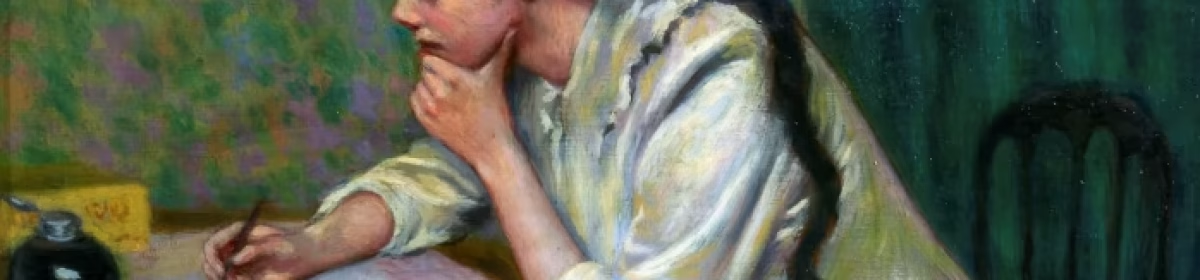
First of all, why can’t we just watch Rita Pierson for every professional development session?
Okay, well we did this year, and that’s a far cry from ‘Remember the Titans’ montages from years past. But that’s the past. And while I am clearly a language and history scholar in my own right, I know the power of a fresh start.
We are definitely getting a fresh start this year: new administration, new leadership, and about fifty percent new staff, each with their own background, experience, and yes, anxiety. And each of us also packs some baggage that may have been better off discarded. We’ve outgrown it. I still see and hear some mocking of children, some negativity, and I am fighting it like a cold. I am immunizing myself and my teaching spirit against it. Whomever mocks children and their parents must have his or her own sense of humor, however much I don’t understand it.
We all come to judgment one way or another. Some folks might think I’m emotional: code for “uncontrolled” or “hysterical.” But I am going to reframe this: our school is tough, and it takes an emotional toll. I will ask that folks do not judge me in June: there is some decompression time that must happen in order to stay mentally and physically healthy. There is not a switch I can turn off and on and be completely on solid footing. And I worry that some colleagues don’t recognize that in themselves, and are still mourning, hurt, or angry, and then hold fast to negativity.
I saw this clip today of this little girl in ballet class, and I just love it — please remember she is us, she is our student, she is our child–we are all trying our best:
And I also learned how to handle the momma bears better, being one myself:
And I learned that some colleagues sound like the first role play, and sometimes I have, too. But mostly, feel strong because I have always tried to be patient and consistent, and this is a strong reminder:
Whenever someone asked me to give advice to new teachers I always tell them the same thing: this child is someone’s baby. No matter what, they are in the world and ready to receive the best of what we have to offer.
An epiphany, oftentimes, doesn’t form as a flash or explosion, but a slow, forward creeping light. This is mine with close reading.
This overwhelming sensation of pulling the wings off the butterfly, of disassembling the parts and not understanding the whole, blind men trying to describe an elephant…all of this. I have read Falling In Love With Close Reading by Lehman/Roberts, and dug plenty into Notice & Note, and When Kids Can’t Read (Beers), and conducted a study of Kelly Gallagher of nearly fangirl proportions. All of these great minds, and intense professional development with close reading, and still I was left bereft.
It ruined my reading life.
For years, (and I am not being hyperbolic) I found that no novel, no news article, heck, not even a cereal box would cross my path without my examination of every word in close detail of where and what and how and when some text passage would spark my EUREKA! LOOK AT THIS CHARACTER RELATIONSHIP TO SETTING! This happened long before I heard the term ‘close reading.’ Annotating, discussion points, questioning, digging…on and on. The (over) analysis of literature, news, history, politics, religion, movies, poetry– and yes — cereal boxes, no longer came to me with just the need to read [say this in a Top Gun voice of ‘I feel the need for speed’]. I didn’t need to read for myself, I needed to read through every students’ brain that came into my classroom.
My best conversations about narrative are always with my husband. But even now, I sometimes tell him I don’t want to analyze what we’re watching, which probably hurts his feelings. I don’t blame him. We did manage to enjoy this anthology’s selection of True Detective, and if you say one word against Vince Vaughn’s performance we can’t be friends anymore. I did have one scuffle with a friend over her inability to appreciate the sad, sweet frosting that is The Grand Budapest Hotel, but I’m not married to her, so I let it go.
But you see how this goes, right? That what we love and share is as close to our hearts as anything can be? And if we love reading, and then must dissect it, masticate it, and regurgitate for others to find the path…then…(don’t worry: I’m going to get to a good place with this).
Another place that’s mine to share when discussing books is a book club one of my dearest friends started. There are several members, mostly NOT teachers, which provides a refreshing place to discuss books. My friend’s turn to choose came up, and she thought a classic would be in order, so she shared her love, Pride and Prejudice. I went through a “Jane Austen” phase in my late 30s, having not read any of her work in high school. I loved them. I got them. And I saw connection after connection between her genuis of writing about social foibles in her time and the relevancy to today. Now, one of my friend’s friends asked her if it was okay to just watch the movie. I don’t blame her. The text was written in 1813, for Elizabeth Bennet’s sake, and it’s hard to make heads or tails out of it.
Take this passage:
“Pride, observed Mary, who who piqued herself upon the solidity of her reflections, “is…
Austen, Jane (2008-02-11). Pride and Prejudice (Kindle Location 216). Dolphin Books. Kindle Edition.
Translation: This girl likes her own opinions.
We all know this girl. The one who interjects into every conversation her personal wisdom and sage advice.
Am I sure that’s what it means? No. I didn’t look up Sparknotes, or talk about it, or have a scholarly discussion about Jane Austen. I JUST KNOW.
*deep breath*
I promised someplace good with this. Some kind of wake for my loss of my reading life. A fête, perhaps.
But here is that slow-burn epiphany: I signed up for this. It doesn’t matter that my inner reading life is no more: I am a teacher now, and all that matters is that I help ease the path for reading, and making meaning, for students. Just like parenting responsibilities, teaching is a biggie. It’s not an avocation or hobby. But unless I get back my own engagement in the conversation with students, it’s going to feel like work. (It did last year, but last year was fraught with a dearth of imagination and abundance of negativity, lack of scope, lack of growth mindset, and just plain bad manners. I can’t abide bad manners.)
But that was last year. This is now. I still love to discuss ideas: ideas from books, movies, graphic novels, politics, media, and world events, past, present and future. As long as I show students that close reading is just a tool to help make reading easier–easier to access the ideas–then it’ll be okay. Close reading, and my internal dialogue and connections with writers’ craft, still delights and engages me, and makes me feel smart and confident. I want my students to share in the same gift.
My dining room table will be spotless by day’s end. This is phase three of the GREAT BINDERING of ’15
There is a popular how-to book going around the ‘net now titled The Life-Changing Magic of Tidying Up: The Japanese Art of Decluttering and Organizing by Marie Kondo. Since I have invested a lot of time and energy in breeding and care of dust bunnies, this topic doesn’t interest me. When the dust bunny farm goes south, perhaps I’ll give it another look. I kid, I kid. A synopsis spiraled around, and the one thing that stood out for me is the concept is don’t clean by area, clean by topic. For teachers, this is huge, and something I’ve always practiced: when moving or cleaning out a classroom, things go in categories: book genres to supplies, etc. It tends to work. Only when cleaning out the BOOK ROOM (this is a big deal) over my years as curriculum leader (aka department head in some academic circles) did I ever trash a few titles that were truly pulp, and not worth the paper they were printed on. I would have like to have gotten ride of Jackie’s Wild Seattle (ugh), but kept it in case it was anyone’s pet book. So far it has about as much charm as a dust bunny with fleas.
And do NOT comment on this full disclosure: I haven’t read the book (yet). Bet I’ve read a few books you haven’t. This one missed me because of my age and place in school–and that is the moral of this post.
This isn’t about my life as a reader, but our students’ lives.
I know this book meant a lot to a colleague of mine, and shaped her thinking about science. She is one of the exemplary science teachers I know. She introduced me to Ray Bradbury’s story, The Veldt, one of my new favorites to use with students.
To share the conversation, consider your own practices of purging through the mindset of “decluttering” —
I found one commenter’s remark curious, about ‘supporting’ my friend’s decision to purge this title. It ignited so many thoughts:
I’ve had six new administration teams and this will be my tenth year of teaching. Each admin team has a vision and new ideas, and we as a staff have had to adjust to the new ‘house rules’ every time, layered with change of guards in professional development focuses, and all the other changes inherent in modern teaching practices. This is my clutter I purge every year. Not books. Yours may be books, or dried up markers, etc.
I have my own ideas about ‘reading lives,’ and considering a time-line of my own reading life. Are You There God, It’s Me Margaret, Blubber, and Forever by Judy Blume were transformative texts for me; their relevance to students now may seem laughable. But that’s not the point: when I share Harriet the Spyto students, explaining what happened to me, more than one student would ask if I had a copy of it.
We all worry about stamina, that students do not pick up books. If we don’t open them for them, they never will. They will see them as traps. How do we break this notion that time spent with a book is wasted, that they have something ‘better to do?’
Nothing, really. Many students DO read, ask me about books, will not only finish a novel, but read it again (talk to me about Ready Player One by Ernest Cline). The trick is not to purge all the reading from all the students: like the Japanese decluttering books, look at readers as topics -help them craft their reading life, and recognize not every reader will be a reader of novels. Offer interest surveys, genre options, and let the book fit the reader, not force the reader to the book. Those are ideas that are timeless and sustaining.
And thank God for Judy Blume.
Postscript: I’m moving classrooms this year. More floor space, but no cupboard space, and there are no existing whiteboards. I’m going to have to change a lot to make it work.
Doug Selwyn is our professor for an ELA/SS course via PSWP (Puget Sound Writing Project). He is the real deal.
Let me show you the hat trick he shared:
Room of ten adults. Fluorescent lighting. Stuffy room. Lack of sleep, coffee, and August is ending. We each get a piece of notebook paper and pen. Nothing else. He asks us a question each of us, through our age and experience might have some familiarity with: “Tell me everything you know about the 2008 financial crisis.” We write. Some more or less. He takes our papers, and puts them aside.
Then he asks a seemingly unrelated question. All the while, the number 2254 is written, small. He asks us to imagine it’s the year 2254, and what might our world be like? We mention a variety of scenarios. What’s interesting is to see who’s read a ton of dystopian literature (me) and who is more optimistic.
Then: (by the way, that in the magic business would be called a ‘misdirection’)
he picks up our papers, and one by one, softly drops one to the ground, stating– this one was lost in the earthquake (being North-westerners we are thinking about earthquakes), this one lost….and this one….and then there are two left. As we watched “our” paper, our ideas, fall to the floor, (we shared later how distraught we felt).
Once the board is fairly full, pick up the student- written stories and start dropping them on the floor, one or a few at time, linking each to something on the board, narrating as you drop. These were lost when the seas flooded the West Coast. This one was used as packing material when a ship left earth to colonize the moon. These were deemed politically untenable. These were used to start a fire in a woodstove when the wood ran out, and so on. Drop stories until there is only one left. Announce that this is the official, surviving history of the event that you have all experienced. Since no one from that shared experience is still alive, those future scholars will only know what is on this one piece of paper.
He chose one, and then read it out loud. Granted, our handwriting is not as careful as it used to be, so plodding through our text proved dodgy at times. When finished, he asked us to share some of the facts and opinions we heard.
Doug Selwyn and Kim Norton
After we dissected one, miraculously the teleporter worked and another piece of history stepped through: this time is was a much closer personal experience with the 2008 crisis, and shared a completely different point of view. More information! More context! More voices heard!
Now those of you who are socially conscious can already see all the possibilities for teaching, and all the ways this can be used to discuss voices in history, whose stories are told, and whose are silenced, what comes through, and how we interpret mysteries from our pasts. And– you also see how valuable it would be to talk about the passing along of knowledge (education) and information. This led into a rich discussion on even now, with the Internet, social media, and an explosion of information and shared ideas, we have loss in not being able to access the digital media as well as many inhabitants of our planet who do not have access or are censored, and even punished, by trying to share in the conversation, by their oppressive governments.
Now: walking back to the parking lot I contemplated on how to bring this to students under our new dictum of learning targets, success criteria, and performance tasks. If those three things are not visible, we are ‘marked down’ on evaluations.
Can you imagine going to see Houdini and he tells you how, why, and what he’s about to do?
I have no issue with students seeing a purpose for their learning, and understanding when they’ve achieved that purpose. But sometimes…
…wouldn’t it be more powerful to let them feel the breathless moment, to ride the emotions, and then reconstruct what just happened? The “How did she DO that?!” moment? I can just see my students protesting when their papers are dropped to the floor, and how they grapple when all the information isn’t provided. Doug made a time machine appear in our minds, and we hung on every word.
Some sentence starters that lend themselves to bridging personal connections to text, or not. *Not my sticky-note, but provided by a superlative consultant my district hired to guide us in close reading strategies.
Wanted to share a great discussion about how students can use personal connection to interact with text more deeply. I cannot remember which educational scholar suggested never to use personal connections when discussing text, but it doesn’t sit right. Every text is personal at some level: it’s the getting beyond the personal that creates critical thinking.
This is also where leveled reading comes in. No matter how good the teacher is, reading complex stuff can be exhausting. Kids need variety, says Willingham, and lots of books that they can read on their own, without much struggle.
The hope, says Willingham, is for these easier texts to build a reader’s confidence and create “a virtuous cycle where, the more you read the more you see yourself as a reader. You’re also picking up more background knowledge. You’re picking up more vocabulary. All of these things sort of feed on one another.” And help when it’s time for the next complex text.
Let’s go back to that reading-as-swimming analogy. It turns out, learning to swim requires both ends of the pool. And, ideally, kids reach a point where they can simply glide under the divider and choose for themselves.
Move to pairings of stories, the many tales we share and hear every day, from the most innocuous, mundane questions, to the powerful stories of perseverance and stamina.
So here it is — every story is personal. If you are a human, you have parents. In class the other day, a colleague shared this story book:
She is quiet and kind: I could ask her why she shared this book, what it means to her, but perhaps her own personal story is just that — personal. We cannot disconnect ourselves from our connected, collective consciousness, and I will challenge anyone who suggests otherwise. The trick is to not allow students’ thinking to be truncated by stopping right at the text nor ending the conversation with a personal anecdote or connection: circle back around. That’s how it’s done.
This past week, and current week, I’m elbow-deep in crafting lessons, mini-units, and all good things in the PSWP ELA/SS CCSS course. Though much of it is a review for me, it’s how I learn–by relearning, adapting, and modifying instruction.
In May, I was reflecting on all that is required of me and instruction in any given moment, and the quality professional development I’ve sought and been offered. I do not turn down opportunities to learn and grow, and it’s hard for me to turn off my brain. I created a lesson plan template largely based on meeting those challenges: gradual release, learning targets, success criteria, performance tasks, the new teacher evaluation cycle (TPEP), and adding assessment and assessment reflection so I can have precise, informed conversations about learning. Next, I plan on creating a document to help track student information on specific standards. Yes, this is the stuff I dream about.
Now, the question will be, will I use it to its full capacity, or become so busy much gets lost in the flood? I’ve promised myself for some of the big concepts, yes–use it as a teacher reflection tool. I am a believer in strong prep work.
Question for my colleagues: what are must-haves on your lesson plan formats?
About two years ago, I and my colleagues tallied eight weeks of instructional time that went directly to summative assessments provided by the school, district, and state/Federal. We asked, and then begged, for a reasonable conversation and dialogue, but it fell on deaf ears. One test cost $8 per student, and I’m not sure we ever saw the results. Imagine you’re a doctor, you treat a patient, and then never know whether the treatment was effective. It’s kind of like the Schrödinger’s cat of education. Is the test alive, or dead? If you open the box and confirm it, you just killed the cat, jerk.
Going to pause right here: I, and many educators, experience fatigue when trying to explain the differences between the Common Core State Standards and their second cousins once removed assessments, SBAC and PARCC. And I’m not even sure how much of an emotional investment I feel about the SBAC: this isn’t about me. It never has been. It’s about students and their parents. What I am proposing is not a slog through the Swamp of Standardized Testing. As my son told me, it’s like Obi-Wan cautioning about Sand People:
Standardized Assessments: they always come back in greater numbers…
So here we are. We can’t ‘inform instruction’ based on opaque and sullied samples. The data are corrupted and invalid. I propose a deep consideration and intentional conversation about portfolio assessments: no matter the grade, content area, or material/method of delivery, we create a meaningful assessment collection system* to truly see where children/students are, and where they need help. This will require concrete and focused PLC meetings, and time for teachers (hopefully in student cohort/cadre teams) to support student growth.
But you already knew that.
Much has been written about the worth of professional development: these news stories begin to hit the teacher media sites about this time of year, naturally. Seasonally this is the time when teachers go back to their buildings prior to school’s openings, and participate in a variety of ice-breakers, agenda items, and yes, some professional development. It’s a time to get to know new staff members, and introduce staff resources and reinforce bonds and make new allegiances. This summer I’ve been fortunate to participate in PD with two long-time colleagues, and am looking forward to a follow up PD this next week through the focus of close reading. The best PD always springs from two fields: it’s high-quality, and that usually means it costs money, or it’s from other teachers. Times when I’ve had coaches in my room have been best when the coach is well-trained, and asks me how my students are doing, and has honest conversations about my instructional choices, listens to my reflections and seeks understanding. The time when coaches came in my room and took over the lesson confused the students, (and me), and the conversation veered from my request to look over a close reading strategy to this taking over of the materials for that class. Enthusiasm sometimes gets the better of all of us, and we step on toes. I know my big size 10 feet have misstepped more than once while I’m learning the dance steps.
So if you’re in a position to provide leadership, or an educator in the classroom, two articles for your consideration:
This one is challenging for new administration teams, because they don’t know who knows what when –perhaps a survey before the in-service days is warranted?
6. Build on Existing Expertise
As a facilitator of learning, you don’t know everything and you don’t need to. When you’re planning, consider how to surface the expertise in the room and build on it. All of your participants, even brand new teachers, know something. Your job when delivering PD is figuring out how to connect new learning and content with what already exists, how to build on what people are bringing with them and already doing. Isn’t that a relief? You don’t need to know everything!
Yes: this began as a look at the data driven into a ditch, and turned into a call for solid professional development and instructional dialogue. This my attempt to wrap my head around what to do about it. It is going to take team-work, and sharing know-how. It’s clear to me that the ‘not knowing’ how to help students is our greatest concern, and we are reluctant to admit we’re not always experts. The best conversations I have are when we’re allowed to identify an issue and be frank about its possible resolutions. Argue the issue, not the personality.
And like Sand People, we startle easily, but we always come back.
*Postscript: my plan is to recreate and refine my data collection systems using portfolios, student reflection, and guidance–allow students to see the meaning of the work, and assess their skills and acuity.
Immersing my mind in close reading, analytical writing, and new content, there are a few more novels to mention. Not making any promises that I’m done, because we know a teacher’s work is never done. I am working on documents of lesson plans, frosted with CCSS goodness and fortified with with enduring understanding vitamins and minerals. (Yes, it’s past lunch time and I’m chugging Diet Coke–it shows.) In any case, if you would like the lessons as they progress, please send me an e-mail: karen.kelly.love@gmail.com
If an entire nation could seek its freedom, why not a girl? As the Revolutionary War begins, thirteen-year-old Isabel wages her own fight…for freedom. Promised freedom upon the death of their owner, she and her sister, Ruth, in a cruel twist of fate become the property of a malicious New York City couple, the Locktons, who have no sympathy for the American Revolution and even less for Ruth and Isabel. When Isabel meets Curzon, a slave with ties to the Patriots, he encourages her to spy on her owners, who know details of British plans for invasion. She is reluctant at first, but when the unthinkable happens to Ruth, Isabel realizes her loyalty is available to the bidder who can provide her with freedom.
From acclaimed author Laurie Halse Anderson comes this compelling, impeccably researched novel that shows the lengths we can go to cast off our chains, both physical and spiritual.
Blistering winds. Bitter cold. And the hope of a new future. In this compelling sequel to Chains, a National Book Award Finalist and winner of the Scott O’Dell Award for Historical Fiction, acclaimed author Laurie Halse Anderson shifts perspective from Isabel to Curzon and brings to the page the tale of what it takes for runaway slaves to forge their own paths in a world of obstacles—and in the midst of the American Revolution.
The Patriot Army was shaped and strengthened by the desperate circumstances of the Valley Forge winter. This is where Curzon the boy becomes Curzon the young man. In addition to the hardships of soldiering, he lives with the fear of discovery, for he is an escaped slave passing for free. And then there is Isabel, who is also at Valley Forge—against her will. She and Curzon have to sort out the tangled threads of their friendship while figuring out what stands between the two of them and true freedom.
In 1776, young Sophia Calderwood witnesses the execution of Nathan Hale in New York City, which is newly occupied by the British army. Sophia is horrified by the event and resolves to do all she can to help the American cause. Recruited as a spy, she becomes a maid in the home of General Clinton, the supreme commander of the British forces in America. Through her work she becomes aware that someone in the American army might be switching sides, and she uncovers a plot that will grievously damage the Americans if it succeeds. But the identity of the would-be traitor is so shocking that no one believes her, and so Sophia decides to stop the treacherous plot herself, at great personal peril: She’s young, she’s a girl, and she’s running out of time. And if she fails, she’s facing an execution of her own.
Master storyteller Avi shows exactly how personal politics can be in this “nail-biting thriller” (Publishers Weekly) that is rich in historical detail and rife with action.
There are more books through diverse lenses I have in my arsenal, so believe me when I promise point of view and perspectives on history are at my core.
Yes, a Thursday night in August, not many days until I start back, though I haven’t really stopped. One week of a writing workshop class, and in the middle of two weeks of a Common Core ELA/SS exploration course, both at University of Washington through PSWP. This involves waking up at 5AM, meeting two colleagues in our work parking lot by 7AM, and spending many hours in a stuffy, fluorescent-lit room–but wouldn’t trade it for anything. Well, okay maybe a sandy beach and swimming-pool sized adult beverages, but other than that…meeting new colleagues and refining work and pedagogical know-how–pretty cool stuff.
So in an effort to refocus my energies to 7th grade US History, I am thinking about the role of disease in our history. When asked what things affect the course of events, most folks would answer war, religion, change of power, etc. To me, disease may not be a direct conflict, but it is a formidable catalyst. Our own nation’s relationship with disease and health/medical access, treatment, and prevention is essential to analyze and seek to understand.
Some essential questions may include:
What role does disease play in how America grew as a nation? What effects or consequences had a larger impact?
What is the role of medicine and health care in American’s growth as a nation? Who has access to medical treatment, and how does that create differences or similarities among its people?
Who takes care of the sick and dying? What misconceptions about health do continued harm? Are we past those misconceptions today with healthcare?
If you think of something that piques your interest, my esteemed colleagues, please comment.
Now, which to read first, the non-fiction or historical fiction? Of course this brings up other major epidemics we have feared, faced, or flee from: small pox, polio, ebola–and the questions about the ‘anti vaccers’ in our nation’s dialogue – what would they have thought if they lived in Philadelphia in 1793? How does historical presence affect one’s opinion?
This is a gift of writing from an exemplary educator, Kristin Storey, who allowed me to share this letter to new and veteran teachers alike.
Thank you, Kristin.
WHY TEACH?
[The backstory: My 25 year old nephew is going through what his mom refers to as a “quarter-life crises” and has been hiking the Appalachian Trail since April considering what he wants to be when he grows up. Earlier this year his mom and dad asked me if I would talk with him about teaching (considering I currently teach high school Language Arts). As you will see from the letter, I had done so before and backed off, and yet I figured one more shot couldn’t hurt. However, once I tried writing it last spring I found myself surprisingly challenged to encourage anyone to become a teacher. I simply couldn’t write a convincing letter in the midst of teaching fulltime. Thanks to eight days at Writing Camp (the amazing Puget Sound Writing Project’s “Just Write” class) I progressed from meta-blathering about why I teach and rambling-musings on what I like and dislike about my chosen profession to this streamlined, hopefully compelling and sincerely honest letter to my nephew.]
Dear Nephew,
As you probably remember, for many years I played the role of the seemingly single-minded, teacher-recruitment aunt. At some point, your demeanor indicated that my persistent cajoling had become tiresome needling and I promised that I would not talk with you about becoming a teacher again. Since then, I’ve held my tongue. However, circumstances have changed and considering yours right now (somewhere on the Appalachian Trail) and the fact that some loving adults in your life recently approached me about this subject, I feel compelled to bend my promise and write this letter about teaching and your future.
I framed this as an answer to the question “Why teach?” and struggled as I sought to answer this seemingly simple question. Truth be told, I could as easily talk you out of this profession as I could talk you into it. And so, what follows is my attempt at a fair and balanced assessment of this profession as you consider your future options.
As I approached this task in earnest I first faced the cliché answers that automatically sprang forth. Why teach?…because teachers make a difference. Why teach?… because teachers help young people grow into their best selves. Why teach?… because teachers touch the future. While there is truth in all of these, how compelling are such broad generalizations? The hard reality: teaching is hard work. Most teachers I know work 20+ hours beyond the standard 40 hour work week in a system that fails to recognize and compensate the breadth of work expected. The current system imposes heavy-handed, data-driven outcomes that often miss the true nature of authentic teaching and learning and teachers often feel overwhelmed, exhausted and sometimes discouraged. Stress disrupts my sleep, my patience wears thin and tears have been shed. My work as a teacher impacts my social life and my family; my search for a healthy work-life balance never ends. And yet, I happily signed my contract and look forward to new classes in the fall. What tips the balance for me? Why do I teach?
I teach because I love learning. I love sharing ideas. Thinking new thoughts. Wondering. Questioning. Whether through reading, writing, or discussing I like exploring the world and how my ideas and the ideas of others make it meaningful. And above all, I love the opportunity to help young adults grow in their quest for understanding, meaning and purpose in the world.
Starting fresh each fall is another reason. A veteran of 50 years told me that she loved teaching because every year she was given the chance to do it better. Teaching constantly changes – no two years are the same, no two classes are the same, no two students are the same. It is constantly in motion and constantly challenges me to improve and grow and learn – an exciting and rewarding way to live.
And what exactly do I try to do better each year? As a teacher I help teenagers learn how to express themselves and learn how to think for themselves while considering the views of others. I share my excitement about reading with a teenage boy who when given The Things They Carried comes back excited and proud that this was the first book he’d read, and liked, since elementary school. I model my curiosity about language and share in a student’s pleasure when they report that “President Obama used the word painstaking in his speech last night!” I experience joy as a student recognizes how efficiently and precisely she is able to identify a writer’s strategies and apply these traits as a writer herself. I guide students to believe in themselves as intelligent, unique and important individuals in community. And constantly I learn with and from my amazing students who strive to succeed and care deeply about their world. I feel privileged and honored to try and do a better job for them year after year.
In reality, teaching happens in many different ways and in many different settings, school being just one method and setting, but you should be mindful that the classic school-teacher model has advantages. The standard school year schedule includes summer break which allows for time to rest, rejuvenate and reconnect. My summers are spent reading and writing, hiking and traveling, taking classes, being with family, being alone, etc. Not a perk to be dismissed lightly and something that definitely makes the 60+ hour September-June work week more bearable.
You demonstrate many traits that would serve you well as a teacher. Creative, clever and curious, you connect with others in an open, authentic and joyful way. You have a positive outlook and a caring heart. Traits such as these will lead to success in any number of future career paths. This letter is intended to give you something to think about as your walk the remainder your current path. Feel free to write me back, to talk to me when we meet again or to use this as fire-starter. The choice is yours. Whatever path you choose, know that I love you and will support you wholeheartedly.