Mighty Myth Month: Round table pizza.

Arthur_Sword_and_Stone

Oh, if only it were that easy.

To know our true identities, our destinies, or our life’s purpose by simply pulling out a sword from a stone.

Any way you slice it, you can’t deny that the Arthurian legends are resoundingly entrenched in Western culture, predominately to the British Empire, which at one point, the sun never set on. (But personally, I think they’re better off not worrying about if the sun is or is not sitting on them, it frees them up to continue to model to the U.S. Parliamentary debating tactics, polish up Stonehenge, and make movies like Son of Rambow.)

Understand that there are those who have spent their lives on studying the tales/legend of King Arthur, and you only need to step in the shallow end of the Internet surf to find out what you need to know for sufficient background knowledge, and “catch” the allusions made in literature, movies, and Spongebob.

http://www.kingarthursknights.com/

http://www.earlybritishkingdoms.com/kids/arthur_life.html

http://www.historyforkids.org/learn/medieval/history/earlymiddle/arthur.htm

I would use up all my blog gigabytes if I wrote a full post on Artie and the Gang; suffice it to say this legend HAS IT ALL! It’s like a great country/western song: loyal friends, cheatin’ wives, and a quest for the Big Gulp in a ’70s Charger. Literally, the 70s. Not the 1970s. Not the 1670s. Most likely, the 570s. And did I say Big Gulp?  I meant cup. No, chalice. Holy Grail, let’s go on a Crusade!

King Arthur’s grand apotheosis (yeah, that’s right, I used one of your vocabulary words!) comes from his final battle with his greatest enemy, Mordred. Even Mordred’s name connotes some serious evil, jealousy, and bad manners. Not very cricket of him, what what!? Arthur mortally wounds Mordred, but also receives a fatal blow; after getting rid of the evidence with the help of his homie Bedivere, Arthur is laid to rest on the Isle of Avalon.

Bedivere waves bye-bye to Excalibur

So, once you’ve succeeded in filling your noggin with sufficient background knowledge on the “real myth,” (wouldn’t that be an oxymoron?) then you may want to move on to these books and a movies:

Song of the Sparrowby Lisa Ann Sandell (G-PG)

Mists of Avalonby Marion Zimmer Bradley (PG13)

Monty Python’s Holy Grail (movie) (PG-13)

It's not a question of where he grips it! It's a simple question of weight ratios! A five ounce bird could not carry a one pound coconut.
It’s not a question of where he grips it! It’s a simple question of weight ratios! A five ounce bird could not carry a one pound coconut.

Carry on.

Myth-of-the-Month Club: Billy Goat G-ROUGH

scared goatIn honor of my husband’s birthday, this post is dedicated to a cryptozoological creature of the southwest/central Americas: the Chupacabra. 

It’s not that I question their existence, (though I do), or that I am skeptical (which I am), but the deeper question to me is, “Why do people in these current times, attribute acts of violence, etc. to made- up critters? Why isn’t there more of an investigation?” Because, seriously, think about it–if there really is a creature that sucks livestock’s and domesticated animals’ blood, leaving behind a wake of death and destruction, and is possibly FROM OUTER SPACE…shouldn’t we be more concerned? Shouldn’t we be doing nightly patrols, with infrared goggles and heat-seeking scanners? C’mon, people! The goats can’t protect themselves, they need our help!

Now, it’s also notable that these sorts of stories tend to pop up more in the news whenever there isn’t much else going on. When “real” news occurs, with all of its horror, pain, tragedy, and grit, the folklore stories are put on the shelf. When there’s been years of drug-related violence in Central/South America, creeping into the U.S. borders, and not to mention the on-going conficts in the Middle East, Chupacabra’s press clippings begin to shrink.

Or do they?

Well, some might make that correlation: http://www.mad.co.uk/Main/Home/Articles/a37a5b5c7f684c6795bd84d7e2aa8e05/Tabloid-sales-continue-to-topple.html

Why do you think that happens?

Huh. Guess I kind of answered my own question. It’s easier and more ‘fun’ to make up stories than to face reality; it’s much more interesting to think big, nasty chupacabres are out there chasing the livestock than to think it might be another man-made horror. Bueno, Chupa. You kept my mind off of the other nastiness, at least for awhile.

Snake charmer.

Talk about your bad hair day.

Medusa

 Once again, some goofy mortal chick is just hanging out, being beautiful, and some god takes an interest in her, and she pays the price:

Medusa, one of the three Gorgons, daughter of Phorcys and Ceto. She was the only one of the Gorgons who was subject to mortality. She is celebrated for her personal charms and the beauty of her locks. Neptune became enamoured of her, and obtained her favours in the temple of Minerva. This violation of the sanctity of the temple provoked Minerva, and she changed the beautiful locks of Medusa, which had inspired Neptune’s love of serpents. According to Apollodorus, Medusa and her sisters came into the world with snakes on their heads, instead of hair, with yellow wings and brazen hands. Their bodies were also covered with impenetrable scales, and their very looks had the power of killing or turning to stones. Perseus rendered his name immortal by his conquest of Medusa. He cut off her head, and the blood that dropped from the wound produced the innumerable serpents that infest Africa. The conqueror placed Medusa’s head on the shield of Minerva, which he had used in his expedition. The head still retained the same petrifying power as before, as it was fatally known in the court of Cepheus. . . . Some suppose that the Gorgons were a nation of women, whom Perseus conquered.

From Lempriére’s Classical Dictionary of Proper names mentioned in Ancient Authors Writ Large. Ed. J. Lempriére and F.A. Wright. London: Routledge & Kegan Paul.

Cecilia...you're breaking my heart...

What strikes me are the explanations (in mythology) of “when good things happen to bad people.” Bad things happen because the gods and goddesses are meddling in mortal matters. The deities are not aloof, watching “off shore through heavy lenses” kinds of omnipotent beings. They are involved, they get in the mix, they cause trouble with their jealousies, infidelities, and revenge. Mortals are quite capable of causing enough problems, thank you very much. Do you think it’s fair that just because Poseidon/Neptune wanted to take a cutie out on a date that she should pay the price for forever with bad hair and stone-etching blood?

Well, I guess on a positive note, she and Poseidon did produce Pegasus, but that’s a horse of another color.

Myth-of-the-Month Club: Lady Gaga Baba Yaga

babayagaBaba Yaga. Even the name sounds retching. She is the Crone: all bone-crushing, baby-killing nastiness. That object that she’s flying around in is a mortar and pestle, which is a little bowl, made of hard, dense ceramic material or rock/granite, and a stubby club-like instrument made to grind spices and concoct potions/herbs in. Cooks still use them, I guess because grinding spices in this old-fashioned way may increase the flavor of the spice.  

Okay, this isn’t a cooking lesson, but I do think it’s interesting to note that in many stories of witches and bad grandmas, kitchen utensils are the weapons or modes of transportation of choice. Women reprsent many powerful aspects of basic human needs: they give birth, they cook food, and they guide and protect humankind. But to every yin there’s a yang, and for every story of life-giving, there’s life-taking, for every home-cooked meal, there’s a poison apple, and for every act of guidance and love, there’s a “throw you into the fire just as soon as my gingerbread cookies are done.”  Talk about mixed messages!

You know the old saying, “If Momma ain’t happy, nobody’s happy.”

And what is going on with the chicken-legs walking house? If you were going to bewitch a mobile home for yourself, wouldn’t you choose something other than chicken legs? Although fried chicken is delicious, and there’s a shortage of pumas in Russia. It’s those little details that make a story represent its culture, its time, and its society. Think about that: if Baba Yaga’s hut moved on tiger legs, it would be an anachronism, something out of its time and place. Sort of like seeing someone use a cell phone in a 1870s Western.

(Yes, children, there was a time when there were no cell phones: that’s the real horror story, isn’t it?)

I have only limited service out here...

One of my favorite fairy tale sites is: http://www.surlalunefairytales.com/

The entire tale of Baba Yaga is here: http://www.surlalunefairytales.com/russian/folktalesfromrussian/babayaga.html

To learn more about the illustrator, Ivan Bilibin, click here: http://www.bpib.com/illustrat/bilibin.htm

Myth-of-the-Month Club: No need to PANic.

Play that funky music, goat man.

Pan – the little goat-man, lover of beautiful girls, and chaser of dreams. His presence creates panic in men because of his wild nature, the forces that cannot be controlled, when we lose ourselves to crazy behavior, mob rule, or “herd” mentality. When we act like sheep, Pan is the deity to blame.

PAN was the god of shepherds and flocks, of mountain wilds, hunting and rustic music. He wandered the hills and mountains of Arkadia playing his pan-pipes and chasing Nymphs. His unseen presence aroused feelings of panic in men passing through the remote, lonely places of the wilds.

Maybe that’s why over eons Pan morphed into a devil-like manifestation: from Greek mythology, he changed into something to be feared, a representation of temptation, debauchery, and evil. Mankind versus Nature has been an age-old conflict, and we all know which side Pan is on.

But perhaps Pan doesn’t deserve this reputation. Maybe he was just ‘green’ before everyone else was. He was a funky hippy dude, playing his flutes, hanging out with Mother Nature, and making organic feta cheese to sprinkle on his pita chips. Soap wasn’t his friend, per se, but animal instinct was his middle name. Pan is the free-thinker, the non-conformist, kind to animals, and not intending any harm. He has his share of heartbreak, too. Maybe if he had used a little deodorant…but there was no way to cover up that stink.

The mythos of Pan gave us other personifications of wildness, youth, and nature, not just the devil. We have the charming tale of never wanting to grow up, in J.M. Barrie’s Peter Pan, and of course, we all get a little ‘satyr but wiser’ with Phil, the trainer in Disney’s Hercules.

Hercules-Phil1

Pan is also featured in one of my favorite authors, Tom Robbins’ novels. But he’s not until you get to college.  Not that anything’s bad, just some more grown-up ideas. Sometimes experience does have its benefits, young ones.

So, when you’re feeling like you need some time to kick back, listen to some music, and just chill, thank your friendly neighborhood Pan for helping you get back in touch with nature. And, don’t forget: reuse, recycle, and reduce!

Myth-of-the-Month Club: Gone fishin' (King of Sharks – Hawaiian)

This is a story with some bite to it: 

Copyright DC Comics
Copyright DC Comics


  The King of Sharks
retold by
S. E. Schlosser

One day, the King of Sharks saw a beautiful girl swimming near the shore. He immediately fell in love with the girl. Transforming himself into a handsome man, he dressed himself in the feathered cape of a chief and followed her to her village.

The villagers were thrilled by the visit of a foreign chief. They made a great luau, with feasting and games. The King of Sharks won every game, and the girl was delighted when he asked to marry with her.

The King of Sharks lived happily with his bride in a house near a waterfall. The King of Sharks, in his human form, would swim daily in the pool of water beneath the falls. Sometimes he would stay underneath the water so long that his bride would grow frightened. But the King of Sharks reassured her, telling her that he was making a place at the bottom of the pool for their son.

Before the birth of the child, the King of Sharks returned to his people. He made his wife swear that she would always keep his feathered cape about the shoulders of their son. When the child was born, his mother saw a mark upon his back which looked like the mouth of a shark. It was then she realized who her husband had been.

The child’s name was Nanave. As he grew towards manhood, Nanave would swim daily in the pool beside the house. Sometimes, his mother would gaze into the pool and see a shark swimming beneath the water.

Each morning, Nanave would stand beside the pool, the feathered cloak about his shoulders, and would ask the passing fishermen where they were going to fish that day. The fisherman always told the friendly youth where they intended to go. Then Nanave would dive into the pool and disappear for hours.

The fishermen soon noticed that they were catching fewer and fewer fish. The people of their village were growing hungry. The chief of the village called the people to the temple. “There is a bad god among us,” the chief told the people. “He prevents our fishermen from catching fish. I will use my magic to find him.” The chief laid out a bed of leaves. He instructed all the men and boys to walk among the leaves. A human’s feet would bruise the tender leaves, but the feet of a god would leave no mark.

Nanave’s mother was frightened. She knew her son was the child of a god, and he would be killed if the people discovered his identity. When it came turn for the youth to walk across the leaves, he ran fast, and slipped. A man caught at the feathered cape Nanave always wore to prevent him from being hurt. But the cape fell from the youth’s shoulders, and all the people could see the shark’s mouth upon his back.

The people chased Nanave out of the village, but he slipped away from them and dived into the pool. The people threw big rocks into the pool, filling it up. They thought they had killed Nanave. But his mother remembered that the King of Sharks had made a place for her son at the bottom of the pool, a passage that led to the ocean. Nanave had taken the form of a shark and had swum out to join his father, the King of Sharks, in the sea.

But since then, the fishermen have never told anyone where they go to fish, for fear the sharks will hear and chase the fish away.

Read the original post on the American Folklore site.

King of Sharks

Myth-of-the-Month Club: Kiyohime

KiyohimesmThere are many stories of love-gone-wrong. And when women especially get their hearts broken, well, brother, you had better watch out. They change. They destroy. They…get…really…upset.

Today’s legend is the Japanese story of Anchin and Kiyohime. Just a couple of crazy kids, in love, planning a life. Until Anchin becomes bored, restless, and is ready to move on, literally and figuratively, taking his love on a boat ride…Well, that’s one version. Other versions say he was just hanging out, minding his own business, and Kiyohime mistakes him for her one true love, and turns into a snake/serpent to show that she is VERY DISAPPOINTED. Unrequited love hurts. Love scars. Love wounds, and mars. (Sorry– went back to 1974 for a second).

It’s not really a very old story, relatively speaking, originating circa 928: there are other older an newer stories that connect with this one, such as Medusa (the old “turn you into stone” thing), Circe (“you’re such a pig!”) and various harpies, sirens, Scylla, and Ariel. Yes, I said Ariel. Because in the original Little Mermaid story she takes the high road and doesn’t turn into a sea serpent, murderer, or even a a shrimp boat captain, but sea foam. Sea foam. Really, Hans Christian Andersen? Foam? Ultimately she turns into some kind of spirit that seeks out good children, because for every good kid she finds, it moves her closer to heaven:

The little mermaid lifted her glorified eyes towards the sun, and felt them, for the first time, filling with tears. On the ship, in which she had left the prince, there were life and noise; she saw him and his beautiful bride searching for her; sorrowfully they gazed at the pearly foam, as if they knew she had thrown herself into the waves. Unseen she kissed the forehead of her bride, and fanned the prince, and then mounted with the other children of the air to a rosy cloud that floated through the ether.”

“After three hundred years, thus shall we float into the kingdom of heaven,” said she. “And we may even get there sooner,” whispered one of her companions. “Unseen we can enter the houses of men, where there are children, and for every day on which we find a good child, who is the joy of his parents and deserves their love, our time of probation is shortened. The child does not know, when we fly through the room, that we smile with joy at his good conduct, for we can count one year less of our three hundred years. But when we see a naughty or a wicked child, we shed tears of sorrow, and for every tear a day is added to our time of trial!”

How’s that for some guilt? Every time you were naughty, you kept the little mermaid from going to her just reward.

But, let’s return to Kiyohime. The symbolic meaning of serpents, snakes, and reptiles is huge. People have been afraid of All Things Wiggly since the beginning of time. Dragons deserve their own day in the Myth-of-the-Month club, and their belly-crawling cousins, snakes.

AnchinKiyohime

 One perspective I found interesting is that Kiyohime is not really considered an evil being, just misunderstood (isn’t that right, gals?):

Kiyohime was not a villainess, even in folklore. The concluding words of Koi no tenarai, “The Learning of Love”, from the Nagauta cycle “Kyo Kanoko Musume Dojoji” paint a sensitive picture of a woman tormented by her love, and an unfeeling rejection from one to whom she considered herself bound.

The moral of the story is, sometimes when you love someone, they don’t love you back. Try not to be so clingy.


I’m not sure who originally wrote this website, but there are a lot of misspellings in it. However, you’ll get the gist of the story: http://www.dojoji.com/e/anchin/anchin.html

Here’s a synopsis of the story here: http://ccdl.libraries.claremont.edu/cdm4/item_viewer.php?CISOROOT=/cyw&CISOPTR=311

And a longer, more detailed version here: http://everything2.com/title/Legend+of+Anchin+and+Kiyohime

One more: http://www.robynbuntin.com/dictionary.asp

Fire good. (Or Saturn, Snow White, and Baby New Year share a Yule Log.)

Feeling mighty low...

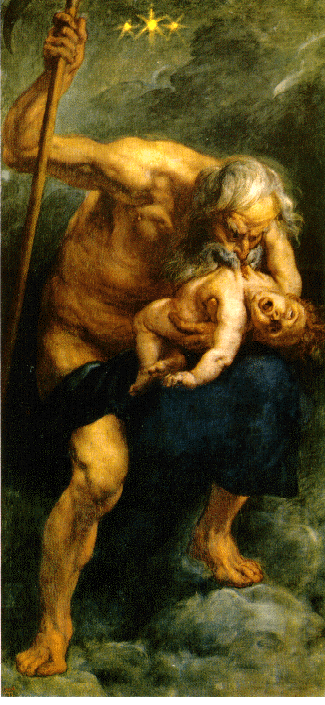
I have a hemispheric bias. I understand my northern hemisphere, its traditions, and its quirks. We northerners personify the dark days.When I see an image of Chronos/Saturn using one of his children as a midnight snack, it’s a metaphoric munchie , and innately I understand its cultural roots and the darkness of December–it’s time eating our lives.

It is near logical to me that people, in their complete and “advanced darkness” (thanks, Spongebob) would make finding out when the darkest day of the year would be a really…big…deal. Time to cut down some evergreen branches and put another log on the fire. Heck, sacrifice a young maiden if you need to, it’s dark! We want light! Sun, come back! Come back, sun!! I can set my Stonehenge to it.

And how do I connect Saturn to Snow White? When the Queen, with one tenuous hold on her youth and beauty, all due to the subjective whims of a rhyming mirror, decides that the ebony-haired beauty, with nary a grey hair or wrinkle,  is encroaching on her territory, well, then, Snow’s heart is the price she must pay! What is it with older folks symbolically ‘eating’ the young? Hey, dude, I can buy an i-Pod too – so what if I break a hip trying to dance to it?

Enter Baby New Year. Crackling. Colicky. Cranky. Abandoned by old man Saturn, this kid grows up all over again on his own, to learn the same lessons, to touch the burning stove again, and stick the proverbial fork in the proverbial light socket repeatedly. No wonder why we never learn anything, really.

chronos2

Both Chronos/Saturn and the Queen should have a chat, compare notes. Getting older isn’t all that bad, is it? Reminiscing on past triumphs and errors–it’s as someone said: “It all works out okay in the end. If it’s not okay, it’s not the end.” I can’t think of a more paradoxically optimistic/pessimistic quote as that one.

The sun will come out tomorrow.

 National Geographic Winter Solstice 2009 Link

The Writer’s Almanac Winter Solstice Link (December 21, 2009)

In the northern hemisphere, today is the Winter Solstice, the shortest day of the year and the longest night. It’s officially the first day of winter. It’s officially the first day of winter and one of the oldest known holidays in human history. Anthropologists believe that solstice celebrations go back at least 30,000 years, before humans even began farming on a large scale. Many of the most ancient stone structures made by human beings were designed to pinpoint the precise date of the solstice. The stone circles of Stonehenge were arranged to receive the first rays of midwinter sun.

Science World

Monster spray.

“Courage is resistance to fear, mastery of fear – not absence of fear”–Mark Twain

On Wednesday, while we were reviewing the final Journey of the Hero project, I shared a personal story with some of you about when I was a little girl. My parents were renting a house, and I had a room somewhat separated from the rest of the family. My room had its own bathroom, which on the surface seems very luxurious. The closet in the bathroom, holding cleaners, towels, etc., had a crawl space, that hosted constant shadows, no matter how the light shone in, or how bright the sunlight glowed. There were monsters in that crawl space. No doubt, no question, no mystery. Monsters. Small, yes, but ferocious. Spiky, oozing, biting monsters. Luckily, I had a hero–my dad. When I brought him my worry and concerns about the crawl-space-bathroom-dwelling-monsters, he didn’t dismiss my fears; he solved them. Taking a can of Lysol, he thoroughly sprayed the inside of the monsters’ lair, and all around the bathroom. In my four-year-old’s memory, I can still see those monsters disintegrating like so much foul fog and smoke. He placed the can by my bed, in case I should ever need to kill monsters in the middle of the night. I haven’t had a monster problem since.

That’s kind of a silly story, I know. Just a small moment in time when someone who loved me made me feel braver. I guess I could think of the Monster Spray as being my own supernatural aid.

But we know that heroes face much worse–and that the definition of a hero/heroine is someone who does something for other people without thinking of themselves. But that’s the ideal hero. Humans are far more complicated than that. It’s the complications I want you to think about. We can’t relate to heroes who make it look easy all the time-it becomes unattainable. Maybe that’s why in Greek/Roman mythology, the gods/goddesses are flawed. Maybe that’s why in the Bible story of David and Goliath, David is this runt kid. Maybe that’s why in the legend of Joan of Arc, she’s this crazy teenage girl. There’s the Jewish story of a young girl named Esther, who saved her people through her bravery. Scheherazade used her brains and beauty to tell imaginative stories that not only saved her own neck, but showed her loyalty and faithfulness.

But what is the nature of bravery, and courage?

From Mr. Spencer’s Blog:  I saw a woman lose it at the grocery store the other day. She picked up a pink box  and slammed it to the shelf. I can’t remember the words exactly, but she said, “they’re using cancer to sell cereal. I’m sick of it. Why can’t they just have a celebrity?” And she started into a loud rant that quickly cleared the aisle and left her husband red-faced.

She stopped herself after knocking down a few of the boxes. I stared at Brenna and heard, “I’m sick of wearing pink and I’m tired of pretending. Cancer sucks.”

As I drove my cart off, she took off her hat and cried right there in the grocery store. Loud tears. Heaving sobs. Her husband held her.

Listen to these three stories, chosen because the storyteller met an obstacle, or had to overcome a fear:

http://www.storycorps.org/listen/stories/griselda-lemus-and-her-mother-papsy

http://www.storycorps.org/listen/stories/john-hope-franklin-with-his-son-john-w-franklin

http://www.storycorps.org/listen/stories/ezra-awumey-and-sam-harmon

Holy da Vinci, Batman!


 From The Writer’s Almanac:

It’s the birthday of the comic-book author Bob Kane, (books by this author) born in the Bronx (1916), who was working at DC Comics in 1939 when his editors began asking for more superhero characters to follow up on the success of Superman. Kane thought about it over the weekend, and on Monday morning he turned in some sketches of a character he called Batman. The character made his debut in DC Comics number 27, “The Case of the Chemical Syndicate,” in May of 1939. He is alter ego of multimillionaire Bruce Wayne and one of the few superheroes in the history of comic books who doesn’t have any special powers. He’s just rich enough to build himself special crime-fighting gadgets. Kane said he based the character partly on Zorro, because he liked the idea of a fashionable rich guy dressing up as a vigilante at night to fight crime. He got the idea for Batman’s costume from a drawing by Leonardo da Vinci of a bat-winged flying machine.

So, burning question:

Your faced with a creative challenge. What do you do? What resources will you draw from, (literally, if you’re an artist, or figuratively, if you’re tangling another sort of task)? Did you ever imagine that Bob Kane would use the genius of a 420-year dead guy to inspire him? Happens all the time.